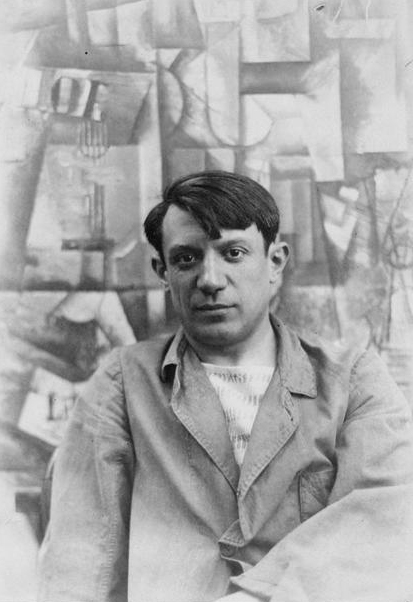
Timeline
Ninety-one years in twenty moments — each dated from the documented record.
1881 — Born in Málaga
Pablo Ruiz Picasso is born on **25 October 1881** in Málaga, Spain, eldest child of the art teacher José Ruiz y Blasco and María Picasso y López.
1891 — The family moves to A Coruña
José Ruiz takes a teaching post in A Coruña, Galicia. The ten-year-old Picasso studies at the local art school, already drawing with unusual discipline.
1895 — Barcelona; death of Conchita
The family settles in Barcelona. Picasso, not yet fourteen, passes the La Llotja entrance exams. His seven-year-old sister Concepción ("Conchita") dies of diphtheria — a grief scholars often link to the mourning imagery of his early work.
1897 — Madrid and the Prado
Picasso enrolls at the Royal Academy of San Fernando in Madrid but soon abandons classes to study the old masters directly at the Prado — Velázquez, El Greco, Goya.
1900 — First Paris visit; first solo show
He visits Paris for the Exposition Universelle (October 1900) and holds his first solo exhibition at **Els Quatre Gats** in Barcelona — the café that was his bohemian headquarters.
1901 — Casagemas dies; the Blue Period begins
On **17 February 1901**, his close friend Carles Casagemas shoots himself in Paris. Picasso begins painting in the deep blues of mourning — the start of the **Blue Period** (1901–1904). He also begins signing works "Picasso" rather than "Ruiz."
1904 — Settlement in Paris; the Rose Period
Picasso settles permanently in Paris at the Bateau-Lavoir in Montmartre and meets **Fernande Olivier**. His palette warms into the pinks and ochres of the **Rose Period** (1904–1906): saltimbanques, harlequins, circus folk.
1905–1906 — The Stein portrait
Gertrude Stein sits for her portrait some ninety times; Picasso finishes the head from memory after she leaves Paris. Told it doesn't resemble her, he reportedly replies: "she will." (See [Sayings](/sayings).)
1907 — Les Demoiselles d’Avignon
Working under the impact of Iberian sculpture and African masks, Picasso paints *Les Demoiselles d'Avignon* — five fractured brothel figures that break single-point perspective. Shown to stunned friends; not publicly exhibited until 1916.
1908–1914 — Cubism with Braque
Picasso and Georges Braque develop **Cubism** in near-total symbiosis: Analytic Cubism (1910–1912), then Synthetic Cubism and the invention of **collage** and *papier collé* (1912). World War I ends the partnership; Braque is mobilized in 1914.
1917–1918 — Parade, Rome, and marriage
Picasso designs sets for Diaghilev's ballet *Parade* in Rome, meets the ballerina **Olga Khokhlova**, and marries her in 1918. Their son Paulo is born in 1921.
1927 — Marie-Thérèse Walter
Picasso meets the seventeen-year-old Marie-Thérèse Walter; their daughter Maya is born in 1935. He separates from Olga the same year (they never divorce).
1930–1937 — The Vollard Suite
One hundred etchings for the dealer Ambroise Vollard, dominated by the Minotaur — Picasso's mythic alter ego, entwined with the women in his life.
1936–1937 — Dora Maar; Guernica
The photographer **Dora Maar** becomes his partner and documents the making of his next great work. On **26 April 1937** German and Italian aircraft bomb Guernica; in May–June Picasso paints ***Guernica*** for the Spanish Republic's pavilion at the Paris Exposition.
1939–1945 — The Occupation years
Picasso remains in Paris through the German Occupation, working in his studio at 7 rue des Grands-Augustins under constrained conditions. In 1944 he joins the French Communist Party.
1943–1953 — Françoise Gilot
His relationship with the young painter **Françoise Gilot** produces two children, Claude (1947) and Paloma (1949). She leaves him in 1953 — the only partner to do so — and publishes *Life with Picasso* in 1964.
1946–1948 — Vallauris ceramics
Picasso takes up ceramics at the Madoura pottery in Vallauris, reinventing himself as a potter and producing thousands of ceramic works alongside sculpture and linocuts.
1961 — Marriage to Jacqueline Roque
He marries **Jacqueline Roque** and withdraws to Notre-Dame-de-Vie near Mougins, painting and drawing with undiminished intensity into his nineties — reworking Velázquez, Manet, and Delacroix.
1973 — Death in Mougins
Picasso dies on **8 April 1973** in Mougins, aged 91, leaving one of the largest bodies of work in art history. He is buried at the Château de Vauvenargues.
1981 — Guernica comes home
*Guernica*, held at New York's Museum of Modern Art since 1939, is transferred to Spain — Picasso had stipulated it return only under democracy — and now hangs in the Museo Reina Sofía, Madrid.
A note on dating
Period boundaries (Blue 1901–1904, Rose 1904–1906, Analytic Cubism 1910–1912) are conventional art-historical ranges, not hard borders — Picasso’s styles overlapped and interpenetrated. Where a specific date is documented (births, deaths, the bombing of Guernica), it is given exactly.
Source notes
Chronology follows the Musée national Picasso-Paris and standard biographical references (Richardson; MoMA). See Sources for the full reference list.