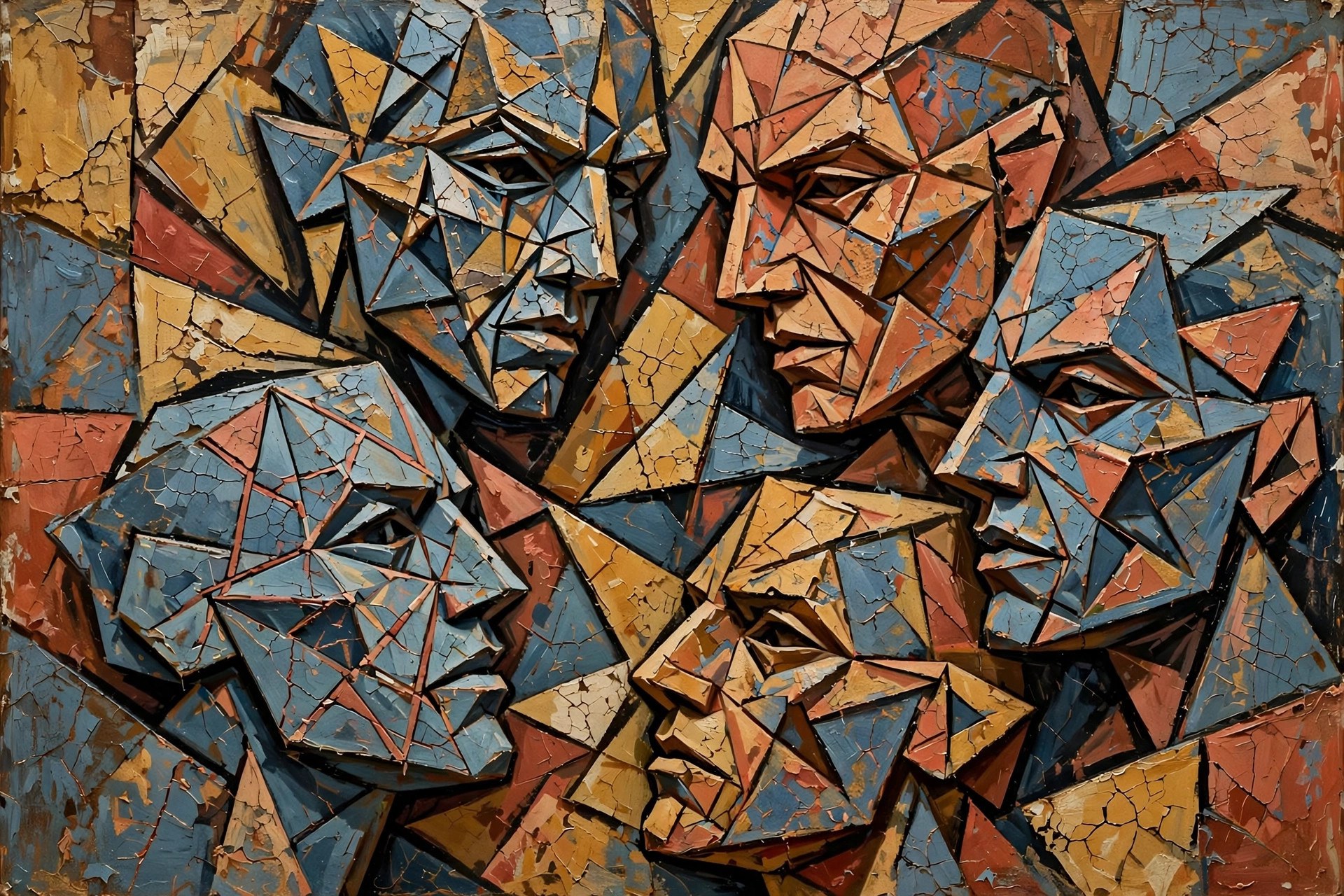
Les Demoiselles d'Avignon
1907 — five figures that broke five hundred years of painting.
What it is
Les Demoiselles d’Avignon (243.9 × 233.7 cm, oil on canvas) shows five nude women — prostitutes in a Barcelona brothel on Carrer d’Avinyó, the street that gives the painting its title — confronting the viewer. Two of the five wear faces like African masks; the space around them fractures into sharp, interlocking planes. There is no single viewpoint, no recession into depth, no invitation: the figures stare out, and the picture pushes forward instead of back.
It hangs today in the Museum of Modern Art, New York (acquired 1939 through the Lillie P. Bliss bequest) — see it at moma.org. It is under copyright and is not reproduced on this site; the museum’s own page shows it.
Why it was a detonation
Nothing in European painting had looked like this. Picasso fused three shocks:
- Iberian sculpture — the archaic stone heads he had seen at the Louvre, with their staring, simplified features.
- African masks and figures — which he encountered in Paris collections in 1907 and later called a revelation: sculpture that was not decoration but power. (African Art)
- Cézanne’s late work — the directive, as the cubists understood it, to treat nature “by the cylinder, the sphere, the cone.”
Even his friends were horrified. Braque reportedly said it made him feel as if Picasso were “drinking gasoline to spit fire” — a remark reported in several biographies. The painter Derain joked that one day Picasso would be found hanged behind it. Matisse, the great rival, was furious and fascinated in equal measure.
The long road to the public
Picasso kept the painting in his studio for years, showing it only to intimates. It was first exhibited publicly in 1916 at the Salon d’Antin in Paris, organized by André Salmon — who gave it its title (Picasso himself had called it, privately, Le Bordel d’Avignon, “The Brothel of Avignon”). By then Cubism was underway and the painting read, in retrospect, as its founding detonation.
Why it matters
Les Demoiselles is the hinge of twentieth-century art: the moment representation stopped meaning “a window onto a scene” and became a construction — multiple views, fractured planes, the mask as a face. Everything Cubism did next starts here.
Source notes
Dimensions, date, and provenance follow MoMA’s collection record. The 1916 Salon d’Antin exhibition and Salmon’s titling are documented in the standard literature. The Braque “gasoline” remark is widely reported in biographies; treat as reported speech. See Sources.