Paris 1900
Three visits, then the decision that made modern art.
October 1900: the Exposition Universelle
Picasso arrived in Paris with Casagemas for the Exposition Universelle — the world’s fair that was fin-de-siècle Paris showing off: the Grand Palais, the first Métro line, Art Nouveau everywhere. The two young Spaniards saw everything, painted the streets and dance halls, and stayed two months. Picasso’s Paris debut followed in June 1901 at Ambroise Vollard’s gallery (arranged through the dealer Pedro Mañach): 64 works, mostly pastels and oils of Parisian life.
1901, 1902: back and forth
He returned in May 1901 — the Vollard show, the first blue paintings — and again in late 1902, living hand to mouth between Paris and Barcelona. These were the years of the Blue Period’s formation: the city gave him subjects (the cafés, the streets, the poor) and the grief gave him the color.
April 1904: the settlement
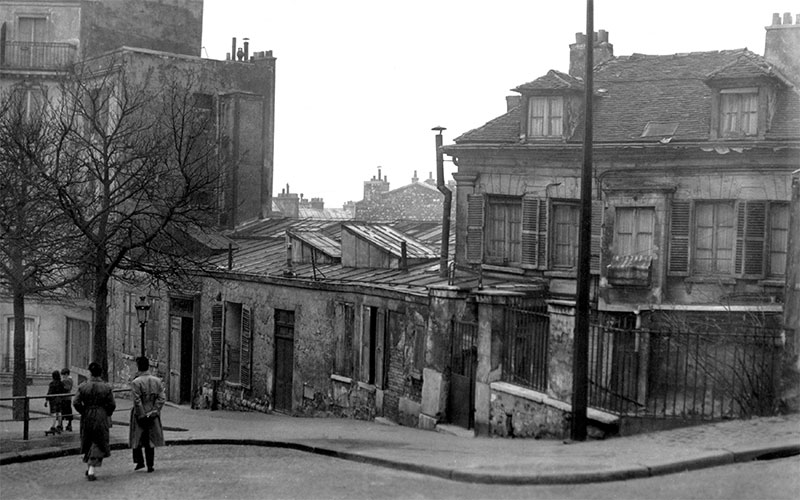
In April 1904 Picasso moved into the Bateau-Lavoir at 13 rue Ravignan in Montmartre — a ramshackle warren of studios the poet Max Jacob nicknamed “the laundry boat” for its rocking corridors. He would live and work there through the Rose Period, Les Demoiselles, and the birth of Cubism. The room that made him was a leaky wooden building on a Montmartre hill.
Why Paris mattered
Barcelona had given him the circle; Paris gave him the collision — rival painters (Matisse!), African art in the ethnographic museum, Cézanne’s posthumous retrospective in 1907, dealers, poets, thieves, models. Montmartre in 1904 was the cheapest place in the art world to be a genius, and Picasso arrived exactly on time.
Source notes
Visit dates and the 1901 Vollard exhibition follow the standard chronology (Richardson; Musée Picasso-Paris). See Sources.