Cubism
1908–1914 — two painters, roped together, climbing a mountain no one had seen.
The partnership
After the shock of Les Demoiselles d’Avignon, Picasso found his climbing partner: Georges Braque. From 1908 to 1914 the two worked in extraordinary symbiosis — painting the same subjects, signing canvases on the back so they wouldn’t know whose was whose, meeting nightly to compare the day’s dissections. Their partnership was later described as being “like two mountaineers roped together” — a remark reported in the biographical literature about the pair.
It ended the way the era did: Braque was mobilized in 1914, and the war scattered the avant-garde.
Analytic Cubism (1910–1912)
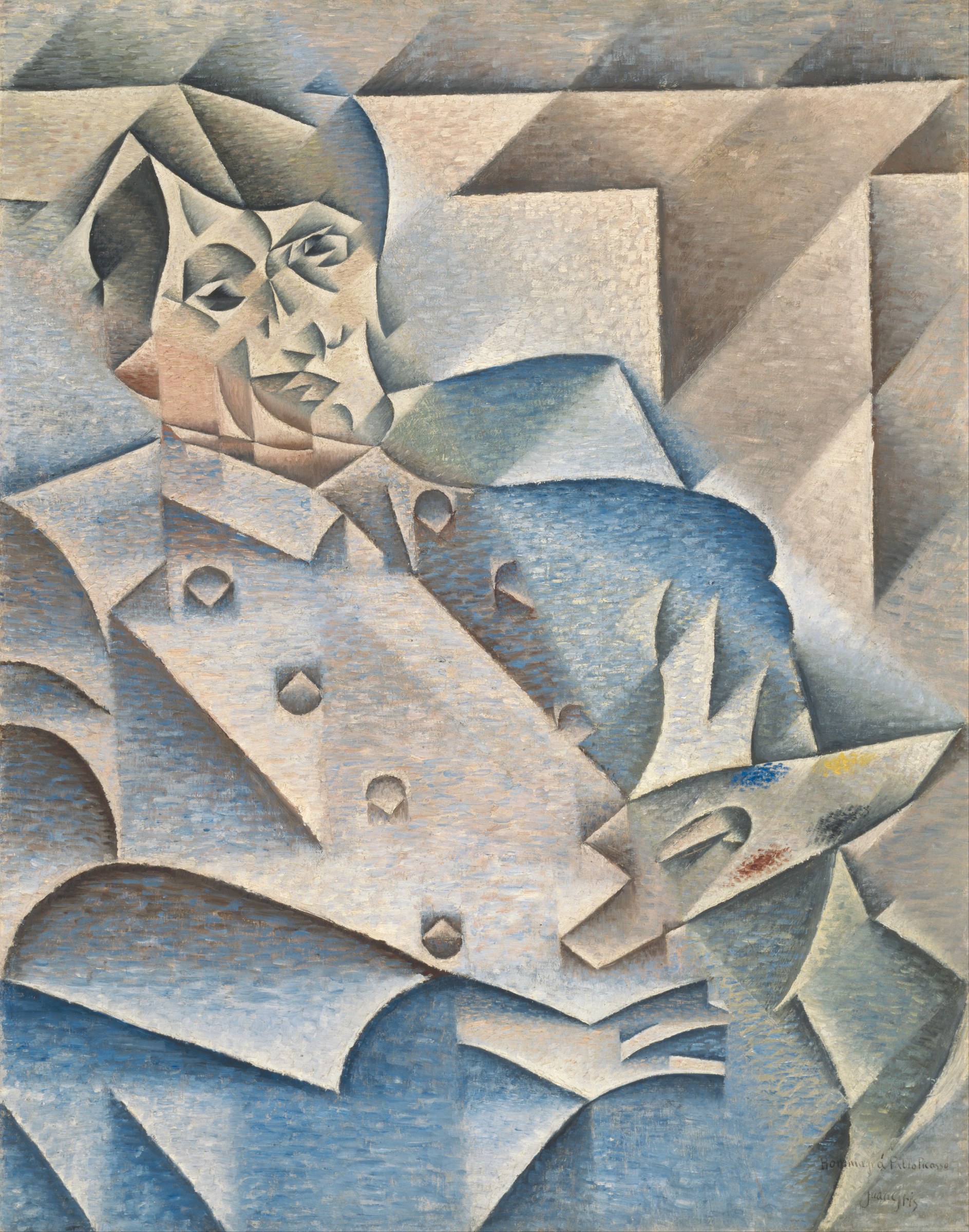
The first phase took objects apart. A violin, a bottle, a face were analyzed into interlocking facets — small planes showing multiple viewpoints simultaneously: the front and the profile of a face in the same image, the top and side of a table at once. Color drained to near-monochrome ochres, grays, and browns so that nothing would distract from the structure. Paintings from these years are famously hard to “read” — and deliberately so; letters and numbers stenciled onto the canvas (“JOU”, fragments of newsprint) are among the few handholds.
Synthetic Cubism and the invention of collage (1912–1914)
Then the method inverted: instead of breaking objects down, the painters began building pictures up from flat shapes — and from real things. In May 1912 Picasso pasted a piece of oilcloth printed with chair caning onto an oval canvas (Still Life with Chair Caning) and framed it with rope: the first collage in fine art. Braque answered with the first papier collé — pasted paper — in Fruit Dish and Glass (1912). Color returned, bold and flat. The picture was no longer a window but a construction site, and anything could be building material: newspaper, wallpaper, woodgrain paper, sand in the paint.
Why it matters
Cubism did to painting what the twentieth century did to everything else: it admitted that a single fixed viewpoint is a fiction. Multiple perspectives, fractured time, assembled fragments — the visual language of the modern world starts here, and it starts with two painters in adjoining studios refusing to tell their canvases apart.
Source notes
The “roped mountaineers” description of the Picasso–Braque partnership is reported in the biographical literature (see Sources); treat as reported rather than verbatim quotation. The 1912 collage/papier collé sequence follows standard art-historical accounts. See Sources.