Start Here
Five minutes, the whole arc — then go deep wherever curiosity pulls you.
Picasso in five minutes
1. A prodigy from Málaga. Born 25 October 1881 in Málaga, Spain, to an art teacher father who trained him rigorously. By his teens he could paint like the old masters — and spent the rest of his life trying to unlearn it. (Biography, Málaga Childhood)
2. Paris, poverty, and the Blue Period. He settled in Paris in 1904. The suicide of his close friend Carles Casagemas in 1901 had already plunged his work into the monochromatic blues of beggars, the blind, and the grieving — the Blue Period (1901–1904). (Blue Period)
3. The Rose Period and the breakthrough. Warmer pinks and circus performers followed (1904–1906), then the detonation: Les Demoiselles d’Avignon (1907), five fractured figures that broke perspective itself. (Rose Period, Les Demoiselles)
4. Cubism. With Georges Braque (1908–1914) he took painting apart and rebuilt it from multiple viewpoints at once — then invented collage by gluing real-world materials onto canvas. (Cubism, Collage)
5. Guernica and the long later life. In 1937, enraged by the bombing of the Basque town of Guernica, he painted his vast black-and-white protest mural. He kept working — sculpture, ceramics, prints — until his death in Mougins on 8 April 1973, aged 91. (Guernica, Late Years)
How to use this site
- Period pages trace each phase with dates, key facts, and what to look for.
- Deep dives go further: Barcelona, African art, Guernica’s journey, the market, and more.
- Sayings gives you his words with citations — and quarantines the quotes he never said.
- Myth vs. Record tests the famous stories.
- People maps the circle around him: Braque, Gertrude Stein, the dealers, the muses.
Two honesties up front
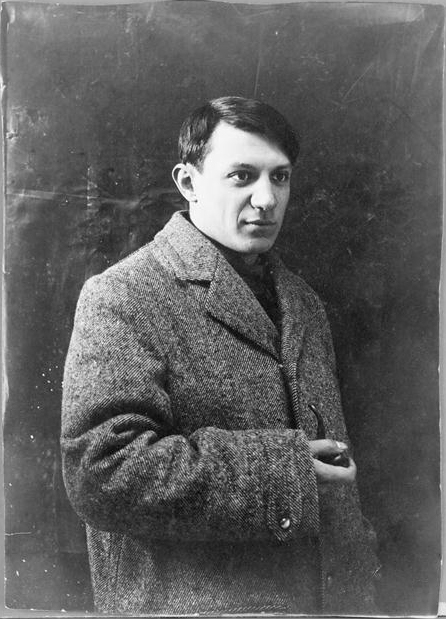
On images: Picasso died in 1973, so his paintings are under copyright. You will not see them reproduced here. You will see real photographs of Picasso and his world, and every image carries its source and license.
On words: The internet credits Picasso with dozens of sayings he never said. This site quotes him only with citations — and names the fakes.
Source notes
All period dates are the conventional art-historical ranges; see Sources for the reference works behind them.