Later Periods
After Cubism, Picasso refused to have a "late style" — so he had five.
Neoclassicism (1917–mid-1920s)
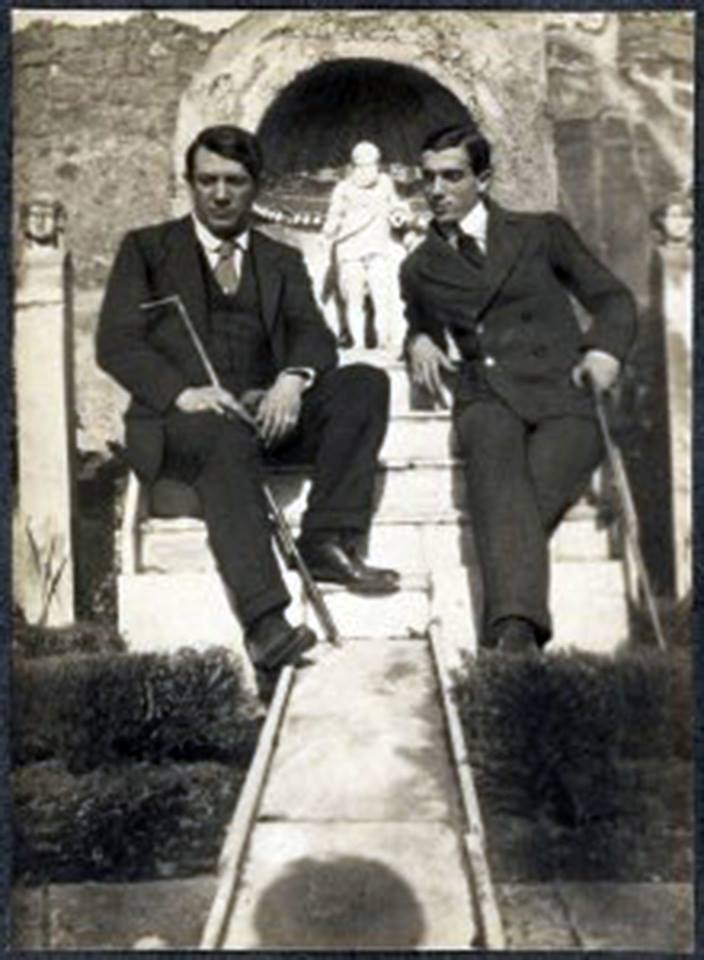
The Rome trip for Diaghilev’s Parade (1917) redirected him again: suddenly the great dissector was painting monumental, calm, classical figures — heavy-limbed women on beaches, serene portraits, Ingres-like line. It ran in parallel with continuing cubist work; Picasso no longer believed in one style at a time. The marriage to Olga Khokhlova (1918) and the birth of Paulo (1921) belong to these settled, bourgeois years.
The monsters (late 1920s–1930s)
The marriage soured; the painting curdled magnificently. The late 1920s and 1930s brought distorted, biomorphic figures — bathers with saw-tooth mouths, screaming heads — adjacent to Surrealism (Picasso never joined the movement, but breathed its air). The Minotaur became his alter ego in the Vollard Suite etchings (1930–37): blind, violent, tender by turns. Then came Marie-Thérèse Walter’s curving serenity, Dora Maar’s anguished distortions, and Guernica.
The war years (1939–1945)
Picasso stayed in Paris through the Occupation, working at 7 rue des Grands-Augustins. His work was condemned as “degenerate” by the Nazis; he exhibited little and kept his head down, but kept working — still lifes of skulls and harsh light, the bull’s skull as memento mori. In 1944 he joined the French Communist Party, a commitment that shaped his public image for the rest of his life.
The south: ceramics, linocuts, sculpture (1946–1960s)
After the war he settled in the south of France and reinvented himself again: ceramics at Vallauris from 1946 (thousands of pieces at the Madoura pottery), sculpture in sheet metal and found objects, bold linocuts, the dove drawings for the peace movement. (Sculpture & Ceramics)
The last fury (1960s–1973)
Married to Jacqueline Roque from 1961 and withdrawn to Notre-Dame-de-Vie near Mougins, the eighty-year-old Picasso painted as if pursued: hundreds of canvases reworking Velázquez’s Las Meninas, Manet’s Déjeuner sur l’herbe, Delacroix — erotic, grotesque, virtuosic, refusing to stop. Critics who had written him off were forced to look again. (Late Years)
Source notes
Period characterizations follow the standard literature; the 1944 Communist Party membership and the Occupation years are documented in Richardson and the Musée Picasso-Paris. See Sources.