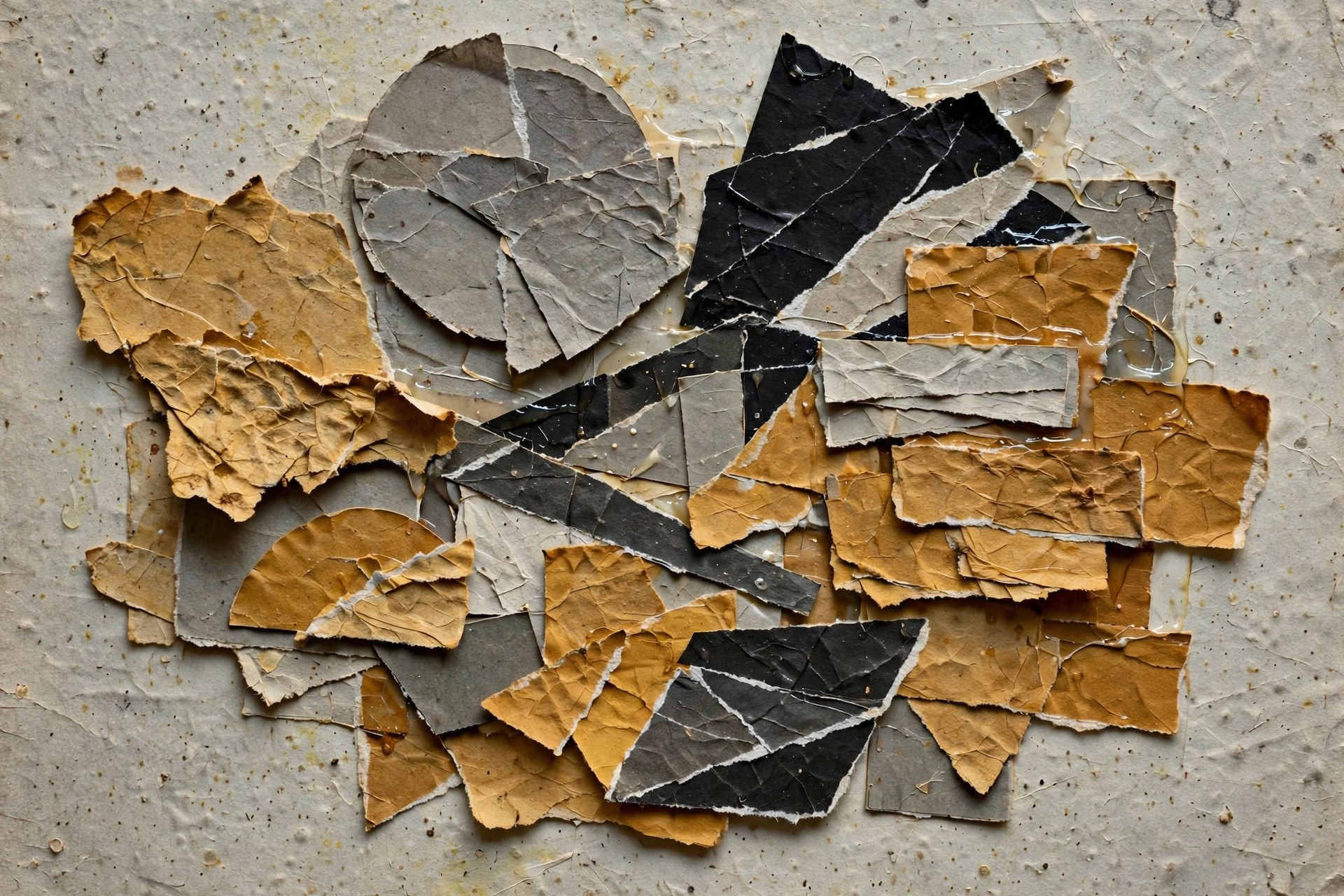
The Invention of Collage
1912 — the day the real world got glued into art.
The oilcloth
In May 1912 Picasso made an oval canvas, painted a café still life in the Synthetic cubist manner — and pasted onto it a piece of oilcloth printed with a chair-caning pattern, framing the whole thing with rope. Still Life with Chair Caning (Musée national Picasso-Paris) is the first collage in fine art: not an imitation of a texture but the texture itself, glued down.
The answer
Braque replied with the first papier collé — Fruit Dish and Glass (1912), pasting paper onto the surface. The two had been competing all year; the competition produced a medium.
Why it was revolutionary
Three ruptures at once:
- The picture stops pretending. A painted chair-caning pattern says “look what I can imitate”; a pasted one says “look what’s actually here.” Representation admitted its own artificiality.
- Anything is material. Newspaper, wallpaper, woodgrain paper, sand mixed into paint — the studio’s trash became the picture’s substance.
- The surface becomes an object. Collage thickens the picture plane; the painting starts toward sculpture, toward assemblage, toward everything the twentieth century would do with real stuff in art spaces.
The long fuse
Dada would pick it up (Schwitters’ Merz), Surrealism would dream on it (Ernst’s collage novels), Rauschenberg would combine-paint it, and every mood board on every designer’s wall is its descendant. The most casual gesture of 1912 — gluing something down — turned out to be one of the century’s load-bearing inventions.
Source notes
The 1912 sequence follows the standard art-historical accounts (see Sources).