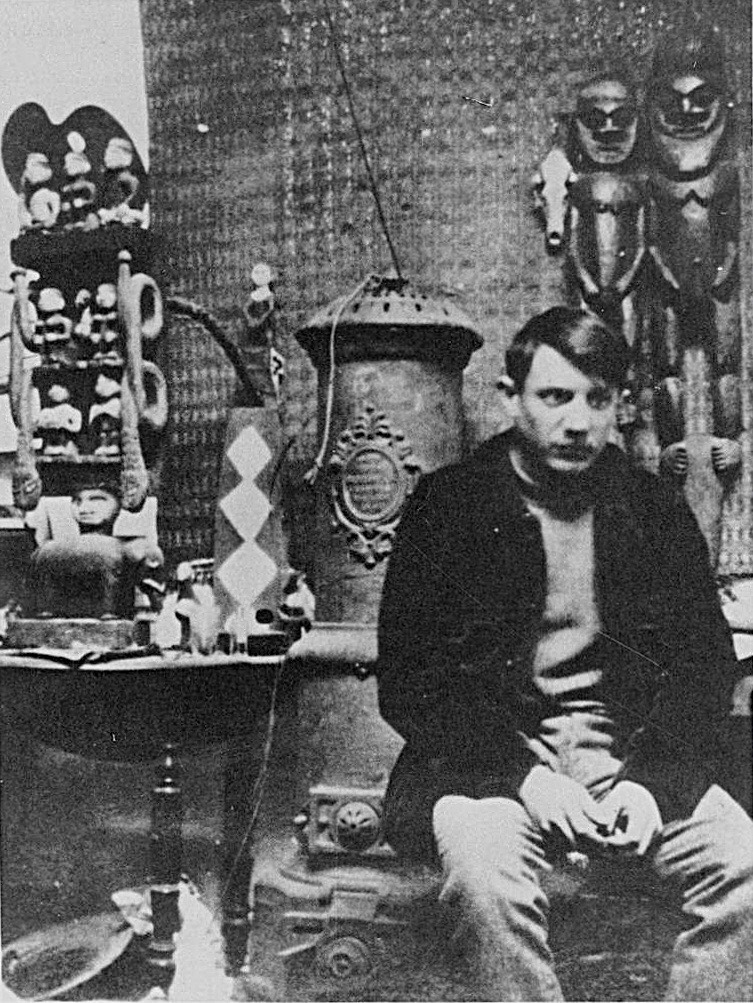
African Art & the Mask
1907 — the revelation that faces could be power, not likeness.
What he saw
In 1907 Picasso encountered African masks and figures — at the ethnographic museum in Paris (then the Musée d’Ethnographie du Trocadéro) and in the collections of friends like Matisse. He later described the experience as a revelation: here was sculpture that wasn’t decoration or portraiture but force — objects made to act on the world, not to please the eye.
What he took
Not style — permission. The masks showed him that a face could be built from signs: a wedge for a nose, slits for eyes, a carved geometry that carried more charge than any likeness. Two of the five figures in Les Demoiselles d’Avignon wear mask-faces outright; the whole painting’s fractured space follows from the same license.
The Iberian half of the equation
Alongside the African material stood ancient Iberian sculpture — the stone heads of pre-Roman Spain, which Picasso studied at the Louvre. The Demoiselles’ other three faces, with their staring, simplified features, descend from these. The painting’s shock is the fusion: his native deep past and a colonized continent’s present, detonated together.
The honest complication
“Primitivism” — the movement’s own word — is a loaded term for what was, from the African makers’ side, sophisticated sacred art encountered through the filter of empire. Picasso’s engagement was artistically genuine and historically entangled: he took formal power from objects whose contexts he didn’t understand, at a moment when France ruled much of the continent they came from. The art history is real; so is the shadow. This site names both.
Source notes
The 1907 encounter and its role in Les Demoiselles are documented across the standard literature. The photograph above (Burgess, 1908) is the contemporary visual record. See Sources.