Biography
Ninety-one years, tens of thousands of works, and a life lived almost entirely in the studio.
Málaga and the prodigy years (1881–1891)
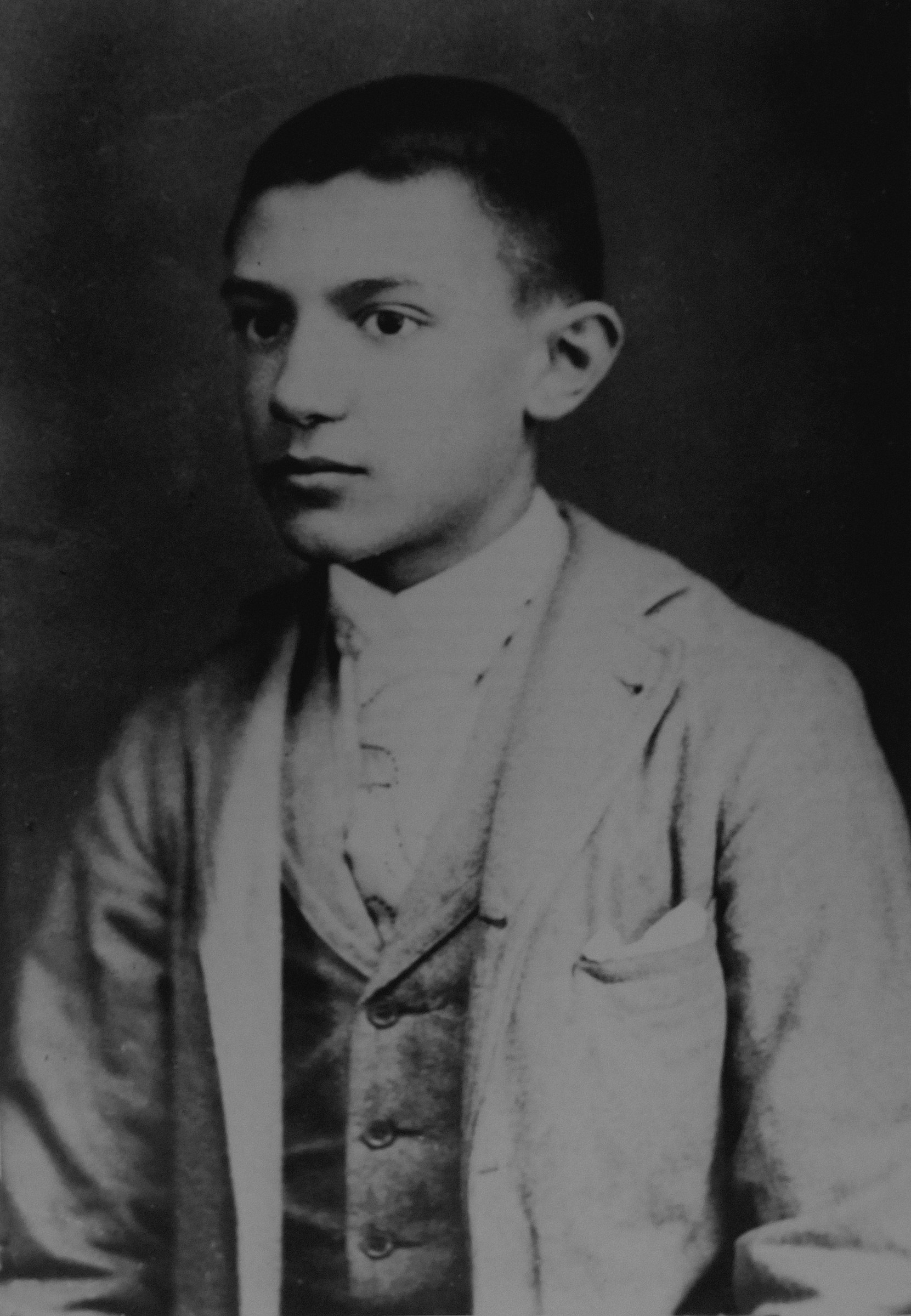
Pablo Diego José Francisco de Paula Juan Nepomuceno María de los Remedios Cipriano de la Santísima Trinidad Ruiz y Picasso was born on 25 October 1881 in Málaga, Spain — the long baptismal name was family custom; the world would know him by his mother’s surname, Picasso. His father, José Ruiz y Blasco, was a painter and art teacher who recognized the boy’s gift early and trained him with academic rigor: drawing from plaster casts, copying the masters. His mother, María Picasso y López, is the source of the famous reported remark about his ambition (see Sayings).
The family moved to A Coruña in 1891 when José took a teaching post, then to Barcelona in 1895 — the city that would make the young artist. (Málaga Childhood)
Barcelona: the making of a bohemian (1895–1900)
In Barcelona, the fourteen-year-old Picasso passed the entrance exams for the prestigious La Llotja art school with startling ease. He fell in with the Catalan avant-garde at Els Quatre Gats (“The Four Cats”), the café that was Barcelona’s answer to Parisian bohemia, where he held his first solo exhibition in 1900 and designed the café’s menu. The circle — Carles Casagemas, Jaime Sabartés, the poets and painters of modernisme — gave him his first audience and his first grief. (Barcelona)
Paris: arrival and the Blue Period (1900–1904)
Picasso first visited Paris in October 1900 for the Exposition Universelle, returning twice more before settling there in April 1904 at the Bateau-Lavoir in Montmartre. In February 1901 his close friend Carles Casagemas shot himself in Paris after a failed attempt to kill the woman he loved. The shock drove Picasso’s palette into the deep, mournful blues of the Blue Period (1901–1904): beggars, the blind, mothers and children, painted in near-monochrome. (Paris 1900, Blue Period)
The Rose Period and the detonation (1904–1907)
With Fernande Olivier, whom he met in 1904, came warmer pinks, saltimbanques and harlequins — the Rose Period. But the decisive rupture was Les Demoiselles d’Avignon (1907), painted under the impact of Iberian sculpture and African masks: five brothel figures whose faces fracture into mask-like planes. Shown privately, it stunned even his friends; publicly exhibited only in 1916, it is now at the Museum of Modern Art, New York. (Rose Period, Les Demoiselles, African Art)
Cubism with Braque (1908–1914)
From 1908 Picasso and Georges Braque worked in near-total symbiosis — “like two mountaineers roped together,” as the partnership was later described — dissecting objects into interlocking planes seen from multiple angles at once. Analytic Cubism (1910–1912) gave way to Synthetic Cubism and the invention of collage: Picasso’s Still Life with Chair Caning (1912) pasted oilcloth printed with chair caning onto canvas; Braque’s Fruit Dish and Glass (1912) was the first papier collé. (Cubism, Collage)
War, ballet, and classicism (1914–1924)
World War I scattered the avant-garde. In 1917 Picasso traveled to Rome with Jean Cocteau to design sets for Diaghilev’s Ballets Russes production Parade — and there met the ballerina Olga Khokhlova, whom he married in 1918. Their son Paulo was born in 1921. The postwar years brought a surprising neoclassicism: monumental, calm figures in a classical idiom, running alongside continuing cubist experiment. (Later Periods)
The 1930s: Minotaurs and Guernica
The decade brought the Vollard Suite of etchings (1930–37), the Minotaur as alter ego, and new relationships — Marie-Thérèse Walter (daughter Maya, born 1935) and the photographer Dora Maar. On 26 April 1937, German and Italian aircraft bombed the Basque town of Guernica. Working in Paris at 7 rue des Grands-Augustins, Picasso painted Guernica in May–June 1937 for the Spanish Republic’s pavilion at the Paris Exposition — a vast black-and-white scream that became the century’s most famous anti-war image. (Guernica, Guernica’s Journey)
Occupation, Vallauris, and the long late years (1940–1973)
Picasso remained in Paris through the German Occupation, working quietly; in 1944 he joined the French Communist Party. After the war he settled in the south of France, taking up ceramics at Vallauris from 1946, making sculpture, linocuts, and returning obsessively to the old masters — Velázquez’s Las Meninas, Manet’s Déjeuner. Françoise Gilot (1943–53), mother of his children Claude (born 1947) and Paloma (born 1949), left him and wrote the revealing memoir Life with Picasso (1964). In 1961 he married Jacqueline Roque and withdrew to Notre-Dame-de-Vie near Mougins, working with undiminished fury into his nineties. (Sculpture & Ceramics, Late Years, Women in His Life)
He died on 8 April 1973 in Mougins, aged 91, and is buried at the Château de Vauvenargues. He left behind one of the largest bodies of work any artist has ever produced — and an art world permanently rearranged around him. (Market & Legacy)
Source notes
Dates and biographical facts follow the standard scholarly record: John Richardson’s multi-volume biography, the Musée national Picasso-Paris, and the Museum of Modern Art’s collection records. See Sources. Relationship details are handled factually on Women in His Life and People.