The Marshals
He couldn't be everywhere, so he manufactured everywhere: the marshals who executed his plans — and the ones who buried them.
The institution
On 19 May 1804, days after the Empire’s proclamation, Napoleon created the Marshals of the Empire — 18 at first: 14 active commanders and 4 honorary elder senators (Kellermann, Lefebvre, Pérignon, Sérurier). It was part reward, part control: the baton bound the Revolution’s generals to the new throne. By the end, 26 men held the rank — the later promotions including Victor, Macdonald, Oudinot, Marmont, Suchet, and Gouvion Saint-Cyr (1809), Poniatowski (1813), and Grouchy (1815).
The title was glittering; the reality was a hierarchy of talent, luck, and survival. A few of them mattered as much as Napoleon did.
The indispensable: Berthier
Louis-Alexandre Berthier, Prince of Neuchâtel, was Napoleon’s chief of staff from Italy to Waterloo — the man who turned the Emperor’s often scribbled intentions into marching orders for hundreds of thousands of men, overnight, without error. Napoleon called him, with rare accuracy, the army’s organizer. Without Berthier the Grande Armée’s legendary speed of maneuver does not happen. He died in June 1815, falling from a window in Bamberg days before Waterloo — whether by accident, suicide, or something darker has never been settled. Label: disputed.
The undefeated: Davout
Louis-Nicolas Davout, Duke of Auerstedt, Prince of Eckmühl — the “Iron Marshal” (reported nickname). On 14 October 1806, while Napoleon beat the main Prussian army at Jena, Davout with a single corps of ~26,000 destroyed the other Prussian army at Auerstedt — some 50,000 men — the greater feat of the day, and one Napoleon never quite forgave him for outshining. Davout was never defeated in battle. He governed Hamburg with an iron severity, remained loyal to the end, and died in 1823 — one of the few marshals to die in bed, unrepentant.
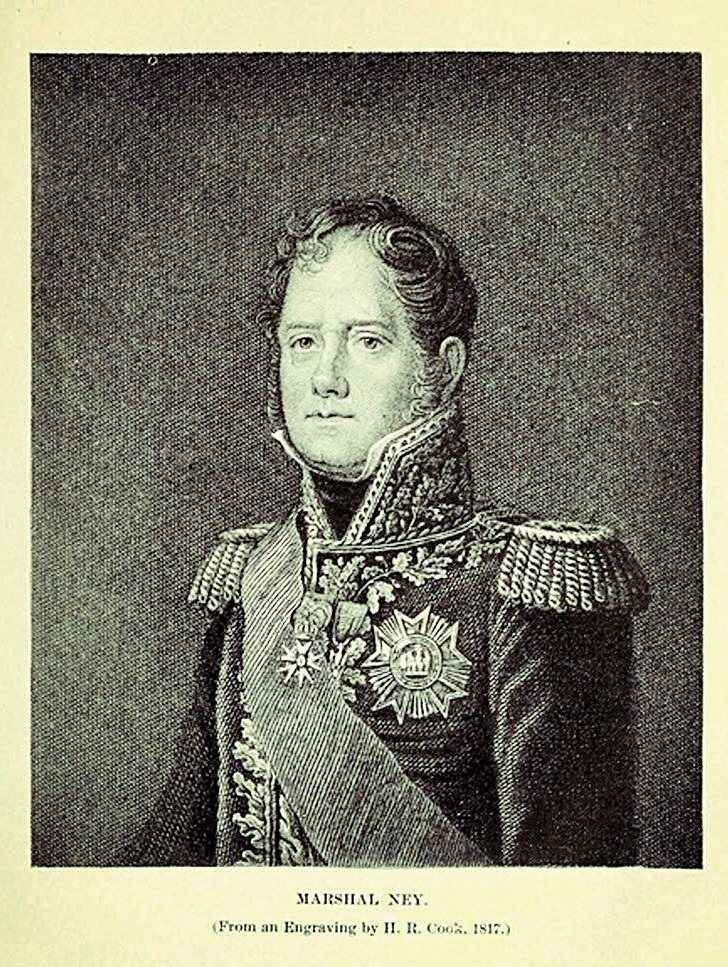
The bravest: Ney
Michel Ney, Duke of Elchingen, Prince of the Moskowa — “the bravest of the brave” (le brave des braves). Label: reported — the nickname is universally attached to him and universally credited to Napoleon, most often to the moment in December 1812 when Ney, given up for dead commanding the rearguard in Russia, walked back into headquarters alive. Ney had commanded the rear guard across the whole retreat and was legend’s “last Frenchman on Russian soil.”
His end was the Revolution devouring its own: after serving Louis XVIII in 1814 and swearing to bring Napoleon back “in an iron cage,” he defected to the Emperor during the Hundred Days, fought ferociously at Waterloo, and was executed by firing squad in Paris on 7 December 1815 after trial by the Chamber of Peers. He is said to have given the order to fire himself — reported, and entirely in character.
The cavalry king: Murat
Joachim Murat — flamboyant, reckless, magnificent — commanded the cavalry that broke every army from Austerlitz to Eylau, married Napoleon’s sister Caroline, and was made King of Naples (1808). He abandoned Napoleon in 1813 to save his throne, came crawling back, was refused for the Hundred Days, and after Waterloo tried to retake Naples with a handful of men. Captured, he was executed by firing squad in October 1815. Napoleon’s reported epitaph for them both might have been: he loved Murat too much and trusted him too little — attributed, not documented.
The dead and the turned
- Jean Lannes, Duke of Montebello — perhaps the most gifted of them all, mortally wounded at Aspern-Essling (22 May 1809), dead nine days later. Napoleon wept at his bedside — reported, by the witnesses present.
- André Masséna — “the dear child of victory” (l’enfant chéri de la victoire, reported nickname), the victor of Zurich (1799).
- Nicolas Soult — the great organizer of the later armies, who lived until 1851, long enough to become a political survivor of three regimes.
- Jean-Baptiste Bernadotte — marshal, then elected Crown Prince of Sweden (1810), then King Charles XIV John — who led Swedish troops against Napoleon at Leipzig in 1813. The marshalate’s strangest career.
- Auguste Marmont — whose defection with his corps in April 1814 gave the French language the word ragusade (from his title, Duke of Ragusa) for betrayal.
The pattern
The marshals’ fates map the Empire’s: the loyal died in bed (Davout) or by mischance (Berthier, Lannes by cannonball); the brilliant burned out (Murat, Ney before firing squads); the adaptable survived everything (Soult, Bernadotte). Napoleon made them, used them, and — the charge his enemies never tired of making — spent them. The charge has evidence behind it. So does the defense: no commander of the age got more from his subordinates, or asked more of them.
Source notes
- Documented: the creation (19 May 1804), the 18/14+4 structure, the later promotions and the total of 26, the battle dates (Jena-Auerstedt 14 October 1806, Aspern-Essling 1809), the executions (Ney, 7 December 1815; Murat, October 1815), Bernadotte’s Swedish election (1810), Soult’s death (1851).
- Reported: the nicknames (“Iron Marshal,” “bravest of the brave,” “dear child of victory”) — all widely attached, none with a primary-source trail to Napoleon’s own hand; the Ney “iron cage” boast; the Lannes deathbed scene; Ney giving his own firing order.
- Disputed: Berthier’s death (June 1815) — accident, suicide, and murder have all been alleged; none proven.
- Image: portrait of Marshal Michel Ney, duc d’Elchingen (1769–1815) — 19th-century, attributed on the file page to François Gérard (d. 1837); public domain regardless. Provenance: the image credits on this page.