The Propaganda Machine
He understood, earlier than any ruler of the modern age, that the battle for opinion is fought with the same seriousness as the battle for ground.
The bulletins
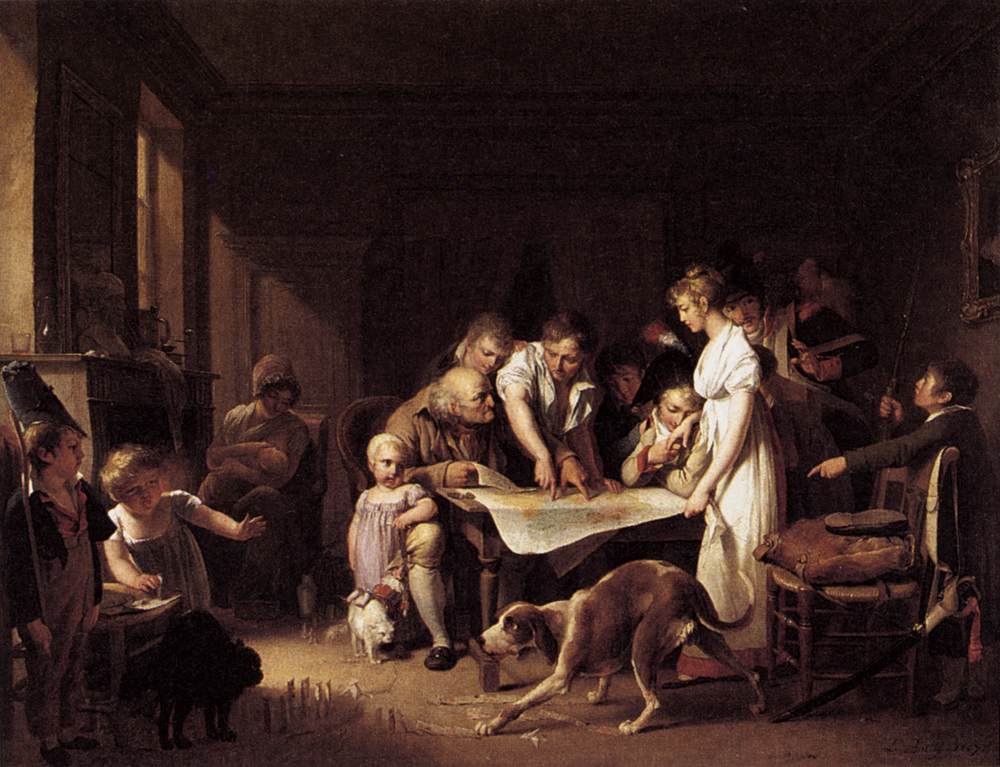
Napoleon’s most effective propaganda instrument was also the most official-looking: the bulletins of the Grande Armée, written (and often dictated) by Napoleon himself, printed in Le Moniteur universel, and read aloud across France. Louis-Léopold Boilly’s 1807 genre painting The Reading of the Bulletin of the Grande Armée shows a family following a campaign on a map as the bulletin is read — the regime’s news cycle made visible.
The bulletins exaggerated victories, minimized losses, and — their masterstroke — spoke in the commander’s own voice, turning the nation into an audience for his campaigns. They were, as the International Napoleonic Society’s survey of the bulletins puts it, propaganda and the pen as a weapon of war.
And then there was the 29th Bulletin, dated from Molodetchno on 3 December 1812, the one where the machine had to admit the Russian catastrophe. Napoleon confessed the ruin of the army but laid the blame on the early, brutal winter — and added the sentence that became famous for its grotesque composure:
“La santé de Sa Majesté n’a jamais été meilleure.” (“His Majesty’s health has never been better.”)
Label: documented — the bulletin’s text. It is the perfect artifact of the whole system: disaster acknowledged, responsibility redirected, the Emperor personally flourishing. (The often-quoted English summary “the army is in the most brilliant health” is a loose rendering; the French above is the documented line.)
The painters
Napoleon commissioned his image the way he commissioned his armies — deliberately, and at scale:
- Jacques-Louis David, appointed premier peintre (first painter) of the Emperor in 1804: Bonaparte Crossing the Alps (1801, in five versions) — the general on a rearing horse, the names of Hannibal and Charlemagne carved in the rock beneath him, pure Consulate-era myth-making; The Coronation of Napoleon (1807); The Emperor Napoleon in His Study at the Tuileries (1812) — the tireless administrator, candles burning at 4 a.m.
- Antoine-Jean Gros: Bonaparte at the Bridge of Arcole (1796); Bonaparte Visiting the Plague Victims of Jaffa (1804) — painted five years after the Syrian campaign, showing the general fearlessly touching plague sufferers; Napoleon on the Battlefield of Eylau (1808) — the Emperor as merciful amid the frozen corpses.
- Jean-Auguste-Dominique Ingres: Napoleon on his Imperial Throne (1806) — frontal, hieratic, deliberately archaic.
David’s Alpine crossing is the textbook case: Napoleon actually crossed the Alps on a mule, led by a guide — the version Paul Delaroche would paint, coldly, in 1848–50. David gave him a rearing charger instead. Both paintings hang on this site; only one of them is true. See Napoleon in Art.
The press
Napoleon began as a newspaperman of sorts: in Italy in 1796–97 he founded army newspapers and made sure his proclamations were reprinted in Paris — the young general publicizing himself over his superiors’ heads. As ruler he reversed the polarity: by 1811 only a handful of newspapers survived in Paris, all supervised, with Le Moniteur as the official organ.
The line everyone quotes —
“Four hostile newspapers are more to be feared than a thousand bayonets.”
— is attributed, with no verified primary source. It sounds like him; it cannot be proven his. It is included here as an example of how the propaganda machine generated its own folklore: even his remarks about the press became press.
The system around the system
Propaganda, for Napoleon, was not just messages but staging:
- Timing the trophies: captured Italian artworks were shipped to Paris to arrive with maximum publicity, and displayed at the Louvre — great art and the Bonaparte name, permanently linked.
- The Institute: his election to the Institut de France in 1797 (mathematics section) certified him as a man of intellect, not just a sword.
- Ceremony as media: the coronation (1804), the distribution of the eagles, the imperial court — all designed to be seen, engraved, and circulated.
The irony the bulletins never mentioned: the machine worked best on the French. The peoples of Europe, reading the same bulletins in translation, learned to hate the messenger. The legend he manufactured at home became, abroad, the caricature — Gillray’s “little Boney” — that would outlive the Empire. Both images were inventions. The truth, as usual, was the casualty.
Source notes
- Documented: the bulletins’ publication in Le Moniteur universel; the 29th Bulletin’s date (Molodetchno, 3 December 1812) and its “santé de Sa Majesté” line; David’s appointment as premier peintre (1804); the paintings’ dates and current holdings; the Italian campaign proclamations’ Paris reprinting (per the standard histories).
- Reported: the workings of the bulletin system and the censorship regime, per the standard histories and the International Napoleonic Society’s bulletin survey (Imperial Glory, ed. J. David Markham).
- Attributed: “Four hostile newspapers…” — no primary source found; labeled as such and not quoted as his.
- Translated: the 29th Bulletin line is given in the French original with a literal English rendering.
- Image: Louis-Léopold Boilly, The Reading of the Bulletin of the Grande Armée (1807) — public domain (artist died 1845); Saint Louis Art Museum. Provenance: the image credits on this page.