The Continental System
He couldn't beat the Royal Navy, so he tried to bankrupt its country. The blockade strangled Europe instead — and dragged him into the two wars that destroyed him.
The decrees
After Trafalgar (October 1805) proved Britain could not be invaded, Napoleon turned to economic warfare. From Berlin, days after entering the Prussian capital, he issued the Berlin Decree on 21 November 1806:
“The British Isles are declared to be in a state of blockade.”
All commerce and correspondence with Britain was forbidden across France and its allies and satellites; British subjects were to be arrested as prisoners of war; British goods seized; any ship arriving from a British port treated as a lawful prize. The Milan Decree (17 December 1807) tightened the screws further — neutral ships that had submitted to British inspection could be seized — and further decrees followed: Warsaw (1807), Bayonne (1808), Rambouillet (1810), Trianon (1810, adding punitive tariffs), Fontainebleau (1810, criminalizing smuggling), and St. Cloud (1811, quietly relaxing the system through licensed trade).
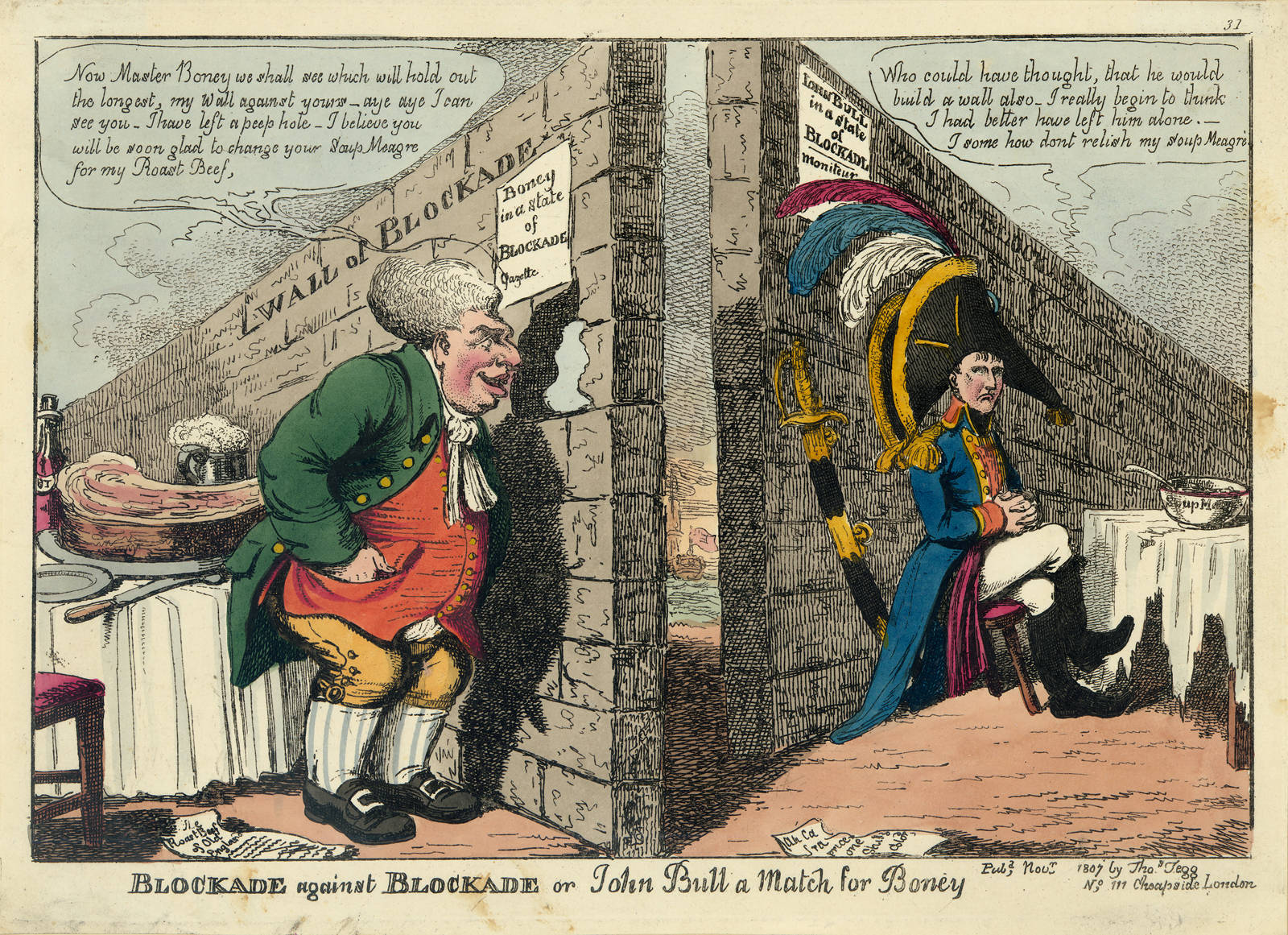
The theory was mercantilist and simple: Britain lived by trade; cut off the European market, drain its gold, break the Bank of England, ruin its credit — and London would have to make peace. Britain answered with its own Orders in Council, a counter-blockade that made the economic war mutual — and helped cause the Anglo-American War of 1812.
Why it failed
A blockade needs a navy. Napoleon had lost his at Trafalgar, so the “blockade” of the British Isles was enforced by customs men and soldiers along thousands of kilometers of coastline — against the greatest smuggling economy in European history.
- Smuggling was universal. British goods poured in through Spain, Russia, the Adriatic, and the North Sea ports; American privateers ran the blockade for profit. Napoleon himself ended up issuing licenses for the very trade his decrees forbanned — the system corrupted from the top.
- Britain found other markets. Cut off from Europe, British merchants expanded trade with the Americas and Asia. British trade was damaged — sharply in 1808 and 1811 — but the economy survived.
- Europe paid the price. Cut off from colonial goods, Europeans faced shortages and soaring prices for sugar, coffee, and cotton. The blockade spurred substitutes — French beet sugar and mechanized textile spinning date from these years — but the hardship bred hatred of the regime. Amsterdam’s commerce collapsed and never recovered its old primacy.
Historian Paul Schroeder’s verdict, widely cited, is that the system proved “an ineffective method of economic warfare.” The embargo ended with the first abdication, 11 April 1814.
The wars it caused
The Continental System’s most important consequence was not economic but military: enforcing it dragged Napoleon into the two catastrophes that destroyed the Empire.
- The Peninsular War (1807–1814): Portugal refused the blockade; Napoleon sent an army through Spain to close Portuguese ports, then seized the Spanish crown for his brother Joseph. The result was the “Spanish ulcer” — a quarter-million French soldiers bled into six years of guerrilla war.
- The Russian invasion (1812): Tsar Alexander I, chafing under the blockade’s ruin of Russian trade, reopened Russian ports to neutral (read: British) shipping in 1810. Napoleon decided the system could only be saved by force — and marched 600,000 men to Moscow to compel Alexander back into it.
A trade policy, enforced by pride, became a death sentence for an empire.
Source notes
- Documented: the Berlin Decree (21 November 1806) and its “state of blockade” formula; the Milan Decree (17 December 1807); the subsequent decrees; the British Orders in Council; the system’s end (11 April 1814). These are official acts of the period.
- Reported: the economic effects (smuggling scale, price rises, beet sugar, Amsterdam’s decline) and the causal links to the Peninsular War and the 1812 invasion follow the standard histories; the Schroeder judgment is quoted as a historian’s assessment.
- Image: Blockade Against Blockade (1807), a British satirical print on the rival blockades — British propaganda, not a neutral record. Public domain (artist George M. Woodward died 1809; etched by Charles Williams). Provenance: the image credits on this page.