Napoleon in Art: Propaganda vs. Reality
The most painted man of his century was also the most invented. A field guide to the images — which ones lie, which ones answer back, and what they tell us anyway.
The official image: David
Jacques-Louis David, the Revolution’s painter turned the Empire’s premier peintre, built the Napoleonic image from whole cloth:
- Bonaparte Crossing the Alps (1801, five versions): the young general on a rearing horse, cloak flying, pointing uphill — with the names Bonaparte, Annibal, Karolus Magnus carved into the rock beneath. The message: he belongs in the sequence of history’s great crossers. The reality: he crossed on a mule, led by a guide, wrapped against the cold.
- The Coronation of Napoleon (1807): the vast Notre-Dame ceremony, the moment he takes the crown from the Pope’s hands — the official record of the founding act, painted to be believed.
- The Emperor Napoleon in His Study at the Tuileries (1812): the 4 a.m. administrator, candle guttering, papers scattered — the Emperor as tireless servant of the state.
David’s Napoleon is always composed, always destined. Nothing in these paintings is accidental — including the hand tucked into the waistcoat, the gesture that became his visual signature. (The pose was a standard gentleman’s portraiture convention of the period; Napoleon’s portraits simply made it his forever.)
The battlefield humanist: Gros
Antoine-Jean Gros, David’s pupil, gave the legend its emotional register:
- Bonaparte at the Bridge of Arcole (1796): the young general seizing the flag — the founding image of the hero.
- Bonaparte Visiting the Plague Victims of Jaffa (1804): painted five years after the Syrian campaign, showing Napoleon fearlessly touching a plague sufferer’s bubo — the general as Christ-like healer. The campaign itself was a failure; the painting is theology.
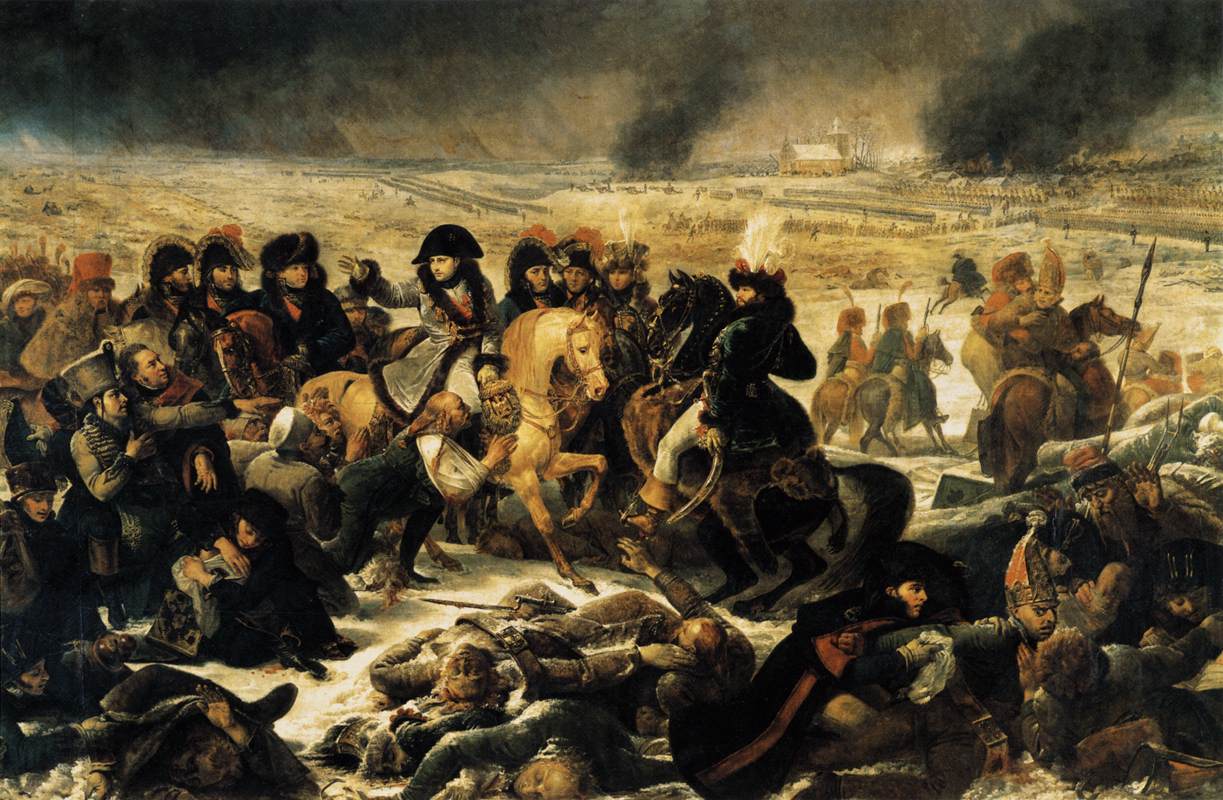
- Napoleon on the Battlefield of Eylau (1808): the Emperor on horseback amid the frozen corpses of one of the war’s bloodiest days, his gesture one of pity — horror acknowledged, then redeemed by his mercy.
Gros’s work is the most interesting propaganda of the three: it admits suffering in order to sanctify the man who caused it.
The hieratic icon: Ingres
Jean-Auguste-Dominique Ingres’s Napoleon on his Imperial Throne (1806) abandons realism entirely: frontal, symmetrical, robed like a Byzantine emperor, the face a mask. It is not a portrait but an idol — power rendered as religion.
The answer: Delaroche
In 1848–50, Paul Delaroche painted Bonaparte Crossing the Alps — the same crossing, the opposite painting: a weary general on a mule, led by a peasant guide through the snow, no rearing charger, no carved conquerors’ names. Delaroche wasn’t painting from life either — it was nearly fifty years after the event — but he was painting against David, using research and realism as weapons against the legend. The pair, David vs. Delaroche, is the whole Napoleonic image-problem in two frames. Both hang on this site.
The enemy’s image: Gillray
The British saw a different Napoleon. James Gillray’s caricatures — The King of Brobdingnag and Gulliver (1803), the tiny emperor in George III’s palm — fixed the “little Boney” myth for two centuries. Napoleon’s actual height was about 1.69 m (5 ft 6½ in), average for the era; the “short” legend is a cocktail of French pieds misconverted to English inches, the tall Imperial Guard around him, and Gillray’s genius. See Legend vs. Scholarship.
How to read them
A rule of thumb for every Napoleonic image:
- Who paid? State commissions (David, Gros, Ingres) are policy documents in paint.
- When? Contemporary images show what the regime wanted seen; 19th-century retrospectives (Delaroche, Northen’s Retreat from Moscow) show what the legend had become.
- What’s missing? The paintings show no deserters, no amputees without glory, no Spanish guerrillas. The absences are the argument.
The art is a primary source — not for what Napoleon looked like, but for what power wanted him to be.
Source notes
- Documented: the paintings’ dates, artists, commissions (David as premier peintre, 1804), current holdings, and the five versions of David’s Alps; the mule-vs-charger contrast; Napoleon’s height (~1.69 m).
- Reported: the interpretations of intent (Delaroche painting “against David,” Gros’s Eylau as calculated mercy) are the standard art-historical readings, presented as readings.
- Translated/quoted: the rock inscription (Bonaparte, Annibal, Karolus Magnus) is as painted.
- Every image on this site is captioned with its status — propaganda, revision, caricature, or retrospective — and none is presented as a neutral record. Provenance: the image credits on this page.