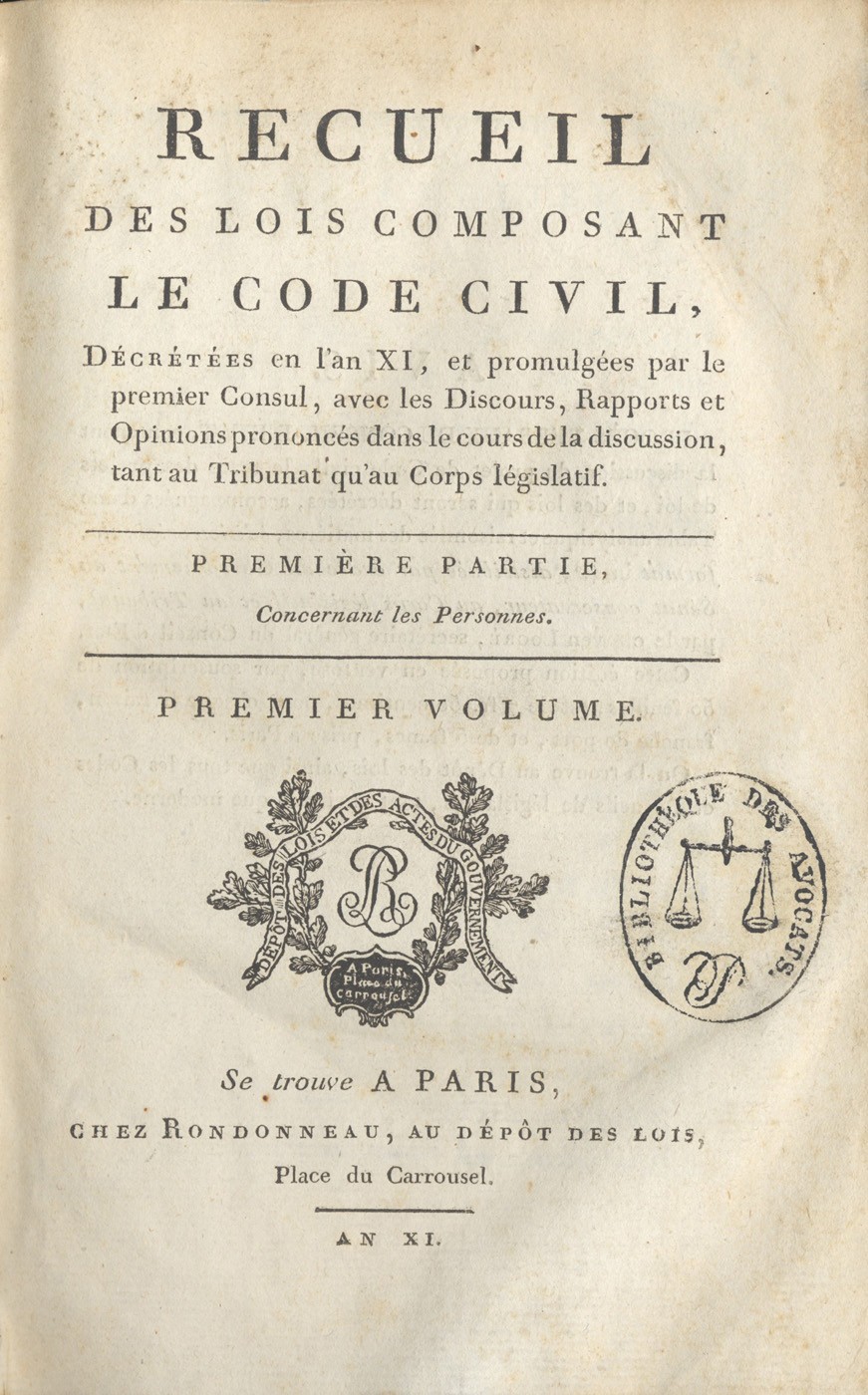
The Napoleonic Code
Forty battles faded. The Code stayed. How four jurists, one relentless First Consul, and 2,281 articles remade the law of France — and much of the world.
What it was
The Code civil des Français, promulgated on 21 March 1804 (30 Ventôse, Year XII), was the first of Napoleon’s five codes and by far the most consequential. It replaced a legal chaos — more than 400 regional customary codes under the ancien régime, Roman law in the south, and over 14,000 pieces of revolutionary legislation — with a single book of 2,281 articles in three parts: persons (articles 7–515), property (516–710), and the ways of acquiring property (711–2281).
Five attempts to codify French law had failed during the Convention and the Directory. The Consulate succeeded where they had not — and the difference was political will applied at close range.
How it was made
In August 1800 Napoleon appointed a commission of four eminent jurists: Jean-Étienne-Marie Portalis, François-Denis Tronchet, Félix-Julien-Jean Bigot de Préameneu, and Jacques de Maleville. The draft was complete by the end of 1801, then debated in the Council of State, where Napoleon himself sat in on the sessions and argued the articles line by line.
How many sessions he attended is one of those small facts the sources won’t quite agree on: one standard account says 36 of the commission’s 87 meetings; the Musée de l’Armée’s account says 55 of 107. Either way, it was an extraordinary personal investment for a head of state in the middle of rebuilding a country — and the Code was nicknamed the “Code Napoléon” for a reason. (It was officially renamed the Code Napoléon in 1807, reverted to Code civil after 1815.)
Portalis, the commission’s leading mind, set the philosophy in his Discours préliminaire (preliminary discourse):
“The function of the law is to determine, by means of basic concepts, the general precepts of the law, and to establish principles fertile in consequence, rather than to go into the details of questions that may arise with regard to each particular matter.”
The style was deliberate: clear, concise, direct — law a citizen could read. It has been called a literary as well as a legal masterpiece, and its language is one reason it traveled so well.
What it changed
The Code consolidated the Revolution’s core legal gains:
- Equality of all men before the law — no more privileges of birth or estate.
- Abolition of feudalism — seigneurial dues and feudal tenure, already abolished in 1789, were buried for good.
- Absolute property rights — including the rights of the purchasers of the biens nationaux (the confiscated church and émigré lands). This was politically decisive: millions of Frenchmen now had a material stake in the Revolution’s survival.
- Secular civil marriage and civil registration — marriage became a civil contract recorded by the state, not a sacrament controlled by the Church.
- Freedom of religion and careers open to talent — government posts to the most qualified.
And it carried the counter-revolution inside it:
- Patriarchal authority was written into law: the husband was the ruler of the household; married women lost individual legal rights (they could not own property or sign contracts independently).
- Illegitimate children’s rights were reduced.
- Divorce, which the Revolution had introduced, was kept but narrowed — and the Restoration would abolish it outright in 1816.
Slavery, reintroduced in the colonies by the law of 20 May 1802, sat outside the Code but stains the same record.
“My true glory”
Napoleon knew what would last. The 19th-century legal literature attributes to him the line “I shall go down to posterity with the Code in my hand” — a reported remark, not a documented one, but consistent with everything he said and did about the work. From St. Helena comes the more famous version, widely attributed though never found in his own hand:
“My true glory is not to have won forty battles… What nothing will erase, what will live forever, is my Civil Code.”
Label: reported/attributed — it circulates in the St. Helena tradition (the same channel as Las Cases) without an autograph source. It is included here because of what it reveals about how he wanted to be remembered, not as a documented quotation.
The legacy
The Code was retained in its majority by the restored Bourbons after 1815 — the law outlived the lawgiver. It became the model for the civil codes of more than twenty nations, across Europe, Latin America, and the Middle East. The Civil Code was followed by the Code of Civil Procedure (1806), the Commercial Code (1807), the Criminal Code and Code of Criminal Procedure (1808), and the Penal Code (1810).
When historians argue about whether Napoleon was the Revolution’s heir or its gravedigger, the Code is exhibit A for both sides: it preserved equality before the law and destroyed it for women in the same binding.
Source notes
- Documented: the promulgation date (21 March 1804), the 2,281 articles and three-book structure, the commission’s membership, the 1807 renaming, the follow-on codes, and the Code’s retention after 1815 are matters of the official and legislative record (summarized here from the standard accounts: the Musée de l’Armée’s Code civil dossier, the Napoleon Series’ Civil Code index, and HISTORY’s 21 March 1804 survey).
- Reported: Napoleon’s session attendance (36 of 87 vs. 55 of 107 — both figures are given above because the sources disagree); the St. Helena “forty battles” remark (attributed, no autograph).
- Translated: Portalis’s Discours préliminaire is quoted in standard English translation; the French original is the authority.
- Context: the pre-Code legal chaos (400+ codes, 14,000 revolutionary laws, five failed codifications) follows the standard histories cited on the Sources page.
- Image provenance: the image credits on this page.