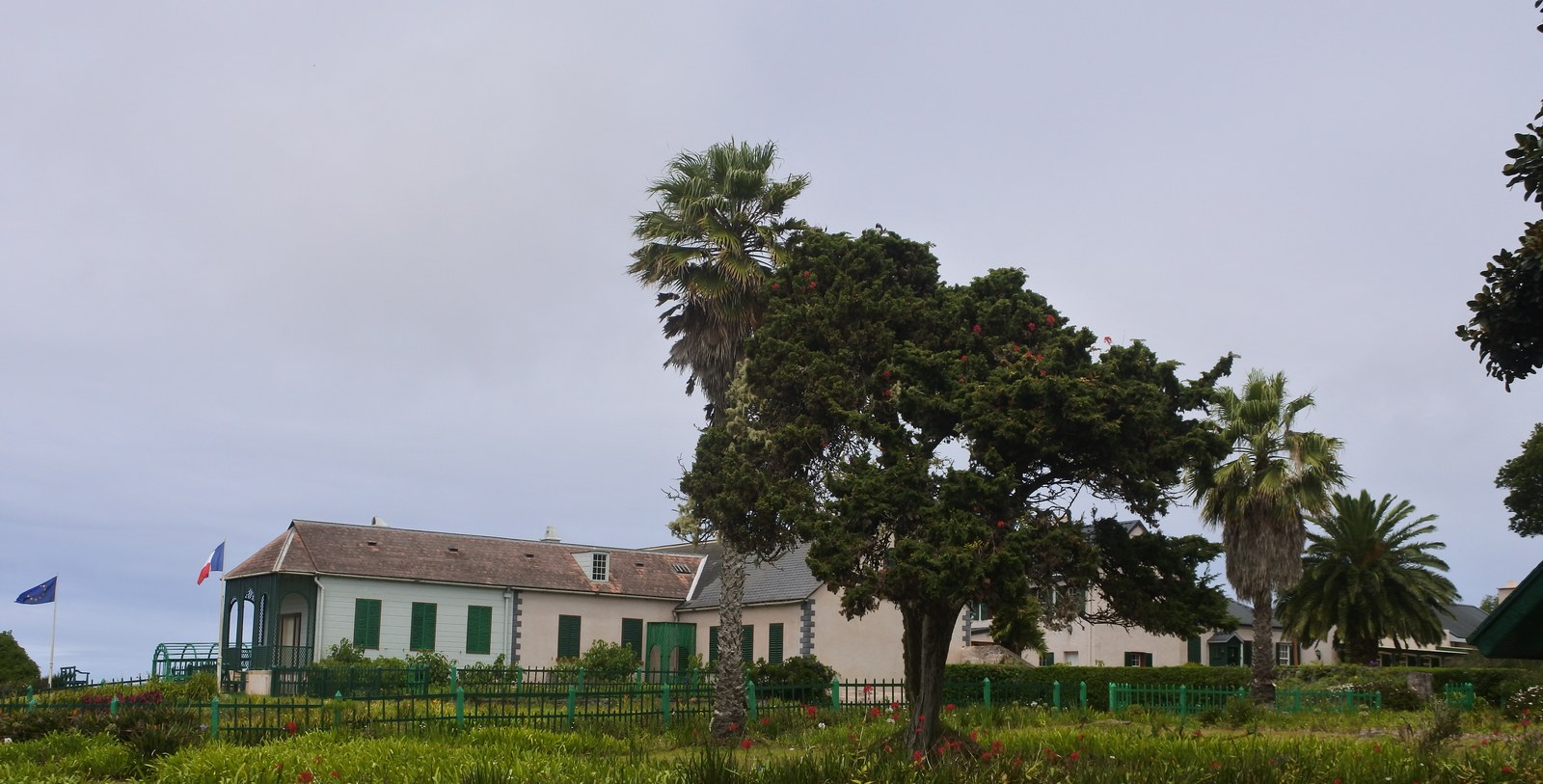
St. Helena: Exile and the Writing of the Legend
A volcanic rock in the South Atlantic, a damp house on a windswept plateau, and five and a half years of dictation that invented the Napoleonic legend.
The voyage out
After the second abdication, Napoleon surrendered to the British — hoping, vainly, for asylum in England. The Congress of Vienna had declared him an outlaw, and on 28 July 1815 the British government decided his fate: St. Helena, 1,900 kilometers from Africa, a British East India Company island chosen because it was, in the polite phrase, easily monitored.
On 7 August 1815 he was transferred to HMS Northumberland under Admiral Sir George Cockburn, with a suite of about twenty-five. On 15 October the ship anchored off the island; the next day he disembarked. On 17 October he took temporary rooms at the Briars Pavilion with the Balcombe family while his permanent residence was prepared — it took seven weeks. On 10 December 1815 he moved into Longwood House, on a plateau exposed to the trade winds, the fog, and sudden alternations of rain and scorching sun. The damp, the rats, and the wind would be characters in everything that followed.
The court in miniature
The companions who chose exile with him:
- General Henri-Gratien Bertrand, Grand Marshal of the Palace, with his wife Fanny
- General Gaspard Gourgaud, former aide-de-camp
- Emmanuel de Las Cases, with his son Emmanuel — the chamberlain turned memorialist
- General Charles de Montholon, with his wife Albine — head of the household
- Louis Marchand, his valet; Louis-Étienne Saint-Denis (“Ali”), the Mameluke; the maître d’hôtel Cipriani; the usher Santini
- Dr. Barry O’Meara, the Bellerophon’s surgeon, allowed to stay as his doctor at Napoleon’s request
The governor was the island’s jailer-in-chief: first Admiral Cockburn, then from April 1816 Sir Hudson Lowe, whose pettifogging restrictions — on visitors, on letters, on the radius of Napoleon’s rides — became the daily theater of the exile. Napoleon refused to meet Lowe for long stretches and waged the quarrel as a war of dignity. Lowe’s defenders say he was enforcing his orders; Napoleon’s companions say he was tormenting a fallen enemy. Both things can be true.
The work of the exile
Deprived of armies, Napoleon did what he had always done with defeat: he narrated it. The days at Longwood fell into a routine of dictation — to Montholon, to Gourgaud, to Las Cases — producing:
- Dictated memoirs of the campaigns (Italy, Egypt), part history, part self-defense
- The long conversations that became Las Cases’s Mémorial de Sainte-Hélène
- Thousands of pages of commentary on politics, war, religion, and his enemies
- The will, dictated in April 1821, with its famous wish: “Je désire que mes cendres reposent sur les bords de la Seine, au milieu de ce peuple français que j’ai tant aimé.” (Documented — the text of the will.)
The Mémorial project had begun even before the island: Las Cases started his journal on 20 June 1815, two days after Waterloo, and the two men agreed aboard the Bellerophon to “write our Memoirs.” Las Cases was expelled from St. Helena at the end of 1816 after being caught smuggling letters; the British confiscated his manuscript and held it until after Napoleon’s death. Published in 1823, it became one of the bestselling books in France between 1826 and 1840 — and the founding text of the Napoleonic legend. See The Legend Industry.
The decline and death
From 1819 his health visibly failed: weight gain, then wasting, stomach pain, vomiting. He died at Longwood on 5 May 1821, aged 51. The autopsy — conducted by his doctor Francesco Antommarchi in the presence of seven British surgeons and ten French witnesses — found a perforated ulcer and, in the surgeons’ words, a stomach whose internal surface was “a mass of cancerous disease.” The finding was stomach cancer, consistent with the death of his father Carlo from the same disease.
Theories of poisoning — arsenic in the hair, in the wallpaper — circulated within decades and still circulate. They are examined, both sides given, on The Death Controversy.
He was buried in the Valley of the Tomb (the “Sane Valley”), in a spot he had chosen. In 1840 his remains were exhumed and returned to France — the retour des cendres — and eventually entombed under the dome of Les Invalides, the tomb completed in 1861.
Longwood today
Longwood House and the Valley of the Tomb were purchased by France in 1858 and remain French property, flying the French flag under a French consul’s supervision — a small piece of France in the South Atlantic. The Briars Pavilion survives; the island’s Napoleonic sites draw the visitors the trade winds allow. The exile that was meant to erase him from history became, instead, the factory where his legend was manufactured.
Source notes
- Documented: the decision date (28 July 1815), the ships and dates of the voyage (Northumberland, 7 August; arrival 15 October; disembarkation 16 October), the Briars stay (17 October), the Longwood move (10 December 1815), the will’s text, the death date (5 May 1821), and the 1840 return are fixed by official records and the published correspondence.
- Reported: the daily life of Longwood, the quarrels with Lowe, and the companions’ motives rest on memoirs — Las Cases, Montholon, Gourgaud, Bertrand, Marchand (whose diaries were not published until 1950), and O’Meara’s Napoleon in Exile (1822). These witnesses are partisan and contradict each other; this page follows them only where they agree or where the fact is independently fixed.
- Dating note: Las Cases began his journal 20 June 1815; he was arrested 25 November 1816 and expelled a month later; the manuscript was returned to him after Napoleon’s death and the Mémorial published 1823 (per the standard accounts).
- The 1858 French purchase of Longwood and the tomb site is the standard account.
- Image: Longwood House, St. Helena — photograph by Luke McKernan, used under CC BY-SA 2.0 (via Wikimedia Commons). Provenance: the image credits on this page.