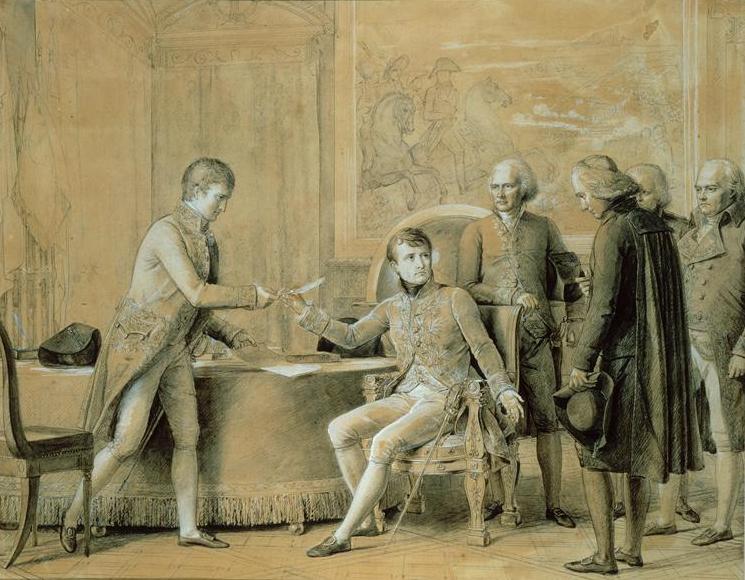
The Concordat of 1801
He was no believer. He made peace with the Pope anyway — because France needed it, and because peace on his terms was power.
The problem
The Revolution had made war on the Catholic Church for a decade: church lands nationalized, the Civil Constitution of the Clergy (1790) turning priests into elected state officials, the schism between “juring” and “non-juring” clergy, dechristianization, and in the west the bloody Vendée revolt — a religious civil war. By 1800 Napoleon, then First Consul, understood what the ideologues had not: most French people were Catholic, and no regime could be stable while at war with their faith.
He opened negotiations with the Vatican in June 1800. His reported remark to his brother Lucien in April 1801 gives the unvarnished motive:
“Skillful conquerors have not got entangled with priests. They can both contain them and use them.”
Label: reported — the remark is cited in the standard histories of the Concordat (via the secondary literature) without a primary-source trail. It is entirely in character, which is not the same as documented.
The negotiation
Napoleon insisted the talks happen in Paris, where the papal envoys would be isolated. His negotiators were his brother Joseph Bonaparte, the councilor of state Emmanuel Crétet, and the theologian Étienne-Alexandre Bernier. Pope Pius VII sent his Secretary of State Cardinal Ercole Consalvi, Cardinal Giuseppe Spina, and the theologian Father Carlo Caselli.
It was a bruising process — drafts drawn up, rejected, rewritten; at one point Napoleon sent an ultimatum ordering his envoy to quit Rome and Murat’s troops to march on the city. Consalvi’s arrival in Paris broke the deadlock. The final text was signed at midnight on 15 July 1801 (26 Messidor, Year IX). Pius VII ratified it on 15 August; Napoleon on 8 September. The legislature approved it — together with the Organic Articles — on 8 April 1802, and it was solemnly promulgated at Notre-Dame on Easter Sunday, 18 April 1802.
The terms
The Concordat’s 17 articles were, as the 1911 Encyclopædia Britannica later put it, largely in the state’s favor — France wielded greater power vis-à-vis the Pope than the old regime ever had:
- Catholicism was recognized as “the religion of the great majority of French citizens” — pointedly not the established religion of the state.
- The Pope condoned the sale of confiscated church property — the biens nationaux stayed sold. In exchange, the state paid salaries to bishops and priests.
- The government nominated bishops; the Pope conferred canonical office. Parish priests were appointed by bishops subject to government approval.
- Dioceses were reorganized and reduced; seminaries could be re-established.
- Bishops swore an oath not to disturb the public tranquility.
In one stroke, the schism was healed, the purchasers of church land were secure, and the clergy became — in effect — salaried servants of the state.
The Organic Articles
Then Napoleon added the sting. Alongside the Concordat he promulgated the Organic Articles (8 April 1802) — 77 articles regulating Catholic worship and 44 for the Protestant churches — unilaterally, without papal agreement. They restated the old Gallican liberties (no papal bull could be published in France without government consent, no council held without permission) and tightened state control over every aspect of church life. The Pope never accepted them; they were never canonically binding. They were the law of France for a century anyway.
The legacy
The Concordat was the organic law of the French Catholic Church for a hundred years, until the 1905 law separating church and state formally denounced it. (It remains in force in Alsace-Moselle, which was German territory in 1905 — a living fossil of Napoleon’s settlement.) It ended the religious civil war, reunited the clergy, and won Napoleon the loyalty of Catholic France — at the price, his enemies said, of selling the Revolution’s principles to Rome, and Rome’s independence to the state. Both charges were true enough to sting.
Source notes
- Documented: the signing (midnight, 15 July 1801), the ratifications (15 August and 8 September 1801), the legislative approval (8 April 1802), the Easter promulgation (18 April 1802), the negotiators on both sides, the Organic Articles’ unilateral character, and the 1905 denunciation are matters of the diplomatic and legislative record.
- Reported: the Lucien remark (April 1801) is cited via the secondary literature without a primary source; the negotiation drama (ultimatums, drafts burned and rewritten) follows the standard histories.
- Quoted: the Concordat’s “religion of the great majority” formula is the treaty’s documented wording (in translation).
- Image: François Gérard, The Signing of the Concordat between France and the Holy See, 15 July 1801 — public domain (artist died 1837). Provenance: the image credits on this page.