Biography
From a Corsican schoolboy to the master of Europe to a prisoner on St. Helena: the life of Napoleon Bonaparte, told straight.
The Corsican years (1769–1789)
Napoleone di Buonaparte was born on 15 August 1769 in Ajaccio, Corsica — the second surviving son of Carlo Buonaparte, a Corsican lawyer, and Letizia Ramolino. Corsica had passed from Genoa to France only in 1768–69, a fact that shaped his whole life: he grew up French by conquest in a family that had briefly sided with Corsican independence under Pasquale Paoli. As a boy he spoke Corsican and Italian; French remained a second language he never fully mastered in accent, though he wrote it at relentless volume.
In 1779 he was sent to the military school at Brienne, then in 1784 to the École Militaire in Paris — a charity scholarship boy among aristocrats, mocked for his accent and his poverty, which he repaid with ferocious study of mathematics and artillery. He graduated in September 1785 as a sous-lieutenant of artillery, aged sixteen.
The Revolution makes him (1789–1799)
The Revolution of 1789 gave a penniless outsider what the old regime never would: a career open to talent. Bonaparte threw himself at the new order — first as a Corsican patriot, then, after breaking with Paoli, as a Jacobin officer. His sister Elisa’s husband aside, almost everything he had came from the Revolution.
Two moments made him:
- Toulon, December 1793. The port had risen against the Republic; the young artillery captain devised the plan to take the heights commanding the harbor. Toulon fell. He was 24, and a brigadier general. See Campaigns.
- 13 Vendémiaire (5 October 1795). Royalists rose in Paris; Bonaparte, given command of the Convention’s defense, cleared the streets with cannon — the famous “whiff of grapeshot.” The Directory owed him its survival, and he collected the debt: command of the Army of Italy.
The Italian campaign of 1796–97 made him famous across Europe: fast, daring, and — crucially — a brilliant publicist of his own victories. His proclamations to the army were reprinted in Paris. By 1797 he was negotiating treaties (Campo Formio) like a head of state, while still a general of the Republic.
Egypt (1798–99) was grander and stranger: an invasion of Egypt that won the Battle of the Pyramids, lost its fleet to Nelson at the Nile, stalled at Acre, and ended with Bonaparte abandoning his army to return to a France in political crisis. It was a military failure and a propaganda triumph — he arrived home a hero anyway.
On 18 Brumaire (9 November 1799) he overthrew the Directory in a coup that was part conspiracy, part farce (he nearly talked himself into arrest in the Council of Five Hundred before his brother Lucien saved the day). The Constitution of Year VIII made him First Consul — in effect, dictator, but a dictator who submitted his constitution to a plebiscite and won it.
The Consul rebuilds France (1799–1804)
The Consulate was Napoleon’s most constructive period, and the part of his legacy that survived him longest. With the war against the Second Coalition ended by Marengo (14 June 1800) and the Treaty of Amiens (1802), he had a breathing space — and used it:
- The Civil Code (1804) — the Napoleonic Code: equality before the law, property rights, secular civil marriage, and (the dark side) the legal subordination of women and the reintroduction of slavery in the colonies in 1802.
- The Concordat (1801) — peace with the Catholic Church after a decade of religious war, on the state’s terms.
- The Bank of France (1800), the franc germinal, the lycées, the prefectoral administration — the machinery of the modern French state, much of it still recognizable.
In 1802 he had himself made First Consul for life; in May 1804 the Senate proclaimed him Emperor. On 2 December 1804, in Notre-Dame, he took the crown from the hands of Pope Pius VII and placed it on his own head.
The Emperor at war (1804–1812)
For a decade Napoleon fought what amounted to a rolling war against shifting coalitions financed and organized, again and again, by Britain. The pattern: a coalition forms, he destroys its armies in a single campaigning season, he imposes a harsh peace, the peace breeds resentment, a new coalition forms.
The peaks: Ulm and Austerlitz (1805) — the Grande Armée’s masterpiece, the “Battle of the Three Emperors,” 2 December 1805, exactly a year after the coronation. Jena-Auerstedt (1806) — Prussia’s army shattered in a single day; Napoleon entered Berlin. Friedland and Tilsit (1807) — Russia’s Tsar Alexander I became, briefly, his ally and admirer.
The costs mounted underneath the victories. The Continental System (from 1806) tried to strangle British trade and strangled Europe’s economy instead. The Peninsular War (from 1808) — “the Spanish ulcer,” as he later called it — bled a quarter-million French soldiers into Spain and Portugal for six years. The invasion of Russia in 1812 was meant to force Alexander back into the blockade; instead it destroyed the Grande Armée. See Campaigns.
At the empire’s height (1811–1812) he ruled or dominated most of continental Europe, had divorced Joséphine and married Marie Louise of Austria, and had a son and heir, the King of Rome (born 20 March 1811). It looked permanent. It lasted months.
The fall (1812–1815)
The Russian disaster broke the spell. In 1813 a new coalition — Russia, Prussia, Austria, Sweden, Britain — beat him at Leipzig, the “Battle of the Nations” (16–19 October 1813), the largest battle in European history to that point. In 1814 the allies invaded France itself; Napoleon fought a brilliant, hopeless defensive campaign with raw conscripts, and in April 1814 he abdicated at Fontainebleau. He was exiled to the island of Elba, off Tuscany — emperor of a toy kingdom.
On 1 March 1815 he landed in southern France with a thousand men. The army sent to stop him joined him instead. Louis XVIII fled; Napoleon entered Paris on 20 March — the Hundred Days. The allies declared him an outlaw. On 18 June 1815, at Waterloo, Wellington’s Anglo-allied army and Blücher’s Prussians destroyed the Armée du Nord. Four days later he abdicated again. He surrendered to the British — hoping, vainly, for asylum in England — and was shipped to St. Helena, a volcanic rock in the South Atlantic, in October 1815.
St. Helena (1815–1821)
He spent his last five and a half years at Longwood House, dictating memoirs, quarreling with his British governor, and crafting the story of his life. The Mémorial de Sainte-Hélène — Emmanuel de Las Cases’s record of their conversations — became the founding text of the Napoleonic legend: Napoleon as the liberal martyr, the Revolution’s heir betrayed by kings.
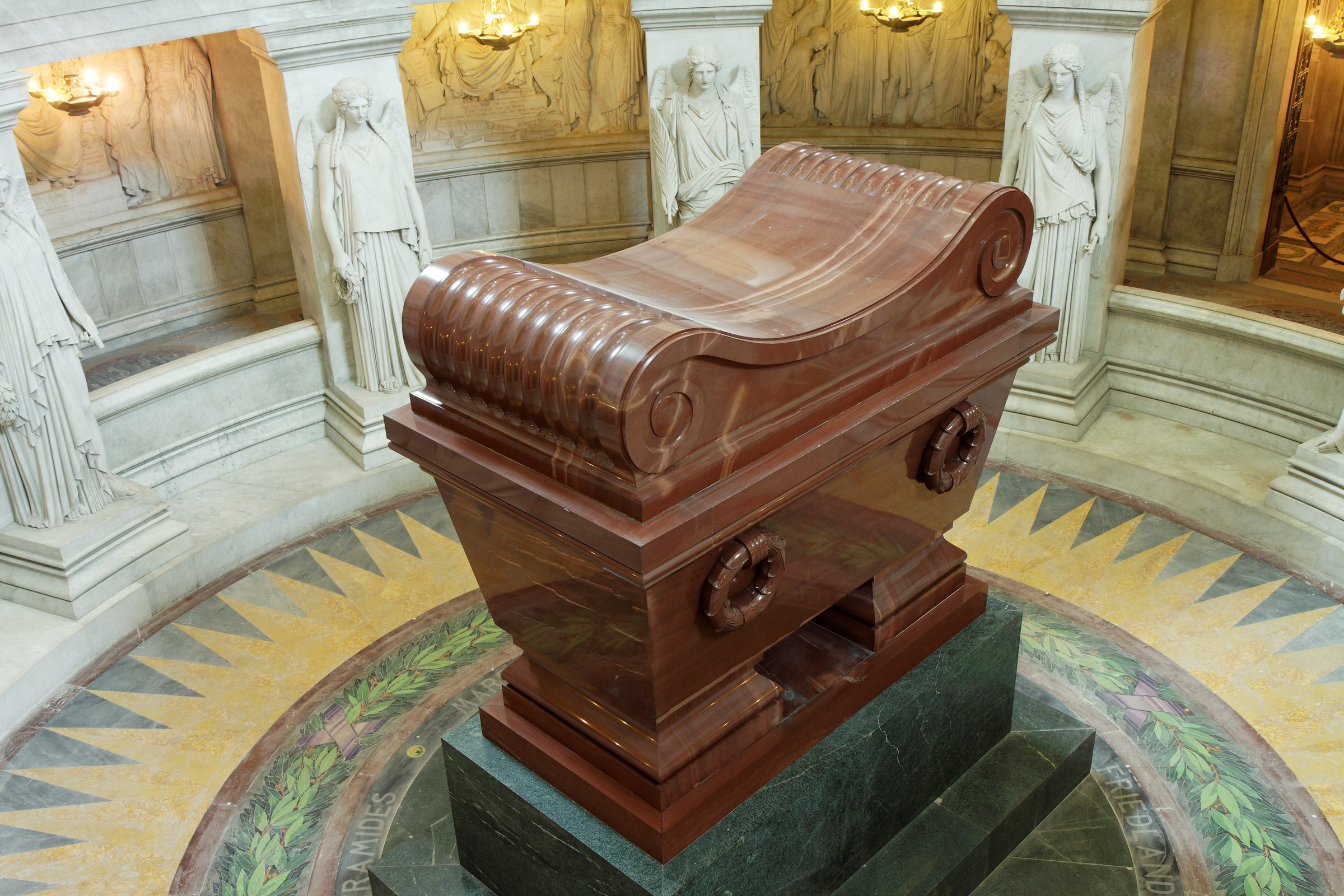
He died on 5 May 1821, aged 51. The autopsy concluded stomach cancer — a finding consistent with his father’s death from the same disease and with the symptoms recorded by his doctors. (Theories of arsenic poisoning circulated for decades; modern analysis of his hair has not sustained them — see Legend vs. Scholarship.) In 1840 his remains were returned to France and eventually entombed under the dome of Les Invalides, where they lie today.
Source notes
- Documented (primary sources): dates of birth, military appointments, the coup, the coronation, the abdications, and the death are fixed by civil records, official acts, and the Correspondance de Napoléon Ier (the published correspondence, 32 volumes). The reintroduction of slavery (law of 20 May 1802) and the Civil Code are matters of the official record.
- Reported (contemporary accounts): details of the Italian campaign’s proclamations, the 18 Brumaire confusion, and the St. Helena years rest on memoirs — Las Cases’s Mémorial, Montholon, Gourgaud — which are partisan and sometimes contradictory. The page follows them only where multiple witnesses agree.
- Open questions: the exact circumstances of his decision to abandon the Army of Egypt (August 1799) and the precise medical history behind the 1821 death are discussed on Legend vs. Scholarship. Nothing disputed is stated here as settled.
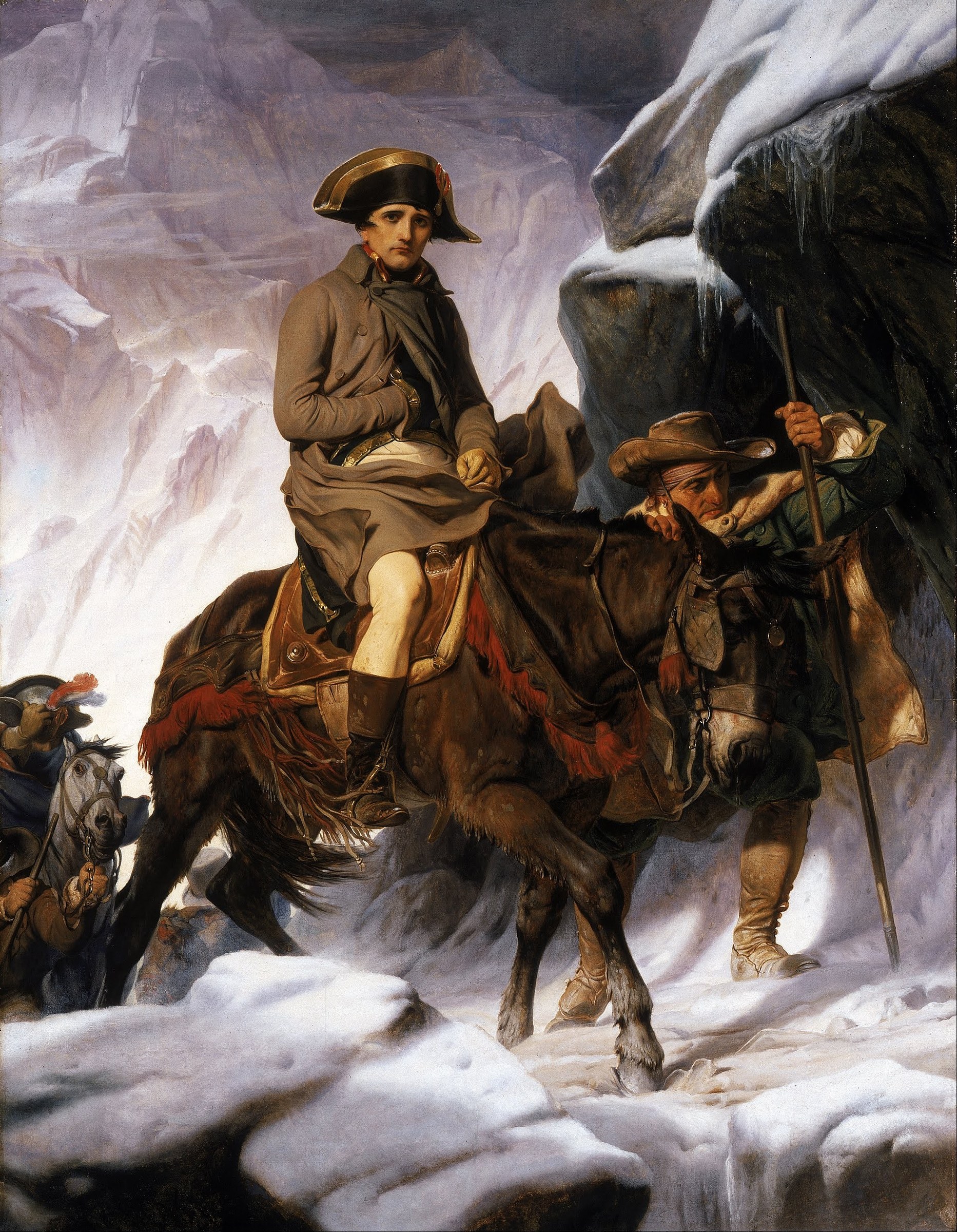
- Portraits: the Delaroche Bonaparte Crossing the Alps (1848–50) is a 19th-century revision of the legend, not a contemporary record — captioned as such above. David’s versions were official propaganda of the Consulate.
- Image provenance for both figures: the image credits on this page.