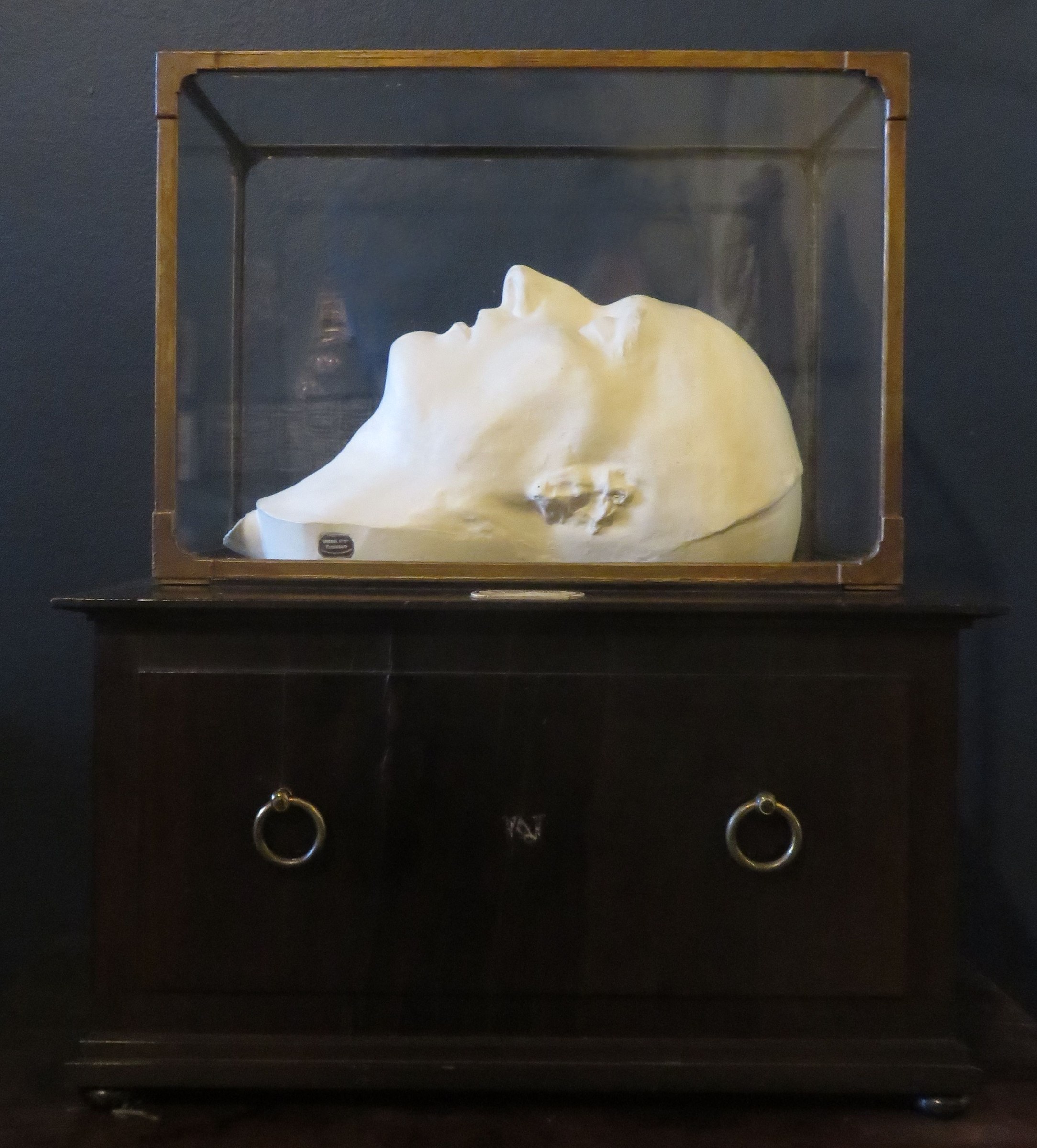
The Death Controversy: Cancer or Poison?
The official finding was stomach cancer. The alternative theory — murder by arsenic — has been tested, retested, and argued for sixty years. Here is the evidence, both sides, with nothing hidden.
What the autopsy found
Napoleon died at Longwood House on 5 May 1821. The next day his physician Francesco Antommarchi — in the presence of seven British surgeons and ten of Napoleon’s French followers — conducted the post-mortem. The report is the single most important document in this controversy:
“An ulcer which penetrated the coats of the stomach was discovered one inch from the pylorus sufficient to allow the passage of the little finger. The internal surface of the stomach to nearly its whole extent was a mass of cancerous disease, or hard tumorous portions advancing to cancer… The stomach was found nearly filled with a large quantity of fluid, resembling coffee grounds…”
The doctors concluded stomach cancer, possibly arising from the ulcer. Two facts support the finding:
- His father, Carlo Buonaparte, died of stomach cancer — a documented family history.
- In 2007, a clinical study (Lugli and colleagues) compared Antommarchi’s detailed autopsy description against modern pathological criteria for gastric cancer and found the findings consistent with advanced gastric cancer — including the “coffee grounds” fluid (digested blood) typical of a bleeding gastric lesion.
On the day before his death he had been given a large dose of calomel (mercurous chloride, a mercury compound then used as a purgative) — a medical intervention that modern physicians note would have worsened a bleeding stomach, whatever the underlying disease. Label: documented (the administration of calomel is in the medical accounts; its contribution is a modern medical judgment).
The arsenic theory
The poisoning case begins with a Swedish dentist. Sten Forshufvud read Louis Marchand’s published memoirs in 1952, recognized in Napoleon’s reported symptoms what he believed were signs of arsenic poisoning, and set out to prove it. Locks of Napoleon’s hair — cut by Marchand after the death and widely distributed as keepsakes — were available to test.
In 1961, Forshufvud, with Glasgow forensic scientist Hamilton Smith and Anders Wassen, published hair-analysis results showing high levels of arsenic, and argued Napoleon had been slowly poisoned over months. The suspected poisoner, in Forshufvud’s telling, was General de Montholon, the head of the Longwood household — who had means, opportunity, and (in this theory) motive.
Variations followed: the arsenic was in the wallpaper at Longwood (the damp walls, the theory went, let mould convert arsenic dyes into toxic gas — “Gosio’s disease,” popularized by a 1980s BBC investigation); it was in his wine; it was administered as medicine. The well-preserved state of the body at the 1840 exhumation was cited as corroboration — arsenic preserves tissue.
The counter-evidence
The arsenic case has been steadily deflated by later science:
- Arsenic was everywhere in the 19th century. In 2008, chemists J. Thomas Hindmarch and John Savory reviewed the evidence and concluded the hair findings proved nothing criminal: arsenic was in rodenticides, insecticides, clothing dyes, face and hair powders — and Napoleon used hair powder — candy wrappers, and the era’s medicines (Fowler’s Solution, an arsenic tonic, was widely prescribed).
- The hair of the King of Rome matched. Physicist Ettore Fiorini’s team (Italy’s National Institute of Nuclear Physics, Milan-Bicocca, 2008) measured arsenic in Napoleon’s hair across his life and found levels comparable to those in his son’s hair at various life stages — consistent with chronic environmental exposure, not a poisoning campaign. Their conclusion: the concentrations were far below what a criminal poisoning would require (they put the criminal threshold around 45 ppm), and the variation along single hairs indicated steady environmental exposure.
- The symptoms fit cancer better than poisoning. The autopsy is a primary document; the hair is not — its chain of custody across two centuries of collectors and auctions is unprovable.
Where the evidence points
The mainstream scholarly position: Napoleon died of stomach cancer, likely arising from a chronic ulcer, as the 1821 autopsy found — with the caveat that the calomel dose and a generally arsenic-rich environment may have hastened the end. The murder theory has produced no evidence that survives the environmental explanation, and no credible mechanism has been established for who would have poisoned him, how, and to what end (the British government wanted him alive and securely held, not martyred).
That said, the controversy is not quite closed: the full French medical records of the exile years are incomplete, Montholon’s papers have never fully explained his conduct, and the hair keeps being retested. What can be said with confidence:
- Documented: the autopsy report and its cancer finding; the father’s stomach cancer; the calomel dose; the 1961 hair results showing elevated arsenic; the 2007–2008 studies and their conclusions.
- Attributed/unproven: the Montholon murder theory; the wallpaper theory; the wine theory. None has a primary-source basis.
- Open: whether chronic low-level arsenic exposure (environmental or medicinal) contributed to the cancer or the decline. The science allows it; it does not establish it.
Source notes
- Primary document: the Antommarchi post-mortem report (6 May 1821), quoted above in the standard English rendering.
- Secondary/scientific: Forshufvud, Smith & Wassen’s 1961 hair analyses; Hindmarch & Savory’s 2008 review; Fiorini’s 2008 INFN presentation of hair-arsenic measurements; Lugli et al.’s 2007 clinical-pathological comparison (as summarized in the standard popular and educational accounts).
- Historical: Marchand’s memoirs (published 1950, the trigger for Forshufvud’s investigation); the 1840 exhumation accounts; the standard biographies for the family cancer history.
- Claims about motive (Montholon) are the poisoning theorists’ claims, presented as such — not as findings.
- Image: Napoleon’s death mask (Musée d’art et d’histoire, Geneva) — photograph by Rama, used under CC BY-SA 3.0 fr (via Wikimedia Commons). The mask is a cast of the dead face, not a portrait from life. Provenance: the image credits on this page.