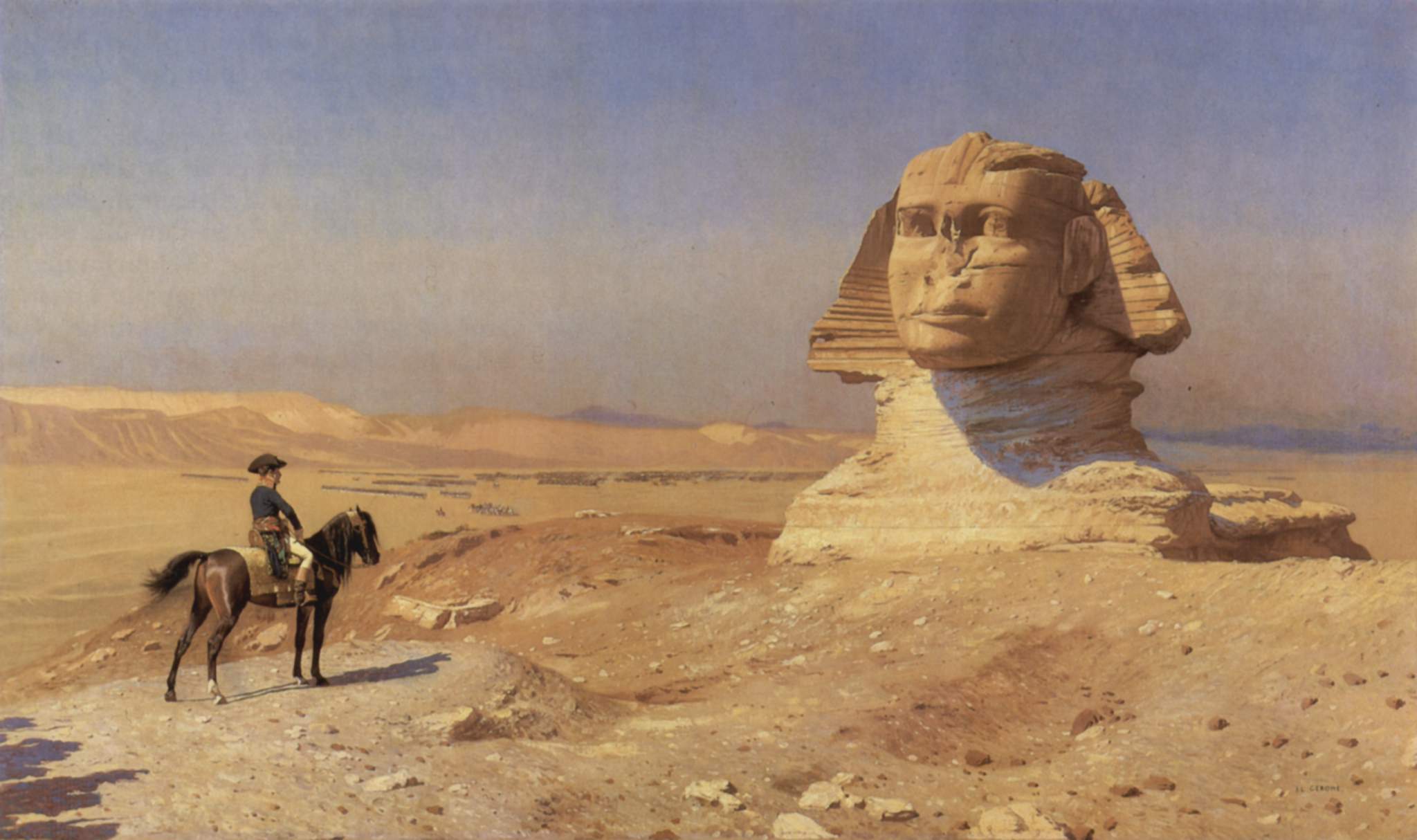
Egypt and the Savants
He invaded Egypt with an army and 167 scientists. The army came home defeated. The scientists came home with a new science.
The plan
In May 1798 — the same year he was elected to the Institut de France — Bonaparte sailed from Toulon with a scheme as audacious as it was half-formed: seize Egypt, threaten Britain’s route to India, and do it with an entourage no conqueror had ever brought before. The fleet carried roughly 34,000 troops and 167 members of the Commission des Sciences et des Arts — engineers, surveyors, cartographers, naturalists, chemists, astronomers, artists, printers, doctors, and musicians. The savants.
Landing on 1 July 1798, the army took Alexandria, and on 21 July 1798 defeated the Mamelukes at the Battle of the Pyramids — the occasion of his most famous reported battlefield line:
“Soldats ! Songez que du haut de ces pyramides, quarante siècles vous contemplent !” (“Soldiers! Remember that from the heights of these pyramids, forty centuries look down upon you!”)
Label: reported — no autograph text survives; the wording comes through the memoirs of those present. See Sayings.
The disaster
Then the expedition came apart, in the order disasters usually do:
- 1–3 August 1798: Nelson destroyed the French fleet at Aboukir Bay (the Battle of the Nile). The army was stranded.
- 1799: the Syrian campaign — Jaffa taken, the plague in the ranks, and Acre holding out against siege until the army turned back. (Gros would later paint the Jaffa plague visit as heroism; the campaign was a failure.)
- July 1799: the one accidental triumph — soldiers rebuilding Fort Julien near Rosetta found a basalt slab inscribed in three scripts: hieroglyphic, demotic, and Greek. The Rosetta Stone.
- 23 August 1799: Bonaparte abandoned the army and sailed for France, arriving in October to a country in political crisis — and a hero’s welcome anyway.
The abandoned army fought on under Kléber (assassinated in Cairo, June 1800) and Menou, and finally capitulated at Alexandria in 1801. Militarily, Egypt was a total loss: tens of thousands of men for nothing.
The science
But the savants had been working the whole time. On 22 August 1798 Napoleon founded the Institut d’Égypte in Cairo — organized in four sections (mathematics, physics, political economy, and arts) — and its members spent three years measuring, drawing, and cataloguing everything: temples and tombs at Thebes, Karnak, Luxor, Philae, Dendera; the flora and fauna; the irrigation, the crafts, the customs of the living Egyptians.
The results, published as the Description de l’Égypte (the imperial edition begun in 1809, appearing through 1829 in volumes of plates, maps, and essays), were the first systematic survey of ancient Egypt ever made — and they detonated Egyptomania across Europe. Vivant Denon’s Voyage dans la Basse et la Haute Égypte (1802), written from his sketches on the campaign, gave Europe its first accurate images of the monuments.
The Rosetta Stone itself went to London under the 1801 capitulation terms (it is in the British Museum), but copies circulated — and in 1822 the Frenchman Jean-François Champollion used them to crack hieroglyphic writing, proving the script mixed phonetic and symbolic signs. Modern Egyptology dates itself from that decipherment, and the decipherment from the stone, and the stone from the savants.
The verdict
Brian Fagan’s summary, in the journal Humanities, is the standard one and is quoted here because it cannot be improved: the expedition was “a disaster by military standards,” but its cultural legacies — the Rosetta Stone and the Description — “did much to popularize Egyptology.” Napoleon lost an army and founded a science. He would almost certainly have preferred it the other way round.
Source notes
- Documented: sailing (19 May 1798), landing (1 July 1798), the Pyramids (21 July 1798), the Nile (1–3 August 1798), the Institut d’Égypte (22 August 1798), the Rosetta Stone’s discovery (July 1799, Fort Julien), Bonaparte’s departure (23 August 1799), the 1801 capitulation, the Description’s publication run (1809–1829), and Champollion’s 1822 decipherment are all matters of the expedition’s records and the standard histories.
- Reported: the “forty centuries” address (see Sayings for the transmission note); the figure of 167 savants is the standard count (sources vary slightly around 150–167).
- Quoted: Fagan’s Humanities assessment is quoted as a historian’s judgment, not as a primary source.
- Image: Jean-Léon Gérôme, Bonaparte Before the Sphinx (1867–1868) — a 19th-century romantic imagining of the Egyptian campaign, painted seventy years after the event, not a contemporary record. Public domain (artist died 1904). Provenance: the image credits on this page.