Legend vs. Scholarship
How the legend was made — and what survives checking.
The legend and the man
No modern figure has been more mythologized than Napoleon — by his enemies while he lived, by his followers after his death, and by the internet ever since. This page separates the three layers: what the British invented, what Napoleon invented about himself, and what the scholarship now holds.
Myths from his enemies
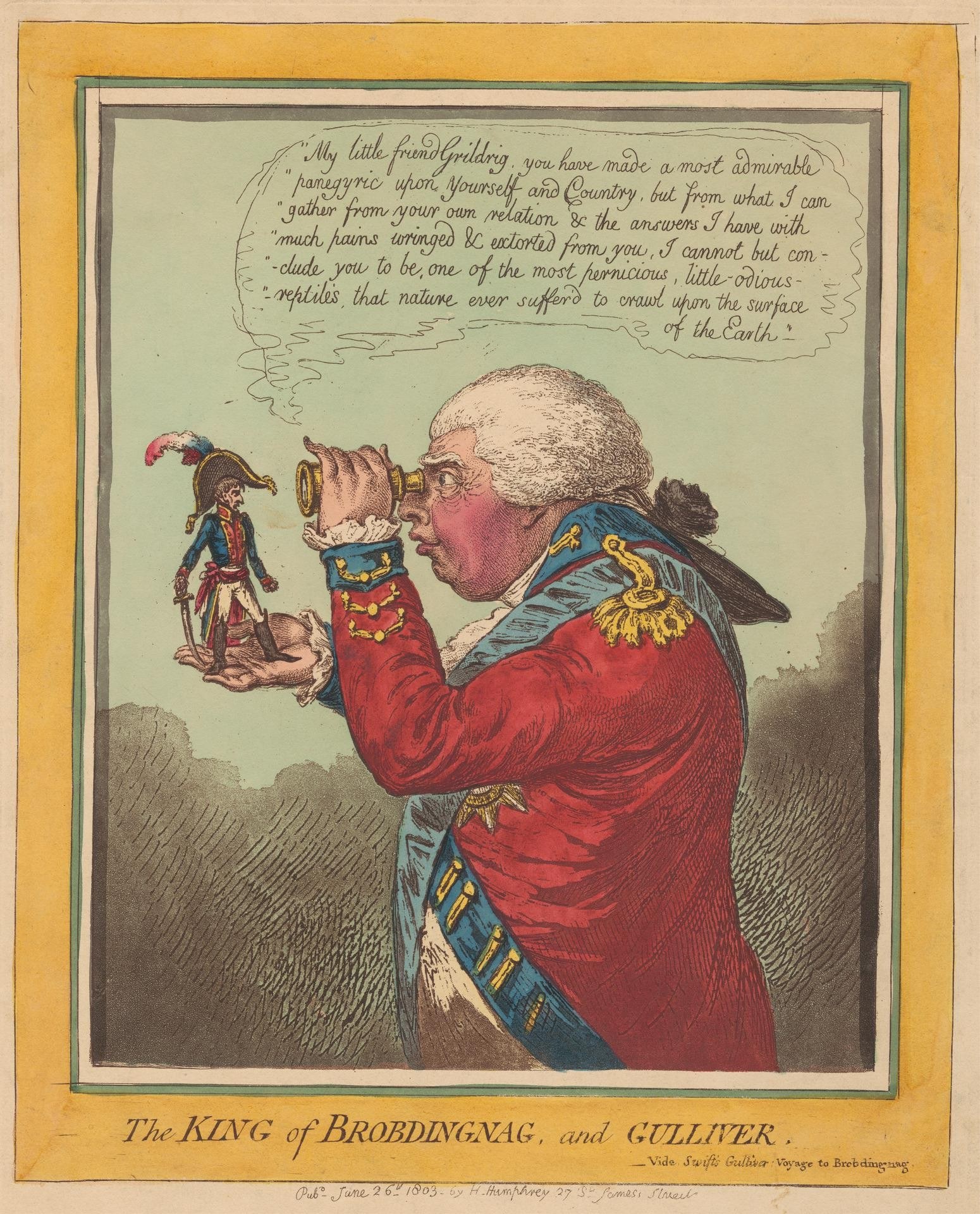
He was short
The most durable myth of all, and the easiest to kill. At his death Napoleon was recorded as 5 feet 2 inches — in French inches (pouces), which are longer than English inches. Converted, that is about 1.69 meters: roughly 5′6″–5′7″, squarely average for a Frenchman of his generation. His valet’s measurements and the autopsy record agree.
Why does everyone “know” he was tiny? Three reasons: British caricaturists (Gillray and Rowlandson drew him as a miniature tantrum-thrower for twenty years), the French/English inch confusion repeated by lazy writers, and the Imperial Guard — he surrounded himself with exceptionally tall guardsmen, so he looked short by comparison. The “Napoleon complex” is a psychological term built on a measurement error.
He kept his hand in his coat to hide a stomach ailment
A popular modern theory (ulcer, cancer pain). The truth is duller: the hand-in-waistcoat was the standard dignified pose of the era — portraits of gentlemen routinely hid the bare hand, which was considered inelegant to display. Dozens of non-Napoleonic portraits use the same pose. It was fashion, not medicine.
Myths from Napoleon himself
The Mémorial: the autobiography as weapon
On St. Helena, Napoleon spent five years dictating his version of history. Emmanuel de Las Cases’s Mémorial de Sainte-Hélène (published from 1823) presented him as the Revolution’s heir and liberal martyr: the man who would have given Europe constitutions and peace if the kings had let him. It was brilliant, moving, and selective — the Terror, the reimposed slavery, the sacrificed armies are conspicuously absent.
The Mémorial sold enormously and shaped every 19th-century image of Napoleon, from Victor Hugo’s poetry to the return of his ashes in 1840. Modern historians treat it as what it is: a primary source for Napoleon’s self-image, not for the facts.
The bulletins: victory, always victory
The Grande Armée’s bulletins — Napoleon’s own dispatches, printed in the official press — reported victories in detail and defeats in euphemism. The 29th Bulletin, announcing the Russian disaster, is the famous exception: “The health of His Majesty has never been better” — the line that told France, between the lines, that the army was gone. Even his catastrophes were stage-managed.
What the scholarship holds
The general
The consensus is genuinely admiring and genuinely qualified. At the operational level — moving 200,000 men across Europe faster than anyone thought possible, the corps system, the concentration of artillery — he transformed warfare, and Austerlitz remains a staff-college staple. But modern historians stress what the legend omits: he repeatedly won battles and lost wars; his strategic judgment decayed as his power grew; Spain and Russia were unforced catastrophes; and his enemies learned — by 1813 the coalition simply refused to fight on his terms.
The ruler
Here the verdict is the most contested ground in Napoleonic studies, and this site does not pretend it is settled:
- The case for: the Civil Code, religious peace, administrative modernity, the end of feudal privilege across much of Europe, careers open to talent. Andrew Roberts’s Napoleon: A Life (2014) argues he was the Enlightenment’s last great statesman.
- The case against: the reimposition of slavery (1802), the police state, the censorship, the millions dead in wars of choice, the dynastic empire built on his relatives. The “liberal martyr” of the Mémorial does not survive the record of the Empire.
- The synthesis most historians now share: he was both — a modernizer whose modernity stopped at the limits of his power, and a conqueror whose conquests undid his reforms. The Code outlived the Empire; the Empire’s wars killed it in the cradle across half of Europe.
The death: cancer, not poison
The autopsy of 1821 concluded stomach cancer — consistent with his father’s death from the same disease and with the symptoms his doctors recorded. From the 1960s, claims of arsenic poisoning circulated (based on arsenic in his hair), spawning a small industry of murder theories. Modern analysis has not sustained them: the arsenic levels are consistent with 19th-century environmental exposure (wallpaper, wine, medicines), and the clinical picture matches gastric cancer. Scholarly consensus: natural death by stomach cancer. The poisoning theory is not supported by the evidence.
The “sleeping giant” and the other quotes
See Sayings: the majority of famous Napoleon quotations have no contemporary source. The legend manufactured his words as freely as his enemies manufactured his height.
How the legend lives now
Beethoven famously dedicated his Third Symphony to Bonaparte, then tore up the dedication when Napoleon crowned himself — the Eroica became “to the memory of a great man.” That gesture captures the whole 19th century: liberals adored the general of the Revolution and despaired of the Emperor.
Today the legend runs on two tracks: the serious historiography (Roberts, Dwyer, Bell, Zamoyski — see Sources), which argues over the ruler’s verdict while agreeing on the facts; and the internet folklore of fake quotes and the “short angry man,” which this site exists to correct. Both are receptions of Napoleon. Only one of them is history.
Source notes
- Height: the 5′2″ French measurement is from the autopsy/death records; the 1.69 m conversion is the standard scholarly figure. The Gillray print (1803) is reproduced above as the myth’s visual source.
- Hand in waistcoat: the pose’s conventional status is documented in art-historical literature on 18th–19th-century portraiture.
- Mémorial: Las Cases’s text is the source for the legend’s content; the characterization of it as selective follows the modern scholarly consensus.
- 29th Bulletin: the “health of His Majesty” line is the bulletin’s documented closing.
- Death: the autopsy conclusion (stomach cancer) is the documented contemporary finding; the arsenic debate and its resolution follow the published forensic literature. The consensus is stated as consensus.
- Beethoven: the Eroica dedication story is the standard account (the manuscript dedication page, violently erased, survives).
- Historians named are real scholars with real books — full citations on Sources.