Campaigns
Five campaigns that made and unmade him — told factually, without glory.
A note on tone
These are accounts of organized violence. The page reports what happened — movements, decisions, outcomes — without celebrating it. Casualty figures are historians’ estimates and are labeled as such; where sources disagree, the range is given.
Toulon, 1793 — The siege that made a general
In the summer of 1793 the great naval port of Toulon rose against the revolutionary government and handed itself to the British. The Republic’s besieging army was badly led — until a 24-year-old artillery captain, Napoleone Buonaparte, arrived and argued that the key was not the town but the heights and forts commanding the harbor: take those, and the British fleet could not stay.
The plan was adopted. On the night of 16–17 December the French stormed the key redoubt; the British evacuated, burning the arsenal as they went. Toulon fell on 19 December. Bonaparte was promoted to brigadier general — the first time his name registered in Paris.
What mattered: not the scale of the action, but the demonstration of a method — massed artillery, careful reconnaissance, the decisive point — that he would repeat for twenty years.
Austerlitz, 2 December 1805 — The masterpiece
After the disaster of Trafalgar at sea (October 1805), Napoleon turned the Grande Armée — some 200,000 men marched from the Channel coast to the Danube in weeks — against Austria and Russia. At Ulm in October he surrounded an entire Austrian army and forced its surrender without a pitched battle.
At Austerlitz, in Moravia, he faced the emperors of Austria and Russia with about 68,000 men against their 85,000–90,000. He deliberately weakened his right flank to tempt the Allies into attacking it, hid a massive reserve behind the center, and when the Allied center thinned to exploit the apparent weakness, smashed through it. The Allied army disintegrated; commonly cited estimates put Allied losses around 25,000–27,000 killed, wounded, and captured against roughly 9,000 French.
The result: Austria sued for peace (Pressburg), the Holy Roman Empire was effectively dissolved the next year, and Napoleon’s reputation as an unbeatable commander was sealed. It was also the battle he chose to commemorate forever — fought on the first anniversary of his coronation, and the date he returned to obsessively in later years.
Jena-Auerstedt, 14 October 1806 — Prussia destroyed in a day
Prussia, alarmed by French domination of Germany, issued an ultimatum and mobilized. Napoleon struck first. In a single day, two battles — Jena and nearby Auerstedt, fought simultaneously by separate French corps — shattered the Prussian army. Commonly cited estimates: Prussian losses around 25,000–40,000 killed, wounded, and captured, against French losses of roughly 5,000–10,000. The Prussian state, Frederick the Great’s army, simply ceased to function as a military power.
Napoleon entered Berlin on 27 October. From Berlin he issued the decree establishing the Continental System — the attempt to close all of Europe to British trade. It was meant to strangle Britain; over the following years it strangled the economies of his own satellites and allies instead, and the effort to enforce it dragged him into Spain and then Russia.
Russia, 1812 — The catastrophe
The invasion of Russia was the largest military operation of its age. On 24 June 1812 the Grande Armée — roughly 600,000 men, French plus allied and satellite contingents — crossed the Niemen. The Russians refused the decisive battle Napoleon wanted, trading space for time and drawing him deeper.
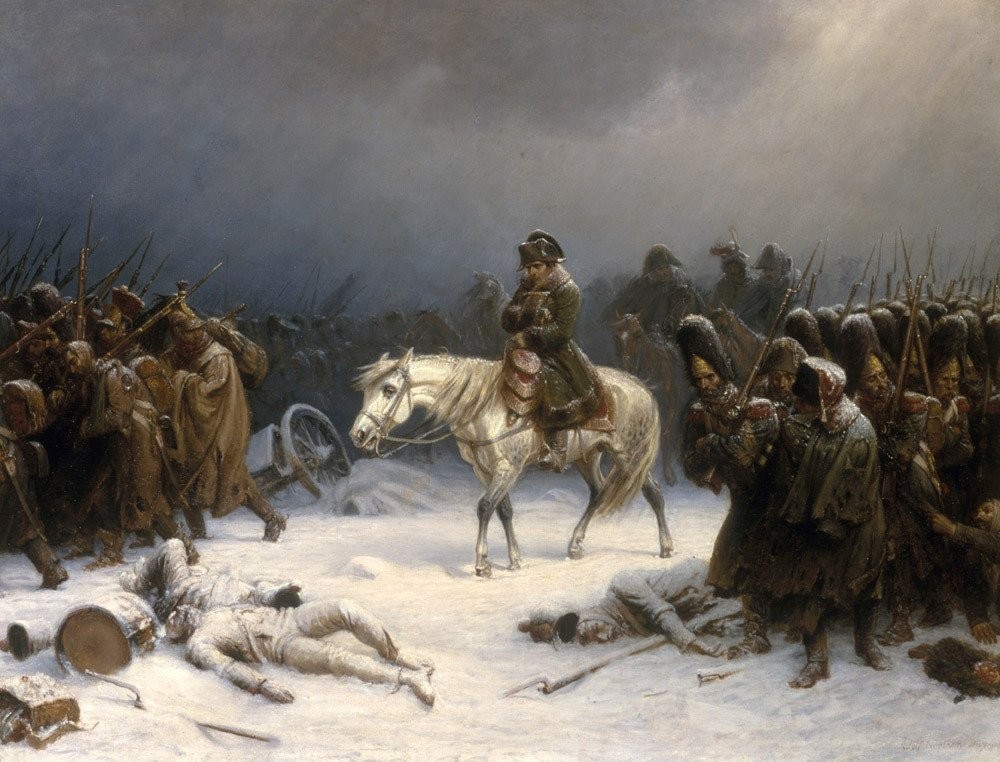
At Borodino (7 September), 120 kilometers from Moscow, the Russians finally stood: a day of frontal slaughter — commonly estimated at 70,000 total casualties — after which the Russians withdrew in order. Napoleon entered Moscow on 14 September to find it burning; Alexander would not negotiate. On 19 October the retreat began, through a Russian winter, with Cossacks harrying the columns and the Berezina crossing (26–29 November) becoming a byword for disaster.
Commonly cited estimates say fewer than 100,000 of the roughly 600,000 who marched in ever marched out; the Guard’s survivors straggled across the Niemen in December. The numbers are debated — disease and desertion killed as many as combat — but the scale of the catastrophe is not. The myth of the “General Winter” is only half the story: the campaign was lost by logistics, distance, and the Russian refusal to be beaten on Napoleon’s terms before the snow ever fell.
Waterloo, 18 June 1815 — The end
The Hundred Days gave Napoleon one last army — the Armée du Nord, about 72,000 men — against the allies gathering in Belgium: Wellington’s Anglo-allied army (~68,000) and Blücher’s Prussians (~50,000, arriving late). Napoleon’s plan was sound in outline: strike between them, beat each separately.
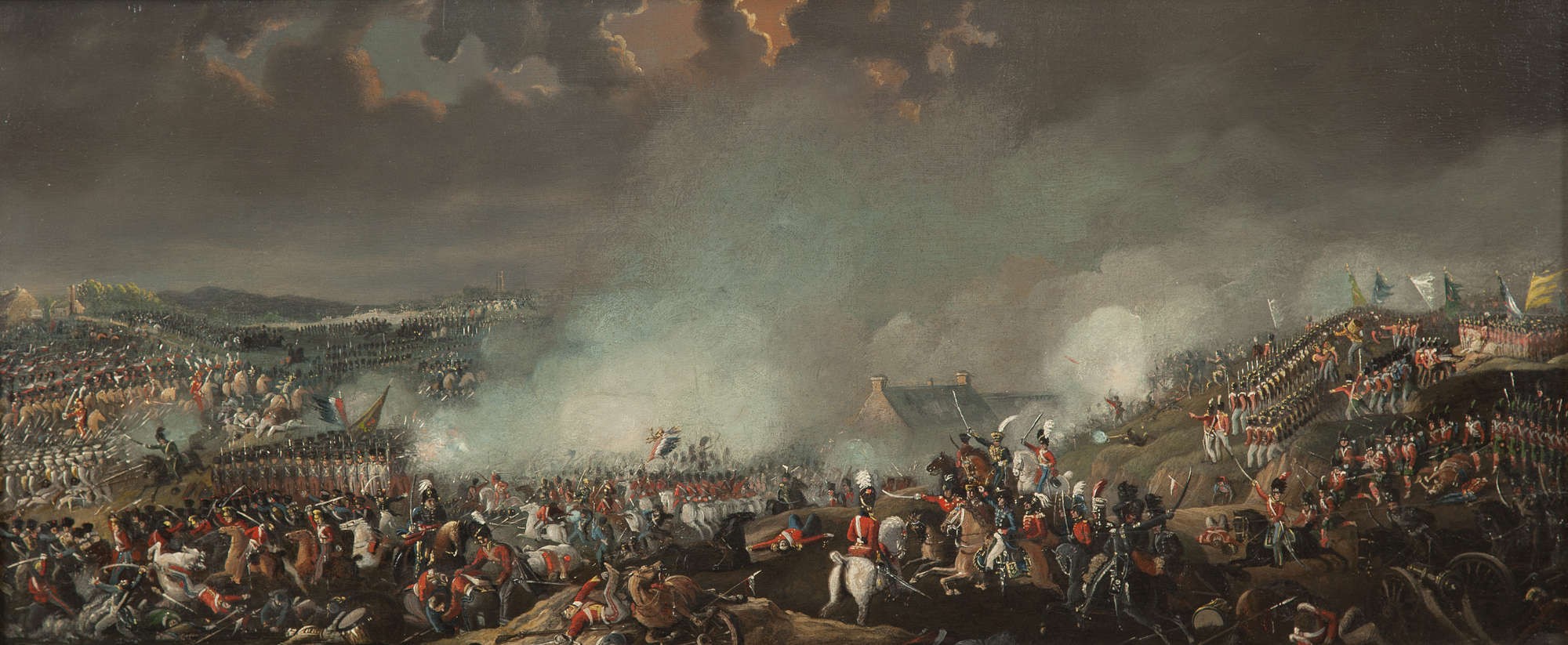
On 16 June he fought the Prussians at Ligny and drove them back, while Ney held Wellington at Quatre Bras. But the Prussians retreated in good order toward Wavre rather than away from the battlefield — the hinge of the whole campaign. On 18 June, at Waterloo, Napoleon attacked Wellington’s ridge position frontally, delayed by rain-soaked ground, while Grouchy’s detached corps chased the Prussians in the wrong direction. In the late afternoon the Prussians began arriving on the French right; the Guard’s final attack failed; the army broke.
Commonly cited estimates: French losses around 25,000 killed and wounded plus some 8,000 captured; Allied losses around 23,000. Four days later Napoleon abdicated for the second time. It was not his largest battle or his worst defeat by numbers — but it was the last.
Source notes
- Strengths and losses: all figures above are the commonly cited estimates from standard military histories; they vary between sources and are given as ranges where disagreement is material. No precise figure should be treated as exact.
- Narrative sources: the campaign accounts follow the standard modern histories (see Sources); Napoleon’s own bulletins are propaganda documents and are not used for casualty claims.
- Dates: Gregorian throughout; battlefield dates are the conventional ones. See Methodology.
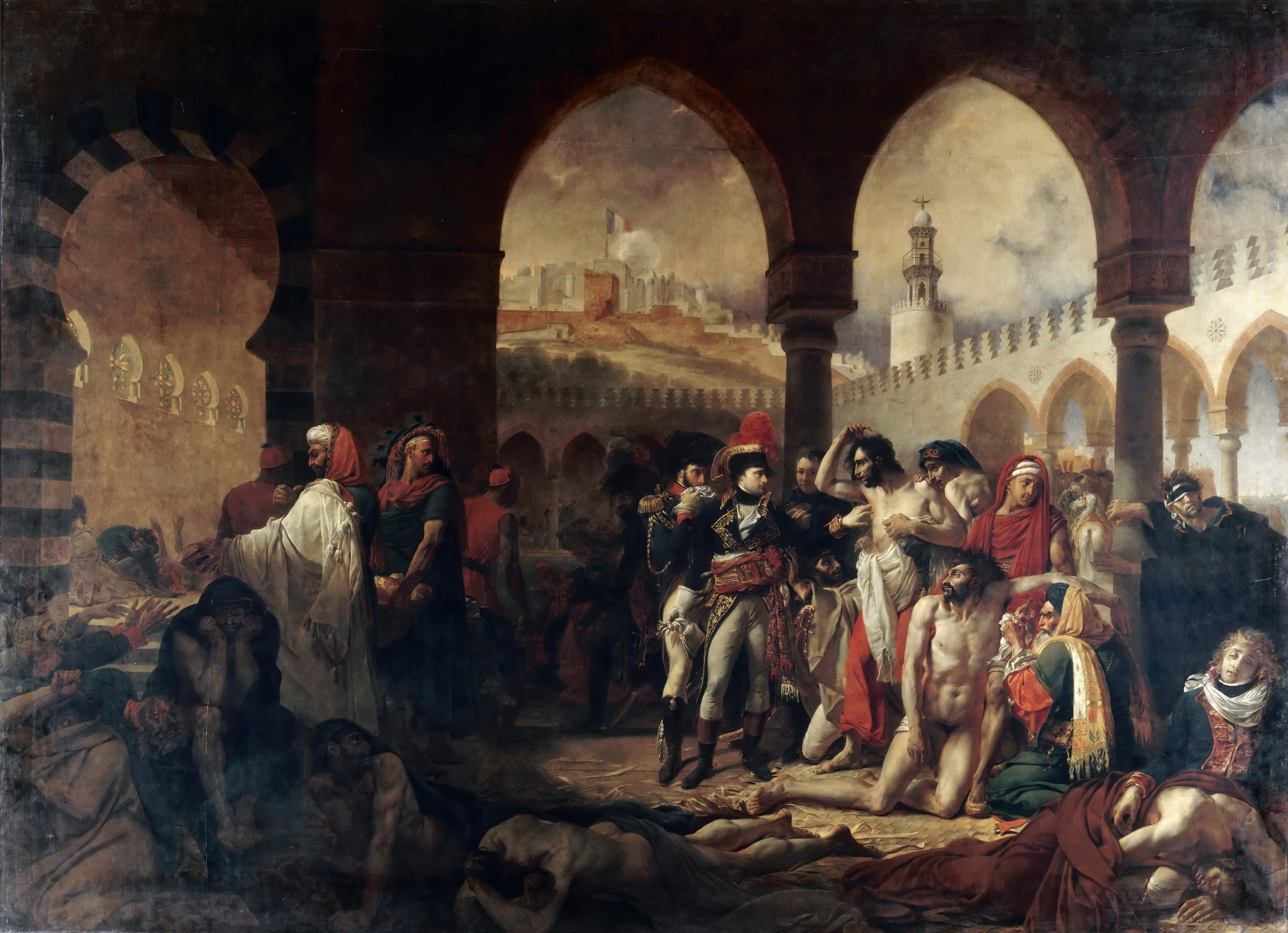
- Images: Gros’s Jaffa (1804) is Consulate-era propaganda; Northen’s Retreat is a 19th-century retrospective; Sadler’s Waterloo is a contemporary commercial panorama. Each is captioned with its status. Provenance: the image credits on this page.