Timeline
Twenty dated events from 1809 to 1922. Each carries a certainty label: certain, approximate, or disputed — because the record is uneven and honesty requires saying so.
1809 — Born in Kentucky certain
February 12, 1809: born in a log cabin on Sinking Spring Farm, near Hodgenville, Kentucky (then Hardin County, now Larue County), to Thomas Lincoln and Nancy Hanks Lincoln.
1818 — His mother dies certain
Nancy Hanks Lincoln dies of “milk sickness” (tremetol poisoning) in Indiana. Thomas Lincoln marries Sarah Bush Johnston in 1819.
1832 — Black Hawk War certain
Lincoln serves as an elected militia captain in the Black Hawk War; he sees no combat. He later joked that his military record consisted of bloody struggles with mosquitoes.
1834 — Elected to the Illinois legislature certain
Elected as a Whig; serves four terms. Admitted to the Illinois bar in 1836.
1842 — Marries Mary Todd certain
November 4, 1842: marries Mary Todd in Springfield, Illinois. Four sons follow: Robert (1843), Edward (1846), William (1850), Thomas “Tad” (1853).
c. 1846 — Earliest known photograph approximate
A daguerreotype attributed to Nicholas H. Shepherd, dated c. 1846–1847 — the earliest known photograph of Lincoln, taken around his election to Congress.
1846 — Elected to Congress certain
Elected to the U.S. House of Representatives; serves one term (1847–1849), opposing the Mexican War.
1854 — The Peoria speech certain
October 16, 1854: a three-hour speech at Peoria against the Kansas-Nebraska Act — Lincoln’s political comeback and his return to the slavery-extension fight.
1858 — The Lincoln-Douglas debates certain
Seven debates with Stephen A. Douglas, August 21 – October 15, 1858, for the Illinois Senate seat. Douglas wins the seat; Lincoln wins national attention. See the deep dive.
1860 — Cooper Union; nominated; elected certain
February 27: the Cooper Union address in New York. May 18: nominated for president by the Republicans at Chicago on the third ballot. November 6: elected with ~40% of the popular vote in a four-way race. Late 1860: grows the beard, after a widely reported exchange of letters with 11-year-old Grace Bedell (her letter October 15, 1860; his reply October 19).
1861 — First Inaugural; Fort Sumter certain
March 4: First Inaugural Address (“the better angels of our nature”). April 12–13: Confederates bombard Fort Sumter; the war begins.
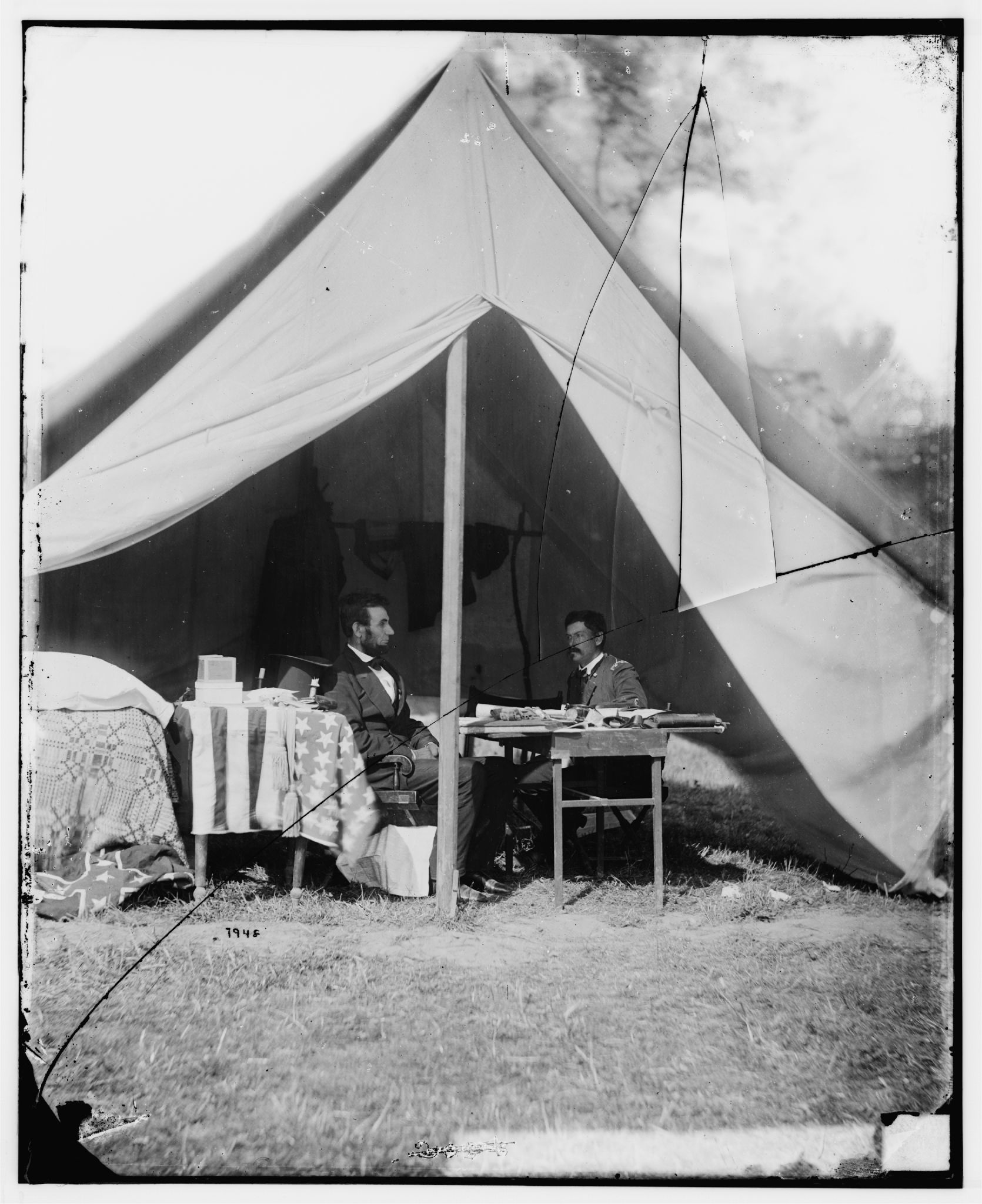
1862 — Antietam; the Preliminary Proclamation certain
September 17: Antietam — the bloodiest single day of the war. September 22: Lincoln issues the Preliminary Emancipation Proclamation, warning that slaves in rebellious states will be freed January 1, 1863. (The document photograph on this site shows this preliminary proclamation — see the Emancipation deep dive.)
1863 — Emancipation; Gettysburg certain
January 1: the final Emancipation Proclamation takes effect. July 1–3: Gettysburg. November 19: the Gettysburg Address — in five manuscript versions (see the deep dive).
1864 — Re-elected certain
November 8: re-elected over Democrat George B. McClellan, carrying the soldier vote decisively. Sherman takes Atlanta (September), sealing the political result.
1865 — Second Inaugural; Richmond; Appomattox certain
March 4: the Second Inaugural Address. April 3: Richmond falls; Lincoln walks the Confederate capital on April 4. April 9: Lee surrenders at Appomattox Court House.
1865 — Assassinated certain
April 14: shot by John Wilkes Booth at Ford’s Theatre during Our American Cousin; dies at 7:22 a.m., April 15, in the Petersen House. See the assassination and the conspiracy.
1865 — The conspirators hanged certain
July 7, 1865: four conspirators — Mary Surratt, Lewis Powell, David Herold, George Atzerodt — are hanged after trial by military commission. Booth had been killed April 26 at Garrett’s farm in Virginia.
1865 — Thirteenth Amendment ratified certain
December 6, 1865: the Thirteenth Amendment, abolishing slavery, is ratified — eight months after Lincoln’s death, completing the work he pushed through Congress in January.
1922 — The Lincoln Memorial dedicated certain
May 30, 1922: the Lincoln Memorial is dedicated in Washington, D.C. — the marble man, consecrated (see Lincoln mythology).
Disputed: the exact wording of the Gettysburg Address as delivered disputed
No full contemporary transcript of the spoken address survives; newspaper reports differ. The five manuscript copies Lincoln wrote out afterward (Nicolay, Hay, Everett, Bancroft, Bliss) differ slightly from one another. This site prints the Bliss copy as the standard text and notes the variants — see the deep dive.
Source notes
- Dates follow The Collected Works of Abraham Lincoln and the standard chronologies (Library of Congress, National Park Service). Certainty labels are this site’s editorial judgment: “certain” for multiply-attested documentary dates, “approximate” for conventionally dated items like the Shepherd daguerreotype, “disputed” for genuinely contested points.
- Image: Lincoln with General McClellan at Antietam, October 1862 — Alexander Gardner (see the image credits on this page).