The Gettysburg Address
Two minutes, ten sentences, five manuscripts. The most famous speech in American history, documented version by version.
The occasion
On November 19, 1863, Lincoln traveled to Gettysburg, Pennsylvania, to dedicate the Soldiers’ National Cemetery — four and a half months after the three-day battle (July 1–3) that had killed, wounded, or captured some 50,000 men. He was not the main speaker: the orator Edward Everett spoke for two hours. Lincoln spoke for about two minutes. The crowd’s reaction was muted enough that Lincoln reportedly told Ward Lamon the speech “didn’t scour” — an anecdote, but a plausible one.
The text (Bliss copy — the standard version)
This is the version most often reprinted, from the manuscript Lincoln wrote out in March 1864 for the soldier-poet Alexander Bliss. Spelling and punctuation follow the manuscript.
Four score and seven years ago our fathers brought forth on this continent, a new nation, conceived in Liberty, and dedicated to the proposition that all men are created equal.
Now we are engaged in a great civil war, testing whether that nation, or any nation so conceived and so dedicated, can long endure. We are met on a great battle-field of that war. We have come to dedicate a portion of that field, as a final resting place for those who here gave their lives that that nation might live. It is altogether fitting and proper that we should do this.
But, in a larger sense, we can not dedicate — we can not consecrate — we can not hallow — this ground. The brave men, living and dead, who struggled here, have consecrated it, far above our poor power to add or detract. The world will little note, nor long remember what we say here, but it can never forget what they did here. It is for us the living, rather, to be dedicated here to the unfinished work which they who fought here have thus far so nobly advanced. It is rather for us to be here dedicated to the great task remaining before us — that from these honored dead we take increased devotion to that cause for which they gave the last full measure of devotion — that we here highly resolve that these dead shall not have died in vain — that this nation, under God, shall have a new birth of freedom — and that government of the people, by the people, for the people, shall not perish from the Earth.
The five manuscript versions
Lincoln wrote out the Address at least five times. No full contemporary transcript of the spoken delivery survives — newspaper reports differ — so the manuscripts are the textual record, and they differ from one another in small but real ways.
| Copy | Written | Held by | Notes |
|---|---|---|---|
| Nicolay | c. November 1863 (first draft) | Library of Congress | Earliest draft, on Executive Mansion stationery; believed to be the reading copy he held at Gettysburg. Lacks “under God.” |
| Hay | c. November 1863 (second draft) | Library of Congress | Second draft, also on Executive Mansion paper. Lacks “under God.” |
| Everett | Early 1864 | Illinois State Historical Library | Written for Edward Everett to auction for charity at the New York Sanitary Fair. |
| Bancroft | Early 1864 | Cornell University | Written for the historian George Bancroft, for a charity volume. |
| Bliss | March 1864 | White House (Lincoln Bedroom) | The last copy, written for Alexander Bliss’s charity volume — the source of the standard text above. |
The differences are minor — “poor power” vs. “poor, power,” “that cause” vs. “the cause” — but they are why scholars print the Bliss copy as standard while noting the variants. The Nicolay and Hay copies, written closest to the event, omit “under God”; whether Lincoln spoke the phrase is one of the small, genuinely unresolvable questions.
What the speech did
The Address redefined the war’s purpose in public language: not just Union, but “a new birth of freedom” — and it rooted that purpose in the Declaration of Independence (“all men are created equal”) rather than the Constitution. Garry Wills’s Lincoln at Gettysburg (1992) argues the speech effectively rewrote the nation’s understanding of itself; critics note that Lincoln’s own policies in 1863 were more limited than the rhetoric. Both can be true.
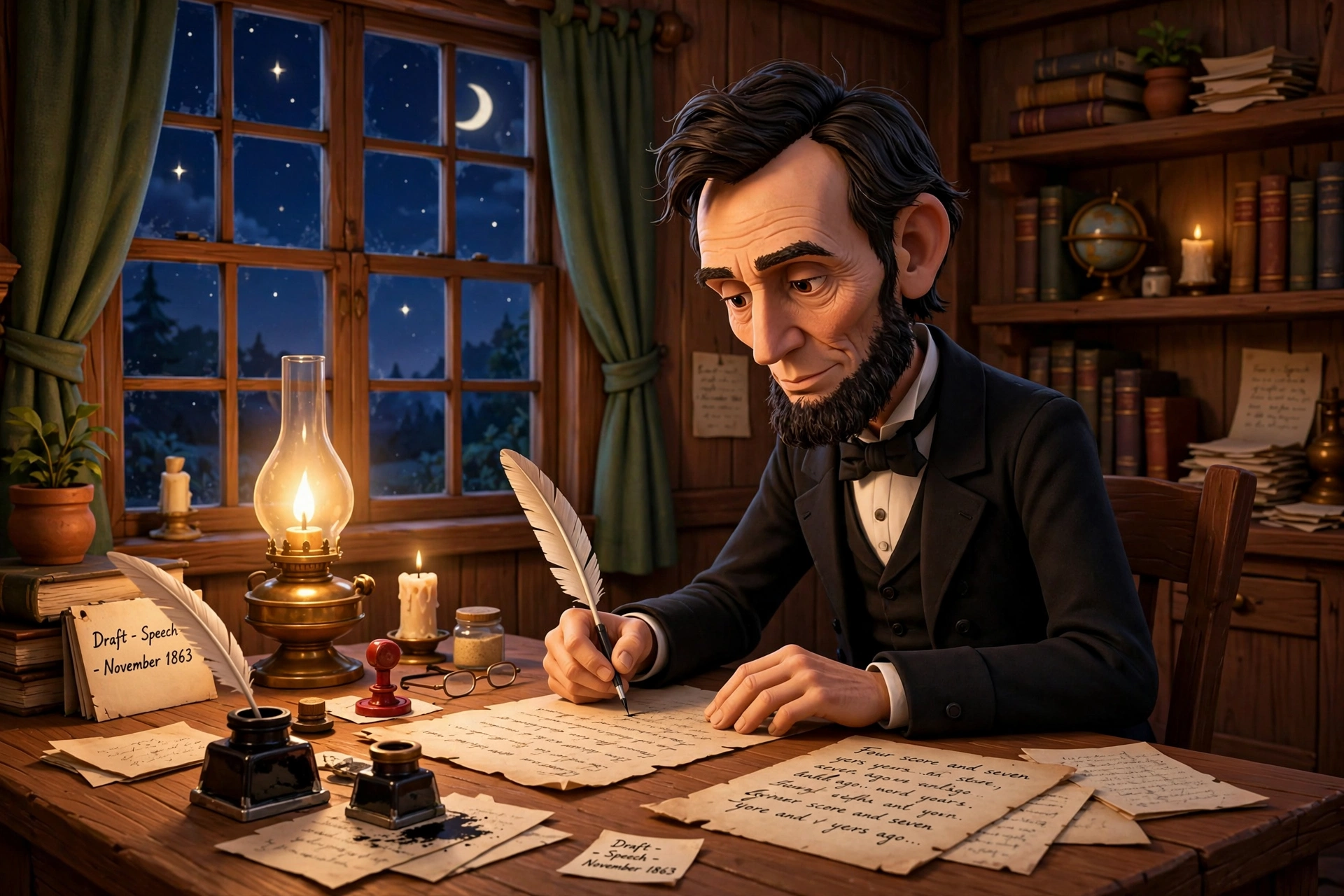
A note on the illustration: the writing-scene image on this page is AI-generated dramatization art. The manuscript pages shown are decorative AI handwriting — not a real Lincoln document. The real manuscripts are at the Library of Congress, Cornell, and the White House.
Source notes
- Text: the Bliss copy, per the Library of Congress and The Collected Works of Abraham Lincoln, vol. 7.
- The five-copy account follows the Library of Congress’s documentation of the Nicolay and Hay copies and the standard manuscript scholarship; Garry Wills, Lincoln at Gettysburg (1992).
- No verbatim contemporary transcript of the delivery survives; press reports (notably the Gettysburg Compiler and Associated Press dispatch) differ in wording — hence the “disputed” label on the delivery wording in the Timeline.
- Image: AI-generated dramatization art in the owner’s Vizlings “Lincoln” character style (see the image credits on this page); manuscript pages depicted are decorative, not real.