The Lincoln-Douglas Debates
Seven debates, three hours each, one Senate seat — and the loser walked out a national figure. What was actually argued in 1858.
The setup
In the summer of 1858, Republican Abraham Lincoln challenged Democratic Senator Stephen A. Douglas — the “Little Giant,” architect of the Kansas-Nebraska Act — for his Illinois Senate seat. They agreed to seven joint debates across the state, August 21 to October 15: Ottawa, Freeport, Jonesboro, Charleston, Galesburg, Quincy, Alton. The format: one candidate spoke for an hour, the other replied for ninety minutes, then a thirty-minute rebuttal. Crowds of 10,000–15,000 attended — in an age before microphones, outdoors, standing.
The stakes were the Senate seat, but the subject was slavery’s future in the West — and, underneath, whether slavery was a moral wrong or a neutral local choice.
The arguments
Douglas’s case rested on “popular sovereignty”: let each territory’s settlers vote slavery up or down. He accused Lincoln of radicalism — of wanting full racial equality, even intermarriage — and painted the “House Divided” doctrine as a call for disunion and war.
Lincoln’s case had three planks:
- Slavery was a moral wrong, and the nation could not permanently endure “half slave and half free.” The Founders, he argued, had placed slavery “in the course of ultimate extinction”; Douglas’s popular sovereignty abandoned that course.
- The Dred Scott decision was political, not sacred — a Court ruling on a political question, which citizens were free to oppose and seek to overturn.
- No social equality — and here Lincoln drew the line his modern admirers find hardest. At Charleston (September 18) he said he was not in favor of “bringing about in any way the social and political equality of the white and black races.” He opposed slavery’s expansion while disavowing abolitionist egalitarianism — the position of most Northern moderates, stated on the record.
The Freeport Doctrine
At Freeport (August 27), Lincoln pressed Douglas with a trap: given the Dred Scott decision (which said territories could not ban slavery), how could any territory exclude slavery under popular sovereignty? Douglas answered that slavery could not survive without supportive local laws — “unfriendly legislation” could exclude it regardless of the Court. This “Freeport Doctrine” kept Douglas’s Northern support but cost him the South, which read it as defiance of Dred Scott — a major step toward the Democratic Party’s 1860 split, which in turn made Lincoln’s election possible.
Who won?
Douglas won the Senate seat — Illinois legislators, not voters, chose senators, and Democrats held the legislature. Lincoln won the future. The debates were published (with Lincoln’s careful editing of the transcripts) and read nationally; they made him the Republicans’ most compelling voice on slavery and the obvious 1860 contender. As the old line has it: Douglas won the battle, Lincoln won the war.
Reading them honestly
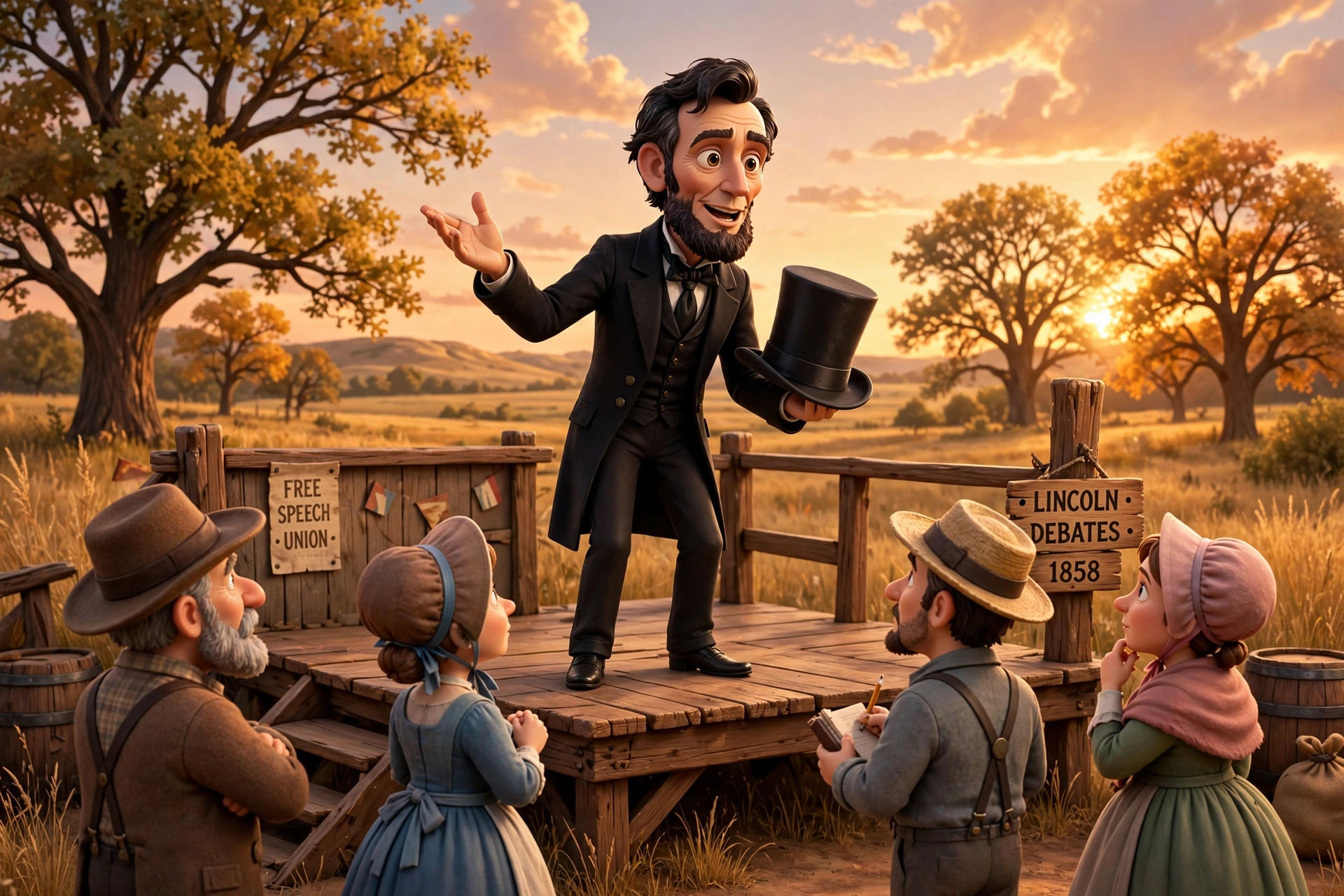
The debates are magnificent political theater and genuinely substantive — but they are not a morality play with a clean hero. Lincoln’s moral clarity on slavery’s wrongness coexists with his explicit disavowal of racial equality, both on the same platforms, sometimes in the same speeches. The illustration on this page is AI-generated dramatization art of a debate scene — not a depiction of any actual 1858 event.
Source notes
- Debate texts: The Collected Works of Abraham Lincoln, vol. 3 (Lincoln’s edited versions); contemporary newspaper transcripts differ in detail.
- The Freeport exchange and its consequences follow the standard scholarly account (see sources.md).
- Image: AI-generated dramatization art in the owner’s Vizlings “Lincoln” character style (see the image credits on this page) — a dramatized 1858 campaign scene, not a historical depiction.