Reception & Debates
Saint, tyrant, racist, emancipator, depressive, genius — Lincoln has been all of them in someone's telling. What the evidence supports, and where the arguments actually are.
In his own time
Lincoln was a hated president before he was a revered one. Southern papers called him a “baboon” and worse; Northern Democrats called him a tyrant over habeas corpus and the draft; Radical Republicans called him too slow on emancipation; abolitionists who later praised him spent 1861–62 denouncing his caution. His 1864 re-election was genuinely in doubt until Sherman took Atlanta in September. The martyrdom of April 1865 transfigured his reputation almost overnight — grief, guilt, and political need fused into the apotheosis. The funeral train’s two-week journey to Springfield was the largest public mourning in American history to that point.
The marble man (1865–1930s)
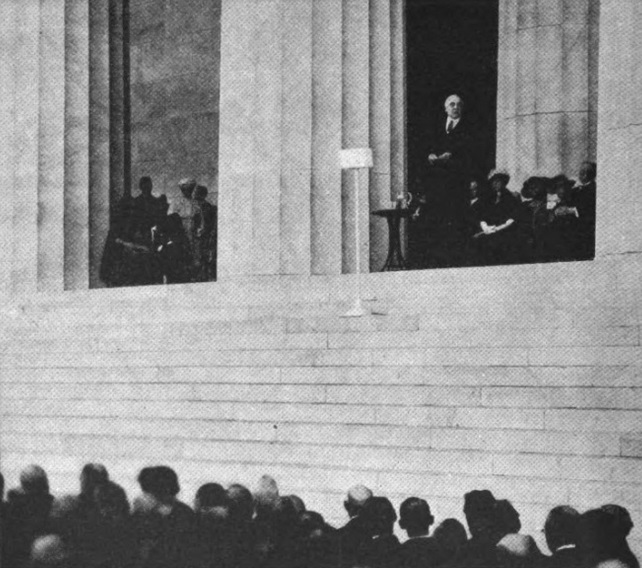
The first biographies were memorials. The ten-volume official life by his secretaries Nicolay and Hay (1890) set the template: the railsplitter, the saint, the savior of the Union. Carl Sandburg’s hugely popular Abraham Lincoln: The Prairie Years (1926) and The War Years (1939) made him a folk poet-hero for the Depression era. Dissenters existed — the Southerner Edgar Lee Masters’s hostile Lincoln the Man (1931) called him a ruthless opportunist — but the marble prevailed, literally: the Lincoln Memorial, dedicated May 30, 1922 (photograph on this page), made the apotheosis stone.
The scholarly Lincoln (1940s–present)
Modern scholarship dismantled the marble without quite replacing it:
- The melancholy Lincoln. Joshua Wolf Shenk’s Lincoln’s Melancholy (2005) argues Lincoln suffered what we would call clinical depression and that it shaped his leadership. The evidence for deep depressive episodes is strong (contemporaries described them); retrospective diagnosis is, as ever, speculative.
- The political genius. David Herbert Donald, Doris Kearns Goodwin (Team of Rivals, 2005), and others document a politician of extraordinary flexibility — principled on ends, opportunistic on means. See The Cabinet for where the “team of rivals” thesis meets its critics.
- The race debate. This is the live wire. Lincoln called slavery a moral wrong and acted against it; he also publicly doubted Black-white social equality (Ottawa, 1858 — quoted verbatim in Sayings), favored colonization (resettling freed Black people abroad) into 1862, and moved only under pressure. Lerone Bennett’s Forced into Glory (2000) argued Lincoln was a committed white supremacist who freed no one willingly — a thesis most scholars reject as overstated but which forced a more honest accounting. The mainstream position: a man of his time who grew, under the war’s pressure, past most of his contemporaries — but not past ours.
- The “was Lincoln gay?” debate. C.A. Tripp’s The Intimate World of Abraham Lincoln (2005, posthumous) argued Lincoln’s close male friendships (notably Joshua Speed) indicated homosexuality. Most historians find the evidence insufficient — 19th-century male friendship had different norms, and the argument rests heavily on reading silences. This site records the debate without adopting the claim.
The polls
Since Arthur Schlesinger’s first historians’ poll in 1948, surveys of scholars have ranked Lincoln first among presidents with remarkable consistency — typically competing only with Washington and FDR. The ranking measures judged presidential performance, not moral perfection, and the race debate above is part of why the question stays interesting.
What this site does about all this
The editorial stance is fixed: document, don’t worship, don’t prosecute. Lincoln’s words are printed verbatim — including the ones modern readers will flinch at. Disputed claims carry their attribution. The mythology deep dive takes the marble apart piece by piece.
Source notes
- Reception history follows the standard historiography (see sources.md): Merrill Peterson’s Lincoln in American Memory (1994) is the essential survey.
- Poll data: Schlesinger (1948, 1962), Murray-Blessing (1982), and subsequent historians’ surveys consistently place Lincoln first.
- Image: the Lincoln Memorial dedication, May 30, 1922 — President Warren G. Harding speaking (see the image credits on this page).