Biography
From a Kentucky log cabin (1809) to the White House (1861) to Ford's Theatre (1865): the documented life, without the marble.
Kentucky and Indiana (1809–1830)
Abraham Lincoln was born February 12, 1809, in a log cabin on Sinking Spring Farm near Hodgenville, Kentucky (then Hardin County), the second child of Thomas Lincoln and Nancy Hanks Lincoln. The family were small farmers; Thomas lost land to disputed titles, and in 1816 the Lincolns moved to Indiana. Nancy died in 1818 of “milk sickness” (tremetol poisoning from white snakeroot). In 1819 Thomas married Sarah Bush Johnston, a widow with three children, who — by Lincoln’s own later account and his stepbrother’s — encouraged his reading. Lincoln’s formal schooling totaled roughly a year, in scattered frontier sessions; he educated himself with borrowed books, doing sums on a wooden shovel and memorizing passages.
In 1830 the family moved to Illinois. In 1831 the 22-year-old Lincoln struck out on his own, settling in New Salem, Illinois, where he worked as a store clerk, postmaster, and surveyor, and served as a militia captain (elected by his company) in the Black Hawk War of 1832 — seeing no combat.
Illinois politics and law (1834–1854)
Lincoln was elected to the Illinois state legislature in 1834 as a Whig and served four terms. He taught himself law, was admitted to the bar in 1836, and moved to Springfield in 1837 to practice with John T. Stuart. In 1842 he married Mary Todd of Lexington, Kentucky; they had four sons: Robert (1843), Edward “Eddie” (1846, died 1850), William “Willie” (1850, died 1862), and Thomas “Tad” (1853, died 1871).
Elected to the U.S. House of Representatives in 1846, Lincoln served a single undistinguished term (1847–1849), notable mainly for his opposition to the Mexican War and his “spot resolutions” demanding to know the exact spot of American bloodshed. He returned to Springfield and a lucrative law practice — riding the circuit, arguing before the Illinois Supreme Court, and becoming one of the state’s leading railroad lawyers. He never owned slaves; his law practice included both slave-related cases and work for free Black clients, a record historians read as that of a working lawyer rather than a crusader.
The road to prominence (1854–1860)
The Kansas-Nebraska Act of 1854 — which opened western territories to slavery under “popular sovereignty” — pulled Lincoln back into politics. His Peoria speech of October 16, 1854, a three-hour attack on the extension of slavery, marked his return. He helped found the Illinois Republican Party in 1856 (his Bloomington speech that May was not transcribed — the famous “Lost Speech”). In 1858 he won the Republican nomination for the U.S. Senate and challenged Democrat Stephen A. Douglas in the seven Lincoln-Douglas debates. Douglas won the seat (the legislature, not voters, chose senators), but the debates made Lincoln nationally known.
On February 27, 1860, Lincoln delivered the Cooper Union address in New York — a lawyerly, heavily researched argument that the Founders had supported federal restriction of slavery. It made him a credible presidential contender. In May 1860 the Republican convention in Chicago nominated him on the third ballot — a result his managers secured with promises of patronage as much as principle. In November he won the presidency with about 40% of the popular vote in a four-way race, carrying every free state except New Jersey’s split vote — and not a single slave state.
President (1861–1865)
Between Lincoln’s election and inauguration, seven Southern states seceded. He took office March 4, 1861, pledging in his First Inaugural to hold federal property and enforce the laws while disclaiming any intent to interfere with slavery where it existed. The Confederate bombardment of Fort Sumter (April 12–13, 1861) began the war.
Lincoln’s war presidency combined political and military management of unusual breadth: he navigated a cabinet of former rivals (see The Cabinet), cycled through generals until Ulysses S. Grant emerged, suspended habeas corpus in contested areas, managed border-state slaveholders and Radical Republican abolitionists simultaneously, and — after the Union victory at Antietam — issued the Emancipation Proclamation. He spoke rarely and briefly: the Gettysburg Address (November 19, 1863, about two minutes) and the Second Inaugural (March 4, 1865, 703 words) are the essential texts.
Re-elected in 1864 over George B. McClellan, Lincoln pushed the Thirteenth Amendment through Congress (January 1865) and began planning Reconstruction (see what he actually planned). On April 9, 1865, Lee surrendered at Appomattox. On April 14, Lincoln attended the comedy Our American Cousin at Ford’s Theatre with Mary; during the third act, the actor John Wilkes Booth slipped into the presidential box and shot him in the back of the head. Lincoln died at 7:22 a.m. on April 15 in the Petersen House across the street. He was 56.
Source notes
- Narrative follows the standard documentary record: The Collected Works of Abraham Lincoln (ed. Roy P. Basler, Rutgers, 1953), the Library of Congress’s Lincoln papers, and the National Archives. Full bibliography in sources.md.
- Family details (births, deaths, marriages) are documented in the standard biographical record; uncertain or disputed claims (e.g., paternity rumors about Lincoln’s mother) are omitted as unverifiable.
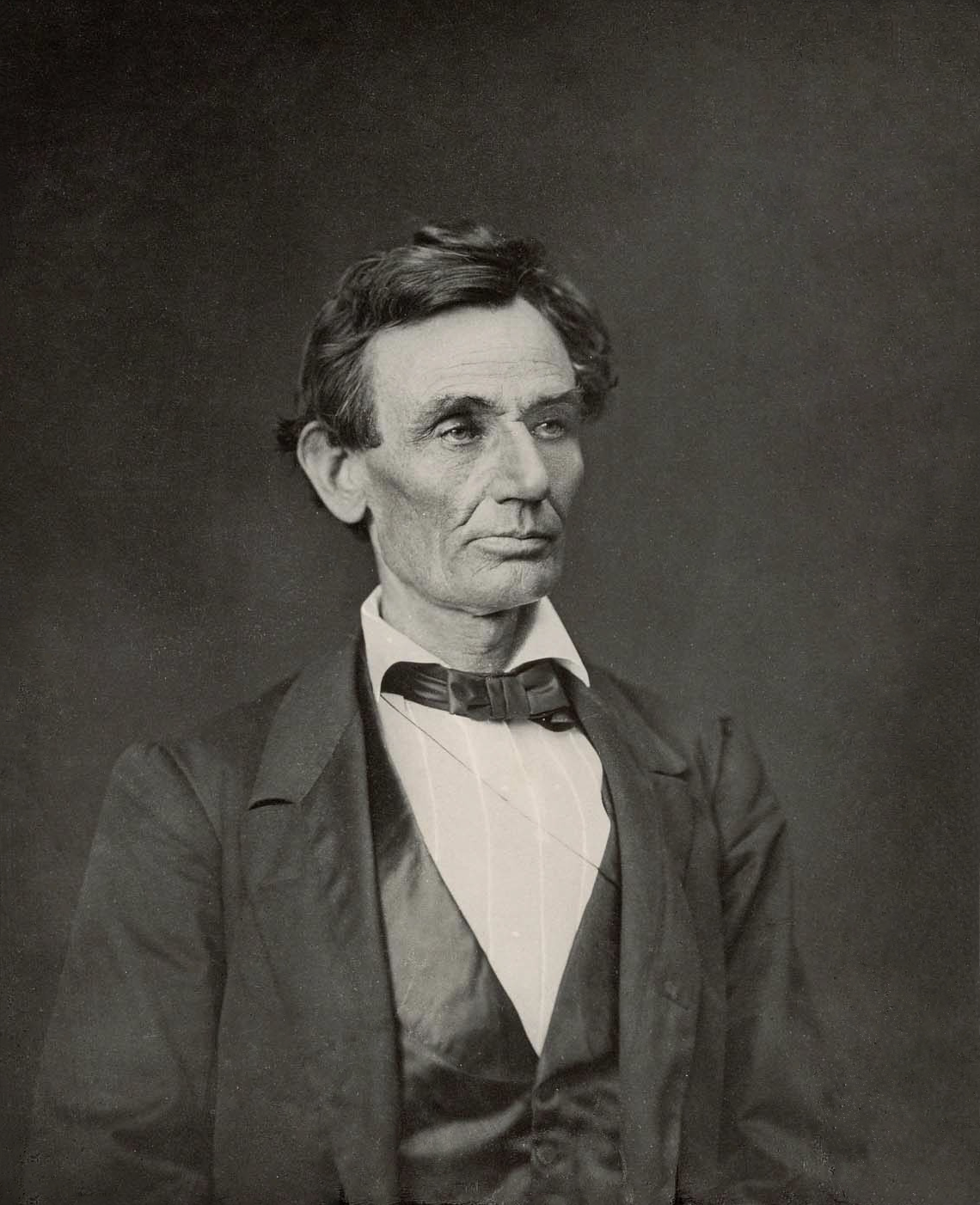
- Image: Alexander Hesler’s June 3, 1860, Springfield portrait — beardless, from the campaign year (see the image credits on this page).