The Cabinet
He staffed his government with the men who had tried to beat him. The famous thesis about why — and the scholars who say it's overstated.
The thesis
Doris Kearns Goodwin’s Team of Rivals (2005) argues that Lincoln’s masterstroke was appointing his chief 1860 rivals to the cabinet — and then managing their clashing ambitions into a functioning government. The lineup:
- William H. Seward (State) — the frontrunner Lincoln beat at Chicago; acted early as though he would be premier, became Lincoln’s closest adviser.
- Salmon P. Chase (Treasury) — the Radical favorite, who schemed for the presidency from inside the cabinet for three years.
- Edward Bates (Attorney General) — the conservative border-state rival, increasingly marginalized.
- Simon Cameron (War, 1861–62) — corrupt and quickly replaced by Edwin M. Stanton, the brilliant, abrasive organizer of the war machine.
- Plus Gideon Welles (Navy), Montgomery Blair (Postmaster General), and Caleb Smith (Interior) — the full spectrum of the fragile Republican coalition.
Goodwin’s claim: Lincoln’s emotional intelligence — his patience, humor, absence of malice — turned rivals into a team, and the team won the war. The book’s success (and its influence, including on Barack Obama’s cabinet-building) made “team of rivals” the standard pop-history frame.
Where scholarship pushes back
Historians broadly accept the facts and debate the interpretation:
- It was coalition politics, not just magnanimity. Every faction of the new Republican Party — former Whigs, Free Soilers, Know-Nothings, Democrats — had to be represented or the coalition would fracture. Appointing rivals was also the price of the 1860 nomination, which Lincoln’s managers had partly bought with patronage promises. Goodwin doesn’t deny this, but the pop version often forgets it.
- He managed them by dominance, not just empathy. Lincoln fired Cameron, humiliated Chase into resigning (then neutralized him with the Chief Justiceship), overruled Seward repeatedly, and ran the war’s strategy himself more than the “humble facilitator” image suggests. The team worked because Lincoln was its undisputed boss.
- The rivals weren’t always rivalrous in office. Seward became genuinely loyal; the “rivalry” framing fits 1860 better than 1863. And some historians argue the cabinet’s dysfunction — the leaking, the backbiting, Chase’s endless intrigue — cost the administration real efficiency, whatever the eventual result.
- The counterfactual is unknowable. Would a cabinet of loyalists have done worse? Perhaps — but the claim that only rivals could have worked is an interpretation, not a finding.
The fair summary
Lincoln did appoint his rivals, did hold together a fractious coalition through four years of civil war, and did it with a combination of patience and ruthlessness that remains remarkable. Whether that was magnanimity, calculation, or — most likely — both is the argument. The cabinet was a political achievement either way; the “team of rivals” label is the beginning of the analysis, not the end.
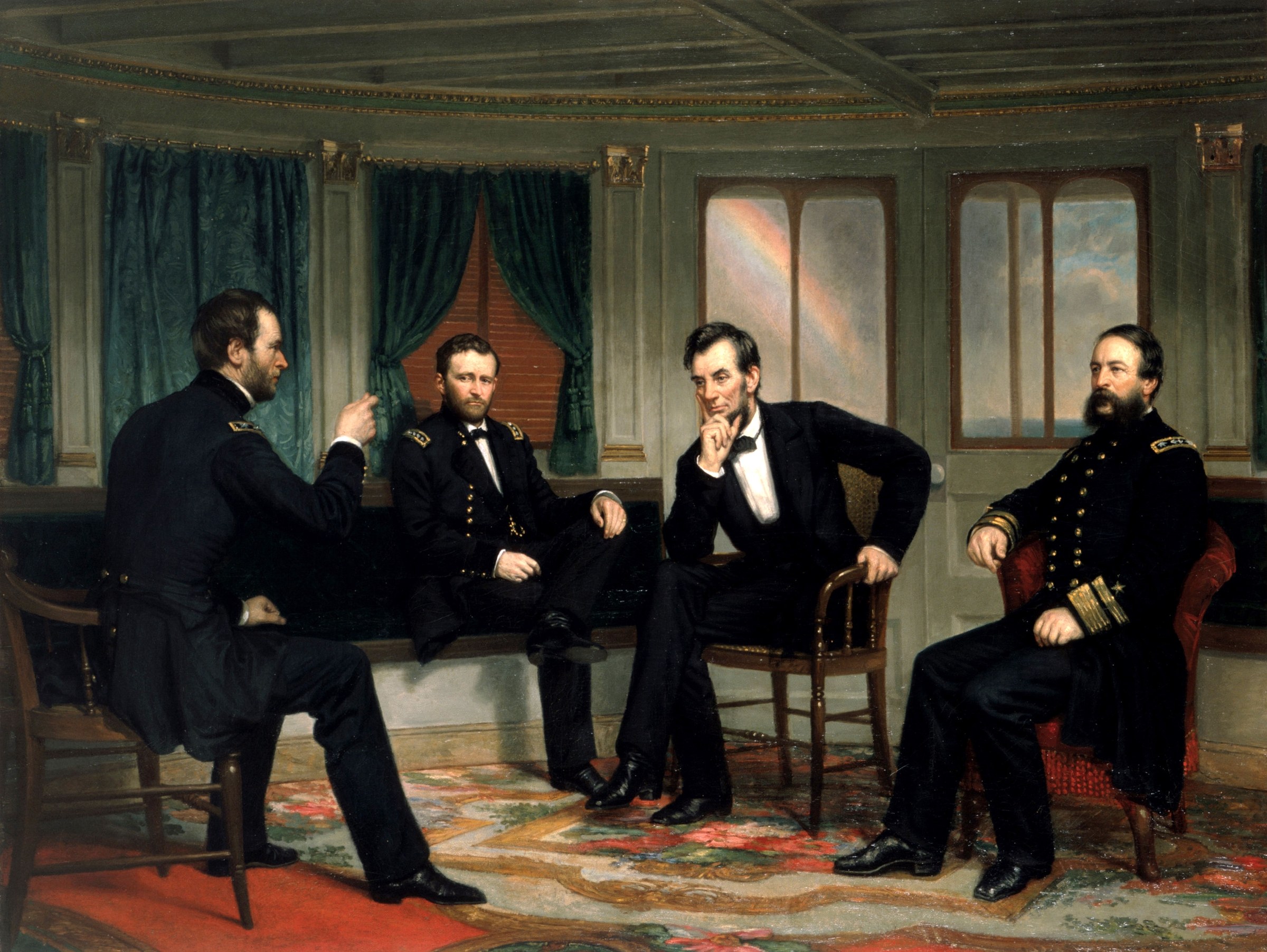
The painting on this page — Healy’s 1868 The Peacemakers, showing Lincoln conferring with Grant, Sherman, and Porter aboard the River Queen in March 1865 — depicts the commander-in-chief at work with his generals, not the cabinet; it is here as the war’s closing image, not as evidence for the thesis.
Source notes
- The thesis: Doris Kearns Goodwin, Team of Rivals: The Political Genius of Abraham Lincoln (2005).
- The pushback synthesizes the critical literature (see sources.md); the patronage-price-of-nomination point is documented in the standard accounts of the 1860 Chicago convention.
- Cabinet facts (appointments, Cameron’s removal, Chase’s resignation and Chief Justice appointment) follow the standard record.
- Image: George P.A. Healy, The Peacemakers (1868) — public domain (see the image credits on this page).