The Emancipation Proclamation
The order that changed the war's meaning — and the limits its admirers sometimes skip. A note on the image: this page shows the preliminary proclamation.
A correction, first
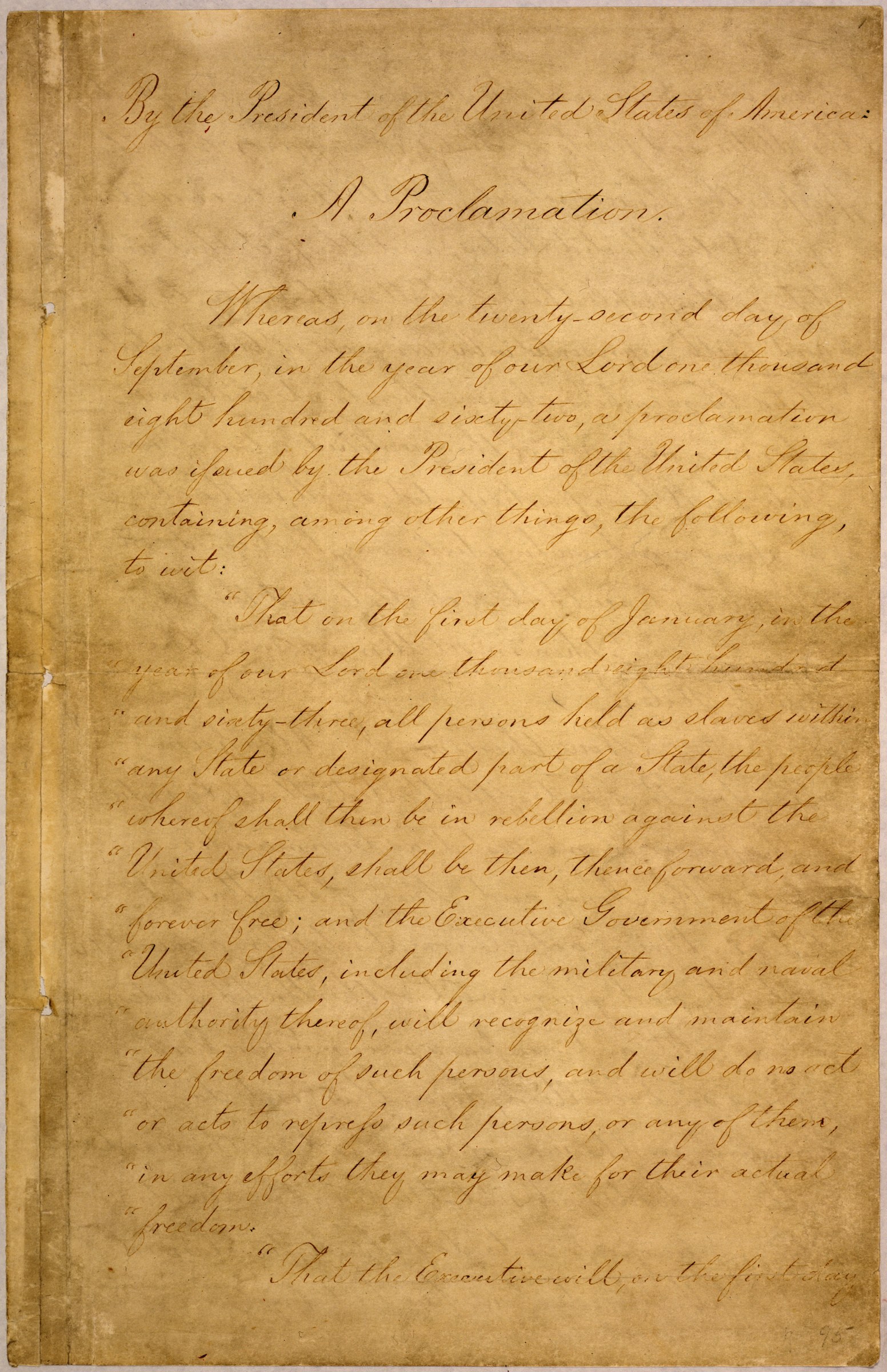
The document photograph on this page shows the Preliminary Emancipation Proclamation of September 22, 1862 — not the final January 1, 1863, proclamation. The image comes from the World Digital Library, whose description dates it to September 22, 1862; the file was renamed and recaptioned when this was verified. The preliminary proclamation warned that slaves in states still in rebellion on January 1, 1863, would be freed; the final proclamation executed that warning. Both are Lincoln’s; they are not the same document.
Why September 1862
Lincoln had decided on emancipation by the summer of 1862 — he told his cabinet on July 22 (the scene in Carpenter’s painting, also on this site) — but Secretary of State Seward persuaded him to wait for a military victory, lest the order look like desperation. Antietam (September 17), bloody as it was, gave him the pretext. On September 22 he issued the preliminary proclamation: one hundred days’ notice that on January 1, 1863, “all persons held as slaves” in rebellious areas “shall be then, thenceforward, and forever free.”
What the final proclamation did (January 1, 1863)
The operative sentence:
“That all persons held as slaves within any State or designated part of a State, the people whereof shall then be in rebellion against the United States, shall be then, thenceforward, and forever free.”
It was, legally, a war measure — issued under Lincoln’s authority as commander-in-chief, seizing enemy “property.” That framing explains both its power and its limits:
- It freed slaves where Lincoln had no power (the Confederacy) and exempted slaves where he had power (the loyal border states, Tennessee, and Union-occupied pockets of Louisiana and Virginia). The exemptions were constitutional caution: as a war measure it could reach only enemy territory.
- It authorized Black enlistment. “Such persons of suitable condition, will be received into the armed service of the United States.” By war’s end roughly 180,000 Black soldiers and sailors served — a fact Lincoln later called decisive.
- It made abolition a Union war aim, which killed any chance of British or French recognition of the Confederacy — no European power would now intervene for slavery.
What it didn’t do
It did not end slavery. It did not free a single slave in the border states. It did not apply to areas already under Union control. The legal end of slavery required the Thirteenth Amendment (passed by Congress January 31, 1865; ratified December 6, 1865 — after Lincoln’s death). Anyone who says “Lincoln freed the slaves” with the proclamation alone is skipping the amendment — and the enslaved people who freed themselves by fleeing to Union lines, whose agency the “great emancipator” framing can obscure.
The honest assessment
Historians across the spectrum agree on the mechanics above; they divide on the moral accounting. The mainstream view: a limited, lawyerly war measure that — by making emancipation a condition of victory and putting Black men in Union uniform — transformed the war’s character and made abolition irreversible. The critical view (see Reception): Lincoln acted late, under pressure, and freed only those he could not yet reach. The document’s own text supports the first reading’s facts and the second reading’s limits. Read it whole.
Source notes
- Texts: National Archives (engrossed final proclamation); The Collected Works of Abraham Lincoln, vol. 6 (preliminary and final).
- The September 22, 1862, dating of the photographed document follows the World Digital Library item description on Wikimedia Commons, verified 2026-09-26 (see the image credits on this page).
- Cabinet meeting of July 22, 1862: documented in the diaries of Gideon Welles and Salmon Chase; depicted in Carpenter’s 1864 painting.
- Black enlistment figures: c. 180,000–200,000 per U.S. Army historical records; this page uses “roughly 180,000” as the conservative documented figure.
- Image: the Preliminary Emancipation Proclamation, September 22, 1862 (World Digital Library; public domain). Carpenter’s painting shows the July 1862 cabinet reading (public domain).