People
Thirty people around Lincoln — the family, the rivals, the cabinet, the generals, the conspirators. Short, sourced, neutral.
Family
Mary Todd Lincoln (1818–1882)
Lincoln’s wife from November 4, 1842. Intelligent, politically attuned, and — by many accounts — difficult: lavish White House spending, fierce temper, and, after 1865, deepening instability. She witnessed the assassination beside him. Her later years included a controversial 1875 insanity trial instigated by her son Robert; modern writers have suggested bipolar disorder, but retrospective diagnosis is speculative and this site does not assert it.
Robert Todd Lincoln (1843–1926)
The only Lincoln son to reach adulthood. Served briefly on Grant’s staff, became a successful railroad lawyer and executive, and served as Secretary of War (1881–1885) and minister to Britain. He was present at or near three presidential assassinations (his father’s, Garfield’s, McKinley’s) and declined later entreaties to seek the presidency himself.
Edward “Eddie” Lincoln (1846–1850)
The Lincolns’ second son, who died of tuberculosis (then “consumption”) at age three — the first of the family’s devastating losses.
William “Willie” Lincoln (1850–1862)
The third son, who died of typhoid fever in the White House on February 20, 1862, at age 11. Both parents were shattered; Mary never fully recovered. Lincoln’s grief is among the best-documented facts of his private life.
Thomas “Tad” Lincoln (1853–1871)
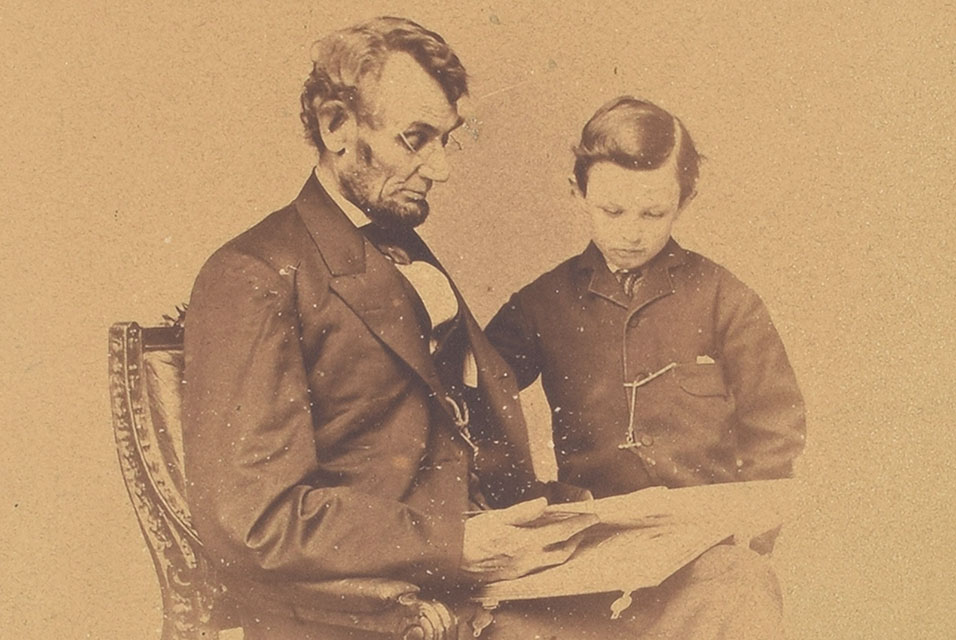
The youngest son — high-spirited, with a speech impediment — who died at 18. The photograph on this page shows father and son together in February 1864.
Nancy Hanks Lincoln (1784–1818)
Lincoln’s mother, who died when he was nine. Lincoln spoke of her rarely and briefly; nearly everything else said about her — including disputed claims about his paternity — is unverifiable and omitted here.
Thomas Lincoln (1778–1851)
Lincoln’s father, a farmer and carpenter. Their relationship was strained; Lincoln did not attend his father’s deathbed in 1851. Historians debate how much of Lincoln’s drive was a reaction against his father — an interpretation, not a fact.
Sarah Bush Johnston Lincoln (1788–1869)
Lincoln’s stepmother from 1819, who encouraged his reading and whom he loved. She outlived him by four years.
Rivals and partners
Stephen A. Douglas (1813–1861)
The “Little Giant” — Democratic senator from Illinois, architect of the Kansas-Nebraska Act, Lincoln’s opponent in the 1858 debates. Douglas won the Senate seat but lost the presidency to Lincoln in 1860; after Fort Sumter he rallied Democrats to the Union cause, then died of typhoid in June 1861.
William H. Seward (1801–1872)
Secretary of State (1861–1865), Lincoln’s chief rival for the 1860 nomination. Early on Seward acted as though he would be the administration’s premier; Lincoln steadily established his own authority, and Seward became a loyal and indispensable partner. Survived Lewis Powell’s assassination attempt on April 14, 1865.
Salmon P. Chase (1808–1873)
Secretary of the Treasury (1861–1864), an ambitious Radical Republican who repeatedly schemed for the presidency while serving in the cabinet. Lincoln tolerated it — “I do not see how he can be spared” — until Chase’s maneuvering became untenable; he then appointed Chase Chief Justice of the Supreme Court, where Chase presided over the postwar Court.
Edwin M. Stanton (1814–1869)
Secretary of War from January 1862, replacing the corrupt Simon Cameron. Brilliant, abrasive, and tireless — the organizer of the Union war machine. Initially contemptuous of Lincoln, he became devoted; he was at Lincoln’s deathbed and is credited (perhaps apocryphally) with “now he belongs to the ages.”
Edward Bates (1793–1869)
Attorney General (1861–1864), the conservative Missourian on the team — a former presidential rival kept for balance, increasingly sidelined as the war radicalized policy.
Hannibal Hamlin (1809–1891)
Lincoln’s first vice president (1861–1865), a Maine former Democrat chosen to balance the 1860 ticket. Dropped in 1864 for Andrew Johnson in a unity move Lincoln later had mixed feelings about, by some accounts.
Andrew Johnson (1808–1875)
Lincoln’s second vice president — a Tennessee War Democrat put on the 1864 “Union” ticket. Became president on Lincoln’s death and clashed catastrophically with Congress over Reconstruction; impeached in 1868, acquitted by one vote.
Generals and the war
Ulysses S. Grant (1822–1885)
The general who finally won the war in the East. Lincoln promoted him to lieutenant general in March 1864 and gave him command of all Union armies, enduring Grant’s appalling casualties because Grant, unlike his predecessors, kept moving. “I can’t spare this man; he fights,” Lincoln reportedly said — the remark is anecdotal but consistent with his actions.
George B. McClellan (1826–1885)
Brilliant organizer, chronically reluctant fighter. Lincoln removed him twice (November 1862 finally stuck), then defeated him as the 1864 Democratic presidential nominee. The Antietam photograph on the Timeline shows them together weeks before the dismissal.
Robert E. Lee (1807–1870)
The Confederate commander Lincoln never faced down personally but whose army was the war’s center of gravity. Surrendered at Appomattox on April 9, 1865.
Jefferson Davis (1808–1889)
President of the Confederacy — Lincoln’s counterpart, a West Point graduate and former U.S. senator. The two never met.
William T. Sherman (1820–1891)
Grant’s partner in the West; his March to the Sea (1864) broke the Confederacy’s interior and, by taking Atlanta in September, likely secured Lincoln’s re-election.
Emancipation and its witnesses
Frederick Douglass (c. 1818–1895)
The formerly enslaved abolitionist orator who recruited Black soldiers, pressed Lincoln on emancipation, and met him at the White House. Douglass’s account of the Second Inaugural — Lincoln seeking him out in the crowd afterward — is a primary source for that day. See the Second Inaugural deep dive.
Harriet Beecher Stowe (1811–1896)
Author of Uncle Tom’s Cabin (1852). The famous greeting attributed to Lincoln at their 1862 meeting — “so you are the little woman who wrote the book that started this great war” — is anecdotal, reported by Stowe’s family, and treated here as unverified.
Grace Bedell (1848–1936)
The 11-year-old from Westfield, New York, whose October 15, 1860, letter urging Lincoln to grow a beard (“all the ladies like whiskers”) he answered on October 19 — and whose advice he took. The beard chronology on this site starts here.
Joshua Speed (1814–1882)
Lincoln’s closest friend — his Springfield roommate in the late 1830s, a Kentuckian who owned slaves and argued with Lincoln about slavery for decades. Their correspondence is a primary window into Lincoln’s private mind.
William Herndon (1818–1891)
Lincoln’s law partner (1844–1861) and first major biographer. Herndon’s informant-based biography is indispensable and unreliable in equal measure: he preserved priceless testimony and pushed theories — Lincoln’s melancholy, his religious skepticism, the Ann Rutledge romance — that scholars still argue over.
John Hay (1838–1905) and John Nicolay (1832–1901)
Lincoln’s private secretaries — “Nico” and “John” — who guarded his papers and wrote the ten-volume official biography (1890). The Nicolay and Hay manuscript copies of the Gettysburg Address are named for them.
The conspirators
John Wilkes Booth (1838–1865)
Actor, Confederate sympathizer, assassin. Shot Lincoln at Ford’s Theatre on April 14, 1865; fled to Virginia; killed April 26 at Garrett’s farm by Union cavalryman Boston Corbett. See the assassination deep dive.
Mary Surratt (1823–1865)
Washington boardinghouse keeper whose house hosted the conspirators’ meetings. Convicted by military commission and hanged July 7, 1865 — the first woman executed by the U.S. federal government. Her guilt remains debated; the trial record is the evidence.
Lewis Powell (1844–1865)
Booth’s accomplice, assigned to kill Secretary of State Seward; brutally attacked Seward and others in his home on April 14 but failed to kill him. Hanged July 7, 1865.
George Atzerodt (1835–1865)
Assigned to kill Vice President Andrew Johnson; lost his nerve and never attempted it. Hanged July 7, 1865.
David Herold (1842–1865)
Booth’s companion in flight; captured with him at Garrett’s farm. Hanged July 7, 1865.
Source notes
- Sketches synthesize the standard biographical record (Collected Works, Library of Congress, National Archives) and the cited secondary literature; full bibliography in sources.md.
- Anecdotal items (Stanton’s deathbed line, the Stowe greeting, “he fights”) are labeled as such in the text above.
- Image: Lincoln with his son Tad, February 1864 (see the image credits on this page).