Sayings
Lincoln is one of the most misquoted figures in history. This page prints only verified verbatim quotations with their sources — and quarantines the famous fakes below.
Verified — his words, documented
1. “If destruction be our lot, we must ourselves be its author and finisher.”
Lyceum Address, Springfield, January 27, 1838.
Source: The Collected Works of Abraham Lincoln, vol. 1.
2. “A house divided against itself cannot stand.”
House Divided speech, Springfield, June 16, 1858. The full sentence continues: “I believe this government cannot endure, permanently half slave and half free.”
Source: Collected Works, vol. 2.
3. “I have no purpose to introduce political and social equality between the white and black races.”
First Lincoln-Douglas debate, Ottawa, Illinois, August 21, 1858. Quoted here because it is documented — it records the limits of Lincoln’s racial egalitarianism as he stated them publicly, and historians cite it constantly. Context matters: he was answering Douglas’s charge that Republicans sought full social equality.
Source: debate transcript, Collected Works, vol. 3.
4. “Public sentiment is everything. With public sentiment, nothing can fail; without it nothing can succeed.”
First Lincoln-Douglas debate, Ottawa, August 21, 1858.
Source: debate transcript, Collected Works, vol. 3.
5. “Let us have faith that right makes might, and in that faith, let us, to the end, dare to do our duty as we understand it.”
Cooper Union Address, New York, February 27, 1860 — the closing line.
Source: Collected Works, vol. 3.
6. “I now leave, not knowing when, or whether ever, I may return, with a task before me greater than that which rested upon Washington.”
Farewell Address at Springfield, February 11, 1861 — spoken extemporaneously at the train depot.
Source: Collected Works, vol. 4.
7. “I have never had a feeling politically that did not spring from the sentiments embodied in the Declaration of Independence.”
Speech at Independence Hall, Philadelphia, February 22, 1861.
Source: Collected Works, vol. 4.
8. “The mystic chords of memory… will yet swell the chorus of the Union, when again touched, as surely they will be, by the better angels of our nature.”
First Inaugural Address, March 4, 1861 — the closing passage (Seward drafted the germ; Lincoln wrote the final form).
Source: Collected Works, vol. 4.
9. “I am not a Know-Nothing. That is certain. How could I be? How can any one who abhors the oppression of negroes, be in favor of degrading classes of white people?”
Letter to Joshua F. Speed, August 24, 1855.
Source: Collected Works, vol. 2.
10. “My paramount object in this struggle is to save the Union, and is not either to save or to destroy slavery.”
Letter to Horace Greeley, August 22, 1862 — written for publication in the New-York Tribune.
Source: Collected Works, vol. 5.
11. “In great contests each party claims to act in accordance with the will of God. Both may be, and one must be, wrong.”
Meditation on the Divine Will, private note, c. September 1862 — never delivered publicly.
Source: Collected Works, vol. 5.
12. “The dogmas of the quiet past, are inadequate to the stormy present. The occasion is piled high with difficulty, and we must rise with the occasion. As our case is new, so we must think anew and act anew.”
Annual Message to Congress, December 1, 1862.
Source: Collected Works, vol. 5.
13. “We shall nobly save, or meanly lose, the last best hope of earth.”
Annual Message to Congress, December 1, 1862. The full sentence: “In giving freedom to the slave, we assure freedom to the free — honorable alike in what we give, and what we preserve. We shall nobly save, or meanly lose, the last best hope of earth.”
Source: Collected Works, vol. 5.
14. “That all persons held as slaves within any State or designated part of a State, the people whereof shall then be in rebellion against the United States, shall be then, thenceforward, and forever free.”
The Emancipation Proclamation, January 1, 1863 — the operative sentence.
Source: National Archives; Collected Works, vol. 6.
15. “Four score and seven years ago our fathers brought forth on this continent, a new nation, conceived in Liberty, and dedicated to the proposition that all men are created equal.”
Gettysburg Address, November 19, 1863 — Bliss copy text (the standard version).
Source: Library of Congress; Collected Works, vol. 7.
16. “The world will little note, nor long remember what we say here, but it can never forget what they did here.”
Gettysburg Address, November 19, 1863 — Bliss copy text.
Source: Library of Congress; Collected Works, vol. 7.
17. “…that government of the people, by the people, for the people, shall not perish from the Earth.”
Gettysburg Address, November 19, 1863 — the closing line, Bliss copy text.
Source: Library of Congress; Collected Works, vol. 7.
18. “The purposes of the Almighty are perfect, and must prevail, though we erring mortals may fail to accurately perceive them in advance.”
Letter to Eliza P. Gurney, September 4, 1864.
Source: Collected Works, vol. 7.
19. “Fondly do we hope — fervently do we pray — that this mighty scourge of war may speedily pass away.”
Second Inaugural Address, March 4, 1865.
Source: Collected Works, vol. 8.
20. “With malice toward none; with charity for all; with firmness in the right, as God gives us to see the right, let us strive on to finish the work we are in…”
Second Inaugural Address, March 4, 1865. The sentence continues: “…to bind up the nation’s wounds; to care for him who shall have borne the battle, and for his widow, and his orphan — to do all which may achieve and cherish a just and lasting peace among ourselves, and with all nations.”
Source: Collected Works, vol. 8.
A note on the Bixby letter
The famous condolence letter to Mrs. Lydia Bixby (November 21, 1864) — “I feel how weak and fruitless must be any word of mine which should attempt to beguile you from the grief of a loss so overwhelming” — is of disputed authorship: a long-running scholarly debate holds that Lincoln’s secretary John Hay may have written it. It is therefore not listed above as verified Lincoln. The dispute itself is documented in the scholarly literature; this site takes no position beyond labeling it.
Misattributed — famous lines with no evidence he said them
Lincoln never said or wrote the following, as far as the documentary record shows. They appear nowhere in The Collected Works of Abraham Lincoln. Quoting them as his words is the single most common Lincoln error.
“You can fool all the people some of the time, and some of the people all the time, but you cannot fool all the people all the time.”
No contemporary source exists; the earliest attributions postdate Lincoln by decades. The most famous Lincoln quote may never have been his at all.
“Whatever you are, be a good one.”
No primary source. A modern inspirational attribution with no trail to Lincoln.
“I am a slow walker, but I never walk back.”
No primary source in the Collected Works; widely repeated, never documented.
“The best way to predict the future is to create it.”
A modern management aphorism (also attributed to Peter Drucker and others). No Lincoln source of any kind.
“In the end, it’s not the years in your life that count. It’s the life in your years.”
No primary source; a 20th-century attribution that stuck.
“Nearly all men can stand adversity, but if you want to test a man’s character, give him power.”
Widely quoted, never traced to any Lincoln text. Treat as anonymous.
“The ballot is stronger than the bullet.”
Often tied to Lincoln’s 1856 Bloomington “Lost Speech” — which was never transcribed, so no wording can be verified. Unverifiable by definition.
“Do I not destroy my enemies when I make them my friends?”
Anecdotal — reported secondhand, no primary source.
“I don’t like that man. I must get to know him better.”
No primary source.
“America will never be destroyed from the outside. If we falter and lose our freedoms, it will be because we destroyed ourselves.”
A viral paraphrase. What Lincoln actually wrote (Lyceum Address, 1838) was: “If destruction be our lot, we must ourselves be its author and finisher.” Quote the real one.
“Don’t believe everything you read on the Internet just because there’s a picture with a quote next to it.”
A modern internet joke. Included here because it keeps appearing — on quote cards, next to his picture.
Source notes
- Verified texts from The Collected Works of Abraham Lincoln (ed. Roy P. Basler, 1953), the Library of Congress Lincoln papers, and the National Archives (Emancipation Proclamation).
- Misattribution assessments follow the documentary test: absence from the Collected Works and from any contemporary source. Where scholars have proposed specific alternative origins, the entry says so; where the trail simply ends, it says that.
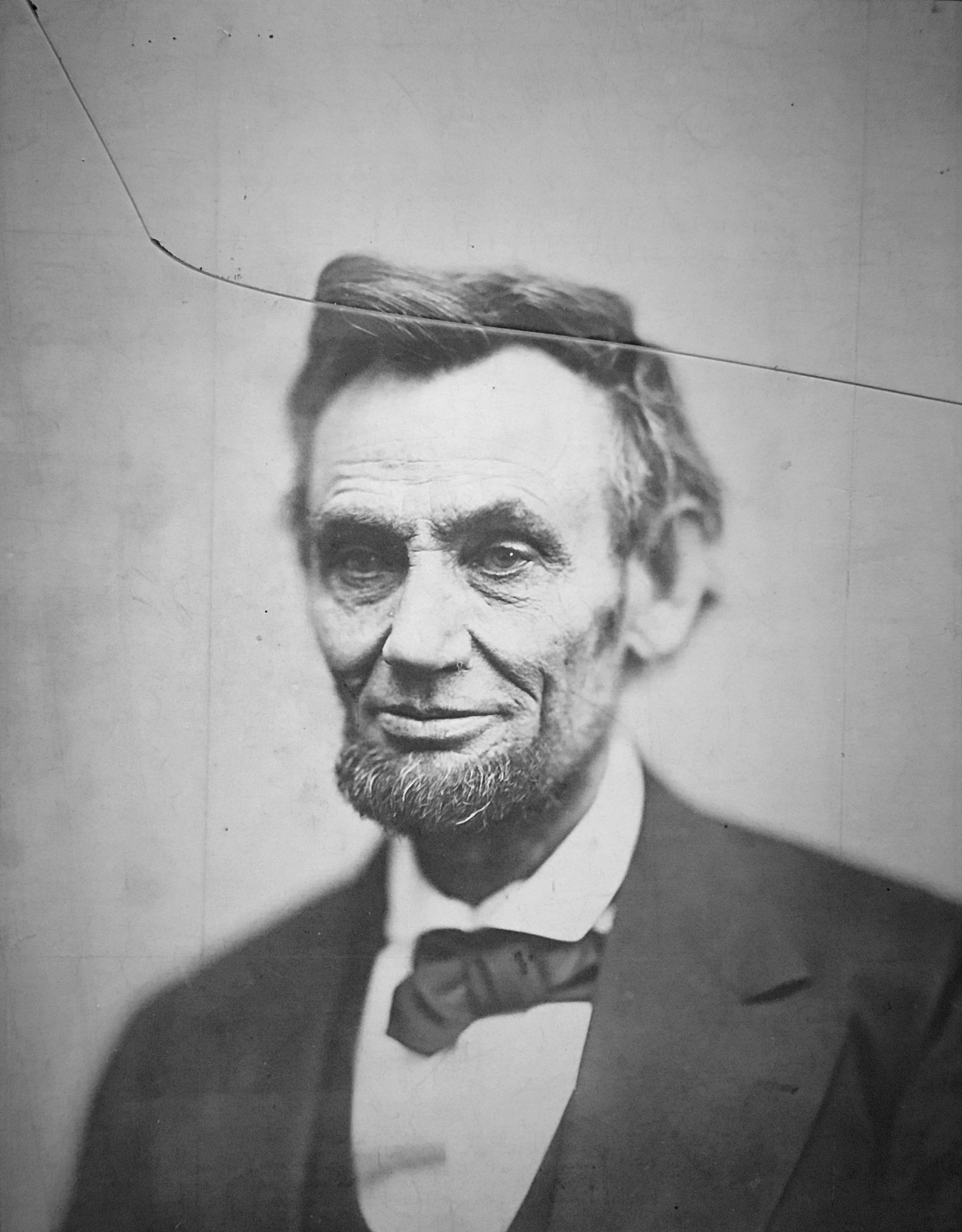
- Image: Gardner’s “cracked plate” portrait, February 5, 1865 — traditionally called the last photograph of Lincoln from life (see the image credits on this page).