The Assassination and the Conspiracy
April 14, 1865 — five days after Appomattox. What happened at Ford's Theatre, who conspired with Booth, and what the trial record shows.
April 14, 1865
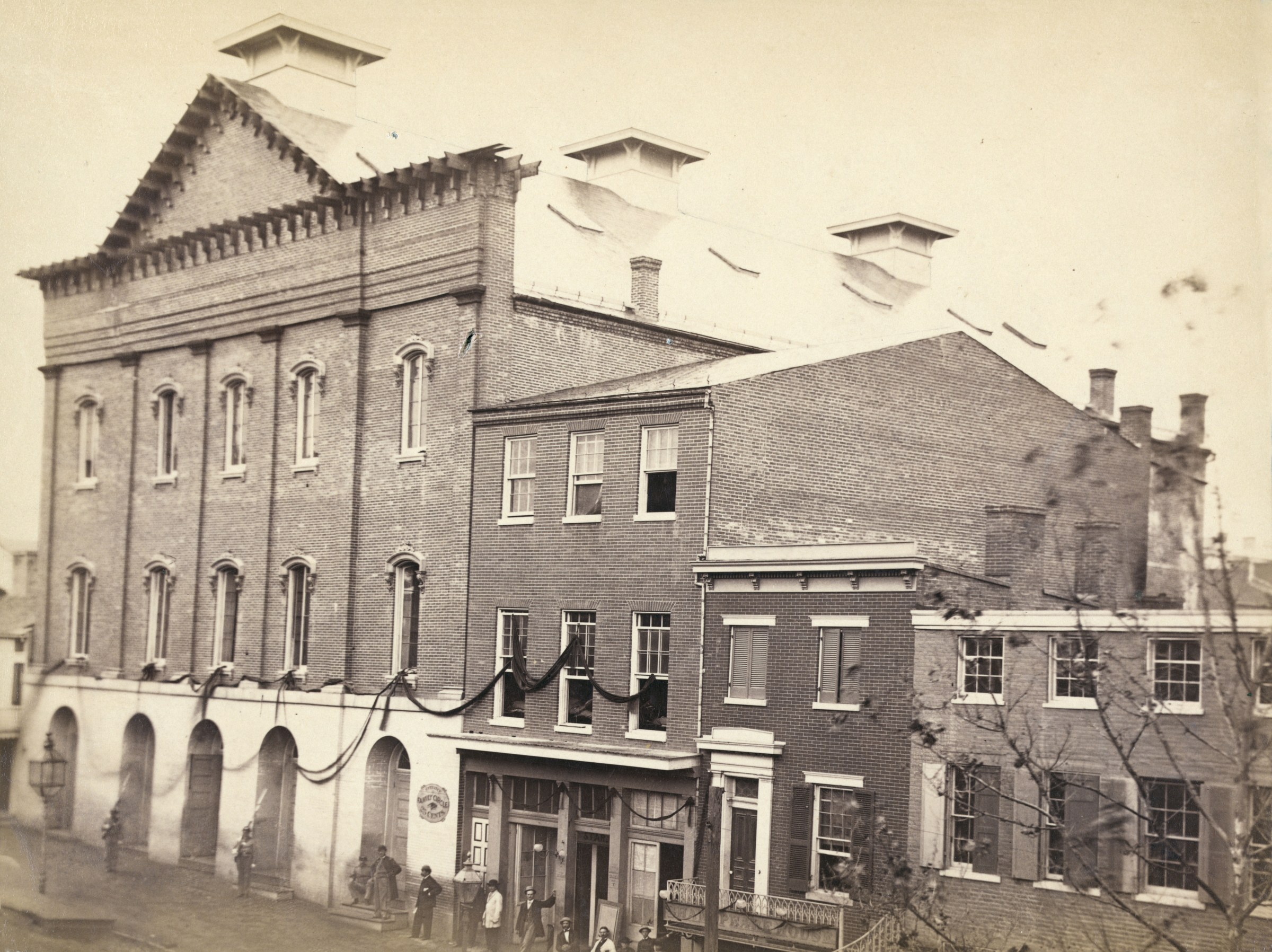
Good Friday. The morning papers carried news of Lee’s surrender; the city was celebrating. Lincoln held a cabinet meeting, then — against the advice of his guard detail — attended the comedy Our American Cousin at Ford’s Theatre that evening with Mary Todd Lincoln, Major Henry Rathbone, and Clara Harris. His bodyguard, John Parker, left his post at some point during the play; the precise timing is disputed, but the box was unguarded when it mattered.
At approximately 10:15 p.m., during the third act, the 26-year-old actor John Wilkes Booth — a famous Shakespearean, a Confederate sympathizer who had been plotting for months — slipped into the presidential box and shot Lincoln in the back of the head with a single-shot derringer. Booth stabbed Rathbone, leapt to the stage (breaking his leg, by most accounts), shouted something — witnesses disagreed on the words; “Sic semper tyrannis” is the traditional version — and escaped out the back door to a waiting horse.
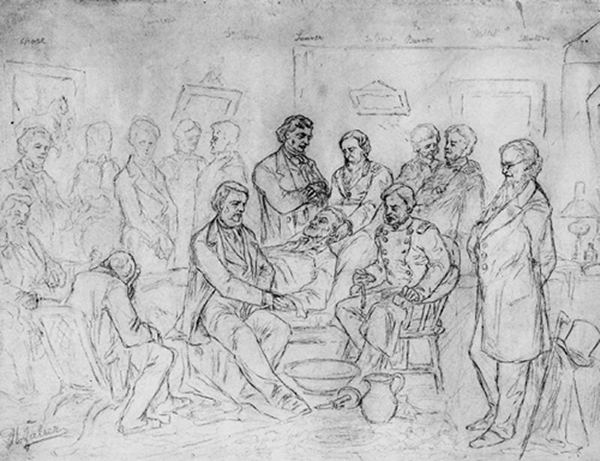
Lincoln never regained consciousness. He was carried across Tenth Street to the Petersen House, where he died at 7:22 a.m. on April 15, 1865. He was 56. Secretary of War Stanton, who ran the government through the night, is credited with the words “now he belongs to the ages” — reported by witnesses, possibly polished in retelling; treat as reported, not verbatim.
The conspiracy
Booth did not act alone. His original plan, hatched in 1864, was to kidnap Lincoln and ransom him for Confederate prisoners; when that collapsed, it became murder — coordinated, simultaneous strikes at the top of the Union government on the night of April 14:
- Booth — Lincoln, at Ford’s Theatre.
- Lewis Powell — Secretary of State William H. Seward, attacked in his bed at home the same night. Powell brutally stabbed Seward, his son Frederick, and others, but Seward survived.
- George Atzerodt — Vice President Andrew Johnson, at the Kirkwood Hotel. Atzerodt lost his nerve, got drunk, and never attempted it.
- David Herold — guided Powell, then fled with Booth.
- Mary Surratt — whose Washington boardinghouse hosted the plotters’ meetings; her level of knowledge remains the most debated question of the trial.
The plot’s scale shows it was meant as a decapitation of the Union government, not a lone revenge killing.
The manhunt and the trial
Booth and Herold fled into Maryland and Virginia, aided by Confederate sympathizers. On April 26, Union cavalry cornered them at Garrett’s farm near Port Royal, Virginia; Herold surrendered, and Booth — who refused — was shot by Sergeant Boston Corbett (against orders to take him alive) and died hours later.
Eight conspirators were tried by military commission in May–June 1865 — itself controversial, since civilian courts were operating. On July 7, 1865, four were hanged: Mary Surratt, Lewis Powell, David Herold, and George Atzerodt. Surratt was the first woman executed by the U.S. federal government; her guilt is still argued. Three others received prison sentences; John Surratt (Mary’s son) fled abroad, was eventually captured, and won acquittal from a hung jury in a civilian trial in 1868.
What remains debated
- Whether Booth shouted “Sic semper tyrannis” (Virginia’s motto) — witnesses disagree; it is tradition, not certain fact.
- Whether the Confederate leadership directed Booth — no credible evidence has ever established it; the consensus is that Booth acted with his circle, not Richmond’s orders.
- Mary Surratt’s guilt — the trial record is the evidence; historians divide.
- The military commission’s legitimacy — debated then and now.
Source notes
- The assassination narrative follows the standard documentary record: the trial transcripts, the War Department investigation files (National Archives), and contemporary press.
- Times (10:15 p.m., 7:22 a.m.) are the conventionally documented figures; minor discrepancies exist in witness accounts and are noted where material.
- Images: Ford’s Theatre, 1865 (public domain); the Petersen House deathbed sketch (1865, via the National Museum of Health and Medicine — CC BY 2.0, attributed in caption). See the image credits on this page.