Lincoln Mythology and the Marble Man
The log cabin, the railsplitter, the saint in marble. How each myth was built — and what survives fact-checking.
The marble man
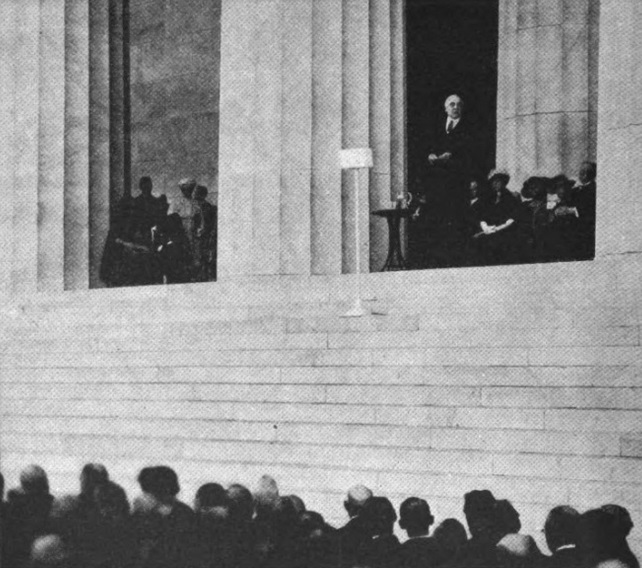
The phrase is Edmund Wilson’s era talking, but the monument is literal: the Lincoln Memorial, dedicated May 30, 1922 (photograph on this page), with Daniel Chester French’s nineteen-foot seated figure and the Second Inaugural and Gettysburg Address carved into the walls. It completed a fifty-year project — begun the morning of April 15, 1865 — of turning a controversial politician into a secular saint. The project had stages, and each stage invented something.
Myth 1: The log cabin
The myth: Lincoln the pure frontier child, born in poverty, rising by sheer virtue.
The evidence: The cabin birth is real (February 12, 1809). The poverty was real but not destitution — Thomas Lincoln owned land and livestock; the family lost ground to title disputes, not to fecklessness. And the “self-made” story skips the stepmother who pushed his reading, the mentors who lent him law books, and the political machine that made him. Real rise, real help.
Myth 2: The railsplitter
The myth: The 1860 campaign’s mascot — “Honest Abe” splitting rails on the frontier, the manual laborer made president.
The evidence: Lincoln did split rails as a young man in Illinois — the campaign displayed actual rails (one set supposedly from 1830). But by 1860 he was a wealthy corporate railroad lawyer, one of the best-paid in Illinois. The campaign knew exactly what it was doing: the rails were props, and brilliant ones.
Myth 3: “Honest Abe”
The myth: The man who could not tell a lie.
The evidence: Lincoln was unusually truthful for a politician — contemporaries remarked on it — and his word was genuinely trusted. He was also a master of strategic silence, misleading emphasis, and the well-timed leak. He told military fibs, pocketed patronage promises, and misled his own cabinet when he thought the cause required it. Honest by the standards of his trade; not a saint by any standard.
Myth 4: The Great Emancipator, single-handed
The myth: Lincoln freed the slaves with a stroke of the pen.
The evidence: The Proclamation was real and transformative — but it was a war measure with exemptions, the enslaved freed themselves in large numbers by fleeing to Union lines, Black soldiers’ service forced the issue politically, and slavery’s legal death required the Thirteenth Amendment, passed by Congress. “Emancipator” is fair; “single-handed” is not. See Emancipation.
Myth 5: The melancholy saint who foresaw his death
The myth: Lincoln the doomed martyr, dreaming of his own assassination (the famous “dream” of a funeral in the White House, reported by Ward Lamon).
The evidence: Lincoln was genuinely melancholic — the evidence for depressive episodes is strong. The prophetic dreams are reported by friends after the fact, when every recollection bent toward martyrdom. He did receive constant death threats and joked about them; whether he foresaw his murder is unknowable, and the stories should be read as grief literature, not reportage.
Why the myths matter
The myths aren’t just errors — they’re evidence of what the country needed Lincoln to be at each stage: the self-made man for the Gilded Age, the folksy democrat for the Depression (Sandburg), the civil-rights forefather for the 1960s. Studying the marble man is studying America. The real man — funnier, shrewder, sadder, and more limited than the statue — is on the other pages of this site.
Source notes
- The myth-by-myth structure follows Merrill Peterson’s Lincoln in American Memory (1994); see sources.md.
- The railsplitter campaign props and Lincoln’s railroad-lawyer income are documented in the standard biographies (Donald; Burlingame).
- The “White House funeral dream” account comes from Ward Lamon’s recollections — post-assassination, and treated here as reported rather than verified.
- Image: the Lincoln Memorial dedication, May 30, 1922 (see the image credits on this page).