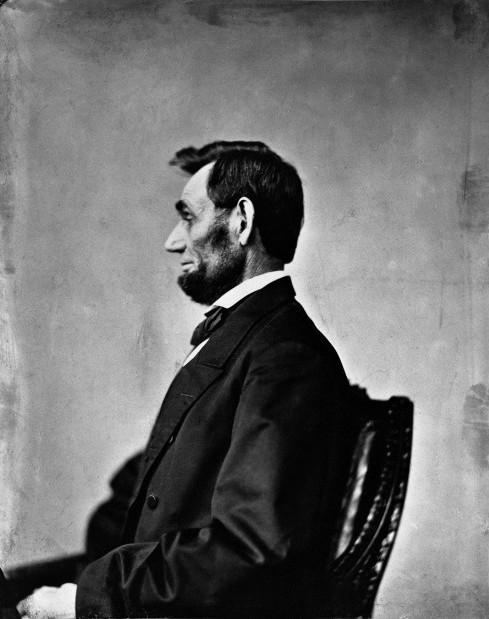
Abraham Lincoln
The 16th president of the United States (1861–1865), who led the country through the Civil War, issued the Emancipation Proclamation, and was assassinated five days after the war's effective end. A neutral reference: documented facts, verbatim quotations with sources, labeled uncertainty.
What this site is
A reference on the historical Abraham Lincoln — not the dramatized stream character, who has his own page here. Every page follows the same rules: documented facts, verbatim quotations with their sources, uncertain claims labeled as uncertain, and real public-domain photographs distinguished from labeled AI dramatization art. See Methodology.
The short version: born February 12, 1809, in a Kentucky log cabin; self-educated frontier lawyer; one term in Congress; lost the 1858 Senate race to Stephen A. Douglas in debates that made him nationally known; elected president in 1860 as the Republican candidate; led the Union through four years of civil war; issued the Emancipation Proclamation on January 1, 1863; delivered the Gettysburg Address and the Second Inaugural; won re-election in 1864; shot by John Wilkes Booth at Ford’s Theatre on April 14, 1865; died the next morning.
Where to go next
- New here? Start with Start Here — the five-minute orientation.
- The life in order: Biography and the Timeline (dates carry certainty labels).
- His words: Speeches & Writings and Sayings — verbatim only, with a labeled section for famous misattributions.
- The people around him: People. The vocabulary: Glossary.
- Deep dives: the Gettysburg Address (all five manuscript versions), the Second Inaugural, the Emancipation Proclamation, the assassination and the conspiracy, what Lincoln actually planned for Reconstruction, the Lincoln-Douglas debates, the cabinet, Lincoln’s religion, the Cooper Union speech, and Lincoln mythology.
- How historians argue about him: Reception & Debates. How this site was built: Sources and Methodology.
Source notes
- Core dates and facts follow the standard documentary record (see sources.md): The Collected Works of Abraham Lincoln (Rutgers University Press, 1953), the Library of Congress, and the National Archives.
- Birth, election, inauguration, proclamation, and assassination dates are among the best-documented in American history; where dating is approximate or disputed, the Timeline says so explicitly.