The Speeches & Writings
The essential texts, in order — what each one was for, and the lines that lasted. All quotations verbatim; full texts and variants live on the deep-dive pages.
1. The Lyceum Address (January 27, 1838)
Delivered to the Young Men’s Lyceum of Springfield at age 28. A young politician’s meditation on how republics die — from within.
“If destruction be our lot, we must ourselves be its author and finisher.”
Source: The Collected Works of Abraham Lincoln, vol. 1. Note: the viral internet version (“America will never be destroyed from the outside…”) is a paraphrase, not his words — see Sayings.
2. The Peoria Speech (October 16, 1854)
Three hours against the Kansas-Nebraska Act — Lincoln’s return to politics and his most sustained early argument against the extension of slavery. He called the repeal of the Missouri Compromise a broken promise and slavery’s expansion a moral wrong the nation could not survive half-embracing.
3. The House Divided Speech (June 16, 1858)
Accepting the Republican Senate nomination at Springfield, Lincoln opened with the line his friends begged him to cut:
“A house divided against itself cannot stand. I believe this government cannot endure, permanently half slave and half free.”
Source: Collected Works, vol. 2. Douglas would spend the debates calling it a doctrine of disunion; Lincoln spent them defending it. See the Lincoln-Douglas deep dive.
4. The Cooper Union Address (February 27, 1860)
A lawyer’s brief, disguised as a speech: Lincoln documented that a majority of the Founders had supported federal restriction of slavery in the territories, then closed with the line that became a campaign slogan — see the deep dive.
“Let us have faith that right makes might, and in that faith, let us, to the end, dare to do our duty as we understand it.”
5. The Farewell Address at Springfield (February 11, 1861)
Eleven sentences at the train depot, leaving for Washington — extemporaneous, by all accounts, and the most personal thing he ever said in public:
“I now leave, not knowing when, or whether ever, I may return, with a task before me greater than that which rested upon Washington.”
6. The First Inaugural Address (March 4, 1861)
A lawyer’s argument for the Union’s perpetuity, closing with an appeal his secretary of state William Seward helped draft — and Lincoln improved:
“We are not enemies, but friends. We must not be enemies. Though passion may have strained, it must not break our bonds of affection. The mystic chords of memory, stretching from every battlefield and patriot grave to every living heart and hearthstone all over this broad land, will yet swell the chorus of the Union, when again touched, as surely they will be, by the better angels of our nature.”
7. The letter to Horace Greeley (August 22, 1862)
Written for publication in the New-York Tribune, after Greeley’s “Prayer of Twenty Millions” demanded faster emancipation. Lincoln stated his hierarchy of aims a month before the Preliminary Proclamation:
“My paramount object in this struggle is to save the Union, and is not either to save or to destroy slavery. If I could save the Union without freeing any slave I would do it, and if I could save it by freeing all the slaves I would do it; and if I could save it by freeing some and leaving others alone I would also do that.”
Abolitionists read it as cold; it was strategy — preparing Northern opinion for what came next. See Emancipation.
8. The Meditation on the Divine Will (c. September 1862)
A private note, never delivered — Lincoln thinking on paper about providence in wartime:
“In great contests each party claims to act in accordance with the will of God. Both may be, and one must be, wrong.”
Source: Collected Works, vol. 5. The seed of the Second Inaugural’s theology. See Lincoln’s religion.
9. The Gettysburg Address (November 19, 1863)
Two minutes, ten sentences, five manuscript versions. The standard (Bliss) text is printed in full on the deep dive.
“…that government of the people, by the people, for the people, shall not perish from the Earth.”
10. The Second Inaugural Address (March 4, 1865)
703 words — the shortest great speech in American history, and the most theologically searching. Printed and analyzed on the deep dive.
“With malice toward none; with charity for all; with firmness in the right, as God gives us to see the right, let us strive on to finish the work we are in…”
11. The last public address (April 11, 1865)
Three days before his death, Lincoln spoke from a White House window about Reconstruction — including his first public suggestion of Black suffrage, limited to “the very intelligent, and… those who serve our cause as soldiers.” John Wilkes Booth was in the crowd; afterward he reportedly said it would be Lincoln’s last speech. See Reconstruction and the assassination.
“It is also unsatisfactory to some that the elective franchise is not given to the colored man. I would myself prefer that it were now conferred on the very intelligent, and on those who serve our cause as soldiers.”
Source notes
- All texts from The Collected Works of Abraham Lincoln (ed. Roy P. Basler, 1953), cross-checked against the Library of Congress’s digitized Lincoln papers and the Miller Center’s transcript collection.
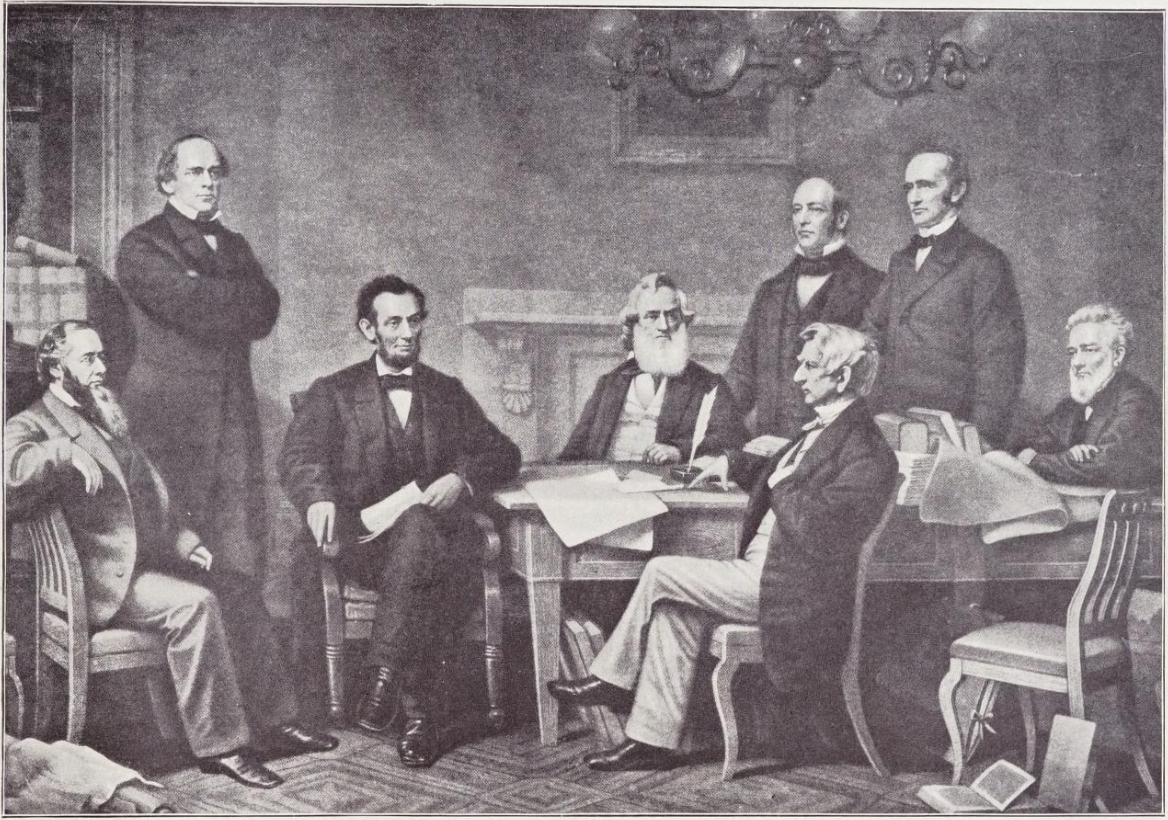
- The image on this page — Carpenter’s 1864 painting of Lincoln reading the preliminary proclamation to his cabinet — depicts the July 22, 1862, cabinet meeting, not the signing; see the image credits on this page.