The Cooper Union Speech
February 27, 1860 — a lawyer's brief disguised as a speech, delivered to New York's elite, that made a prairie politician presidential.
The occasion
In late 1859, Lincoln was invited to speak in New York — originally at Henry Ward Beecher’s church in Brooklyn, moved to the Cooper Union hall in Manhattan. The audience was the Eastern Republican establishment: editors, financiers, and power brokers who had barely heard of the Illinois lawyer. Lincoln researched for weeks, burying himself in the congressional record. He arrived badly dressed (a new suit wrinkled from the train) and, by every account, electrified the room.
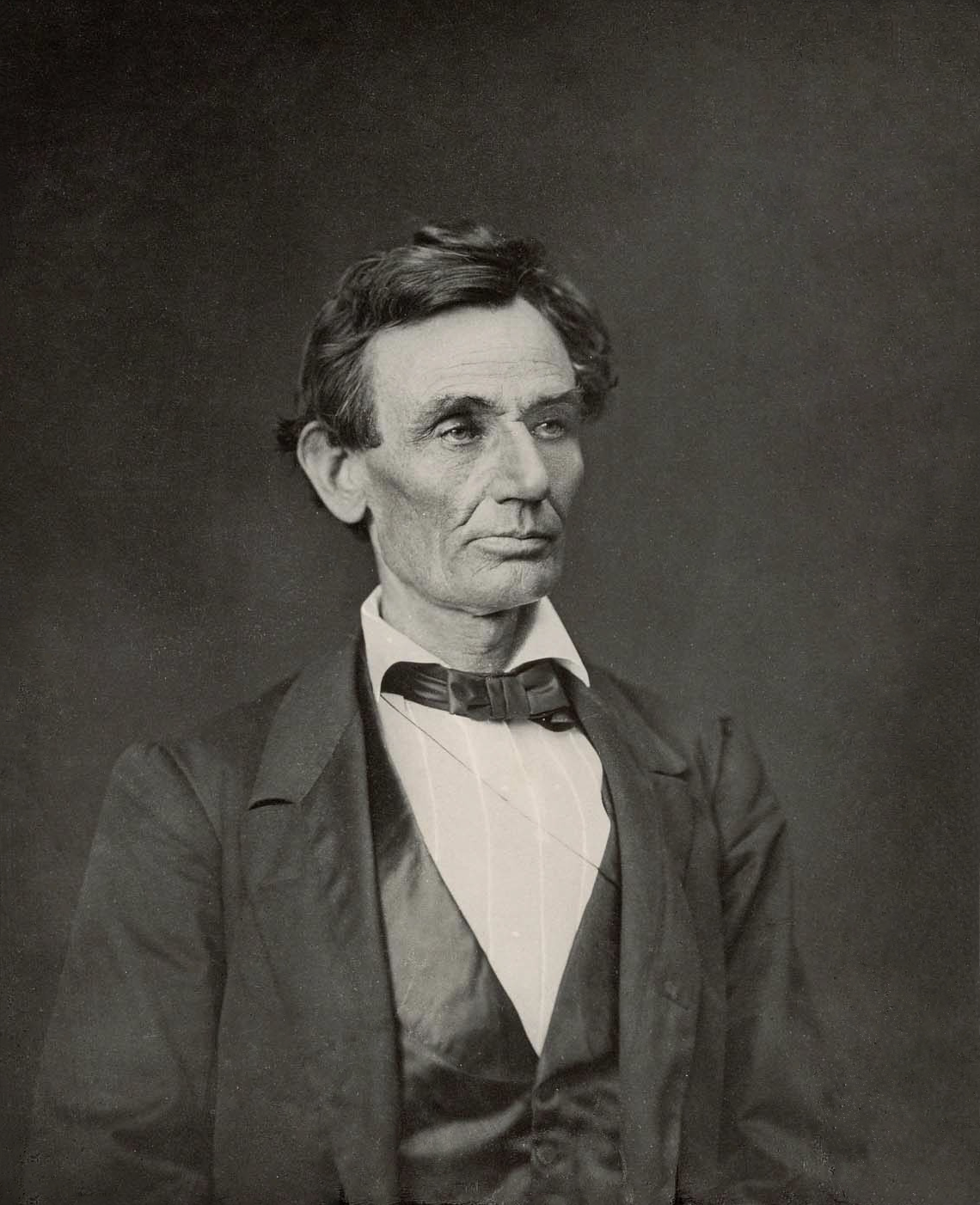
The famous Mathew Brady photograph of Lincoln — the beardless, campaign-defining portrait — was taken the same day, February 27, 1860. (It is not in this site’s collection; the campaign-year portrait on this page is Alexander Hesler’s, from June 1860 in Springfield.)
The argument
The speech’s core was historical and lawyerly: Lincoln documented, vote by vote, that 21 of the 39 signers of the Constitution had supported federal restriction of slavery in the territories — proving that Republican policy was the Founders’ policy, and that it was the South, not the Republicans, who had abandoned the Founders. He then turned to the South directly:
“What will convince them? … If it is slavery that they are for,—if the threat is that they will dissolve the Union unless we let them have their way with slavery in the Territories,—we must meet it as we would any other threat.”
And he closed with the line that became the campaign’s moral:
“Let us have faith that right makes might, and in that faith, let us, to the end, dare to do our duty as we understand it.”
The phrase was a deliberate inversion of the strongman’s “might makes right” — and the audience understood it.
Why it mattered
The speech did three things at once:
- It proved Lincoln could play in the East. Eastern Republicans had dismissed him as a Western anecdote-teller; the speech’s research and structure answered that permanently.
- It positioned him perfectly for 1860. Moderate enough on slavery to hold the party’s center (no abolitionism, no radicalism), firm enough to hold its anti-slavery core — and from Illinois, the state Republicans had to win.
- It created the image. Brady’s photograph, widely reproduced as a campaign print (notably by Currier and Ives), gave the words a face — the tall, solemn, beardless candidate.
Three months later, the Chicago convention nominated him. The standard account gives the Cooper Union speech significant credit for making that possible — an interpretation, but a well-supported one.
Source notes
- Text: The Collected Works of Abraham Lincoln, vol. 3.
- The Brady photograph (February 27, 1860) is held by the Library of Congress; it is referenced here but not reproduced (not in this site’s collection).
- The convention-nomination account follows the standard histories of the 1860 Chicago convention (see sources.md).
- Image: Alexander Hesler’s June 3, 1860, Springfield portrait — beardless, from the campaign year (see the image credits on this page).