Demons in Cabaret & the Jazz Age
The fiction is new; the tradition is old. The real history of devils on stage — cited, and kept firmly separate from the character.
This page is the one place on this site that discusses the real world. Everything about Velvet Damnation himself remains declared invention; nothing here claims he is historical. The history below is documented and cited — it is the tradition the fiction plays with, not the character’s biography.
The Cabaret of Hell: Paris, 1892
The most direct real-world ancestor of The Velvet Club is the Cabaret de l’Enfer (The Cabaret of Hell), founded in November 1892 by Antonin Alexander in Montmartre, Paris — a hell-themed cabaret where patrons entered through the monumental jaws of Leviathan, were greeted by a doorman in a Satan suit with “Enter and be damned!”, and were served by waiters dressed as devils. It stood on the Boulevard de Clichy (moving from number 34 to number 53 in 1895) and operated for over half a century before its demolition in 1950. Its twin across the way, the Cabaret du Ciel (Cabaret of Heaven), dressed its waiters as angels — damnation and salvation as neighboring dinner shows.
A third neighbor, the Cabaret du Néant (Cabaret of the Void), went further into the macabre: a “tavern of death” where hosts used the Pepper’s Ghost illusion to make revelers appear to melt into skeletons.
Sources: Cabaret de L’Enfer — Wikipedia; Gizmodo on the heaven-and-hell nightclubs of 1890s Paris, drawing on W. C. Morrow’s Bohemian Paris of To-day — including his account of devil musicians playing “a selection from Faust” while red imps prodded laggards with red-hot irons.
Faust: the devil as entertainer
Long before Montmartre, the devil was already show business. Christopher Marlowe’s Doctor Faustus (c. 1604) put a deal-with-the-devil on the public stage; Goethe’s Faust (Part One, 1808) made Mephistopheles literature’s great charming tempter; Gounod’s opera Faust (1859) made him sing. The throughline: the devil as the most charismatic figure in the room — the exact archetype Velvet Damnation’s persona riffs on, with the menace filed down to mischief.
Crossroads and contracts
The American thread runs through the blues: the oft-told legend — popularized by the 1960s blues revival — that a musician could trade his soul at a midnight crossroads for mastery of his instrument. The “deal” as a story about artistry, ambition, and the price of the spotlight. The Velvet Club’s bar deals are this legend played for laughs: signed in magenta ink, witnessed by the room, void by sunrise.
The Jazz Age stage
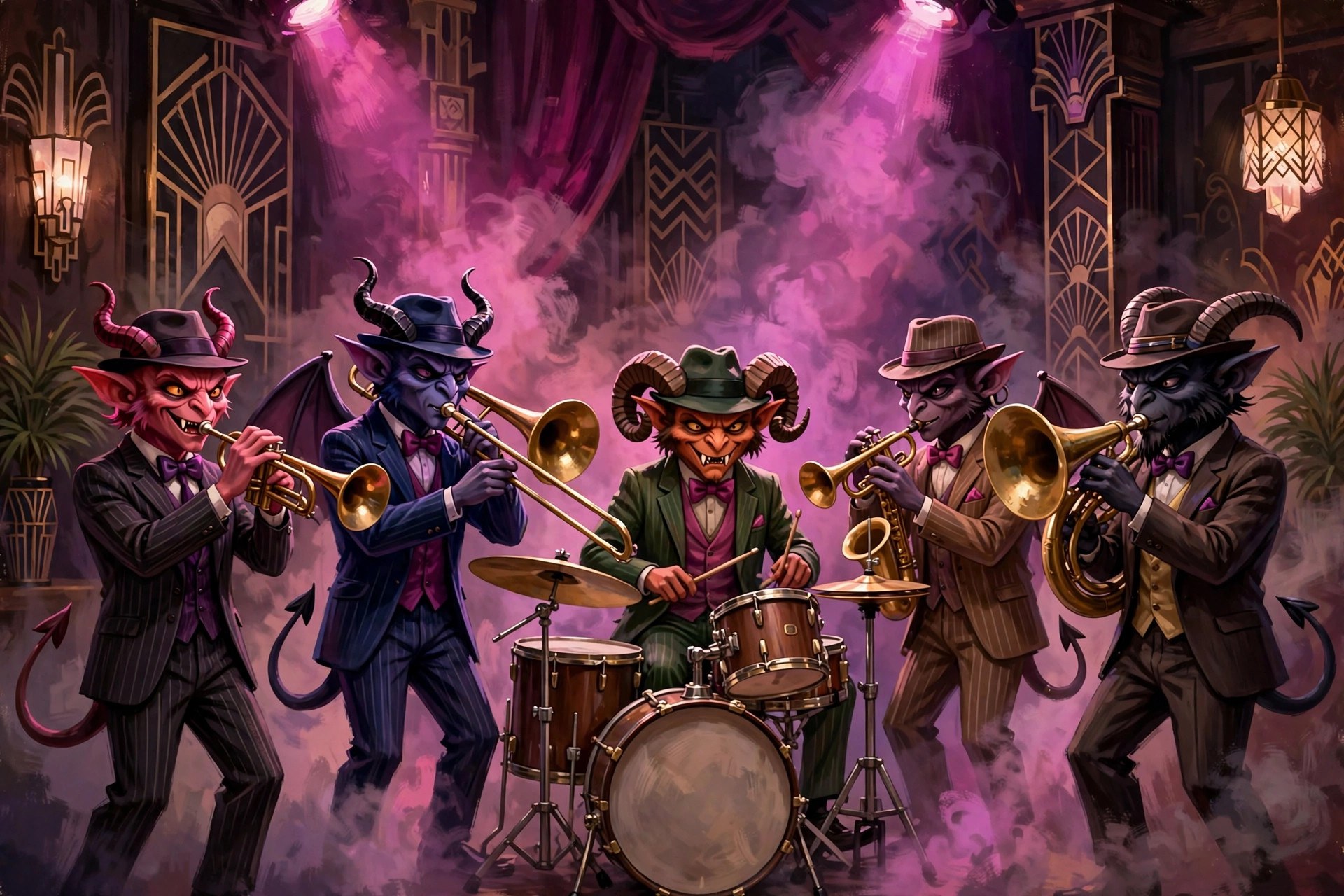
The 1920s gave the demon-host archetype its natural habitat: the jazz club. Harlem’s Cotton Club — where Duke Ellington’s orchestra held court from 1927 with its “jungle style” — proved that a late-night room with a charismatic frontman could be the center of a city’s imagination. Velvet Damnation’s midnight shows, his band introductions, his house toast: all jazz-age stagecraft, filtered through demonology.
The boundary
To be explicit: the Cabaret de l’Enfer was real; The Velvet Club is not. Faust is literature; Velvet Damnation is a Vizlings app character with one line of canon (“Velvet Damnation Demon Tuxedo”). This page exists so the fiction’s ingredients are visible — never to suggest the character walked out of history.
Source notes
- Cabaret de l’Enfer / du Ciel / du Néant: founded November 1892 by Antonin Alexander; Boulevard de Clichy, Paris; demolished 1950 — Wikipedia; Gizmodo (via W. C. Morrow, Bohemian Paris of To-day); Dennis Cooper blog roundup.
- “Enter and be damned!” doorman greeting and devil-waiter details: 1899 visitor account via Euvolution/Morbid Anatomy.
- Doctor Faustus (c. 1604), Goethe’s Faust Part One (1808), Gounod’s Faust (1859): standard literary history; see sources.md for editions.
- Crossroads legend and Cotton Club/Ellington (1927–1931): standard music history; framed here as legend where the scholarship is contested.
- Page written 2026-09-27.