Cats in Mythology
The real myths behind the fictional cat — Bastet, nine lives, and folk belief, cited honestly and kept separate from character canon.
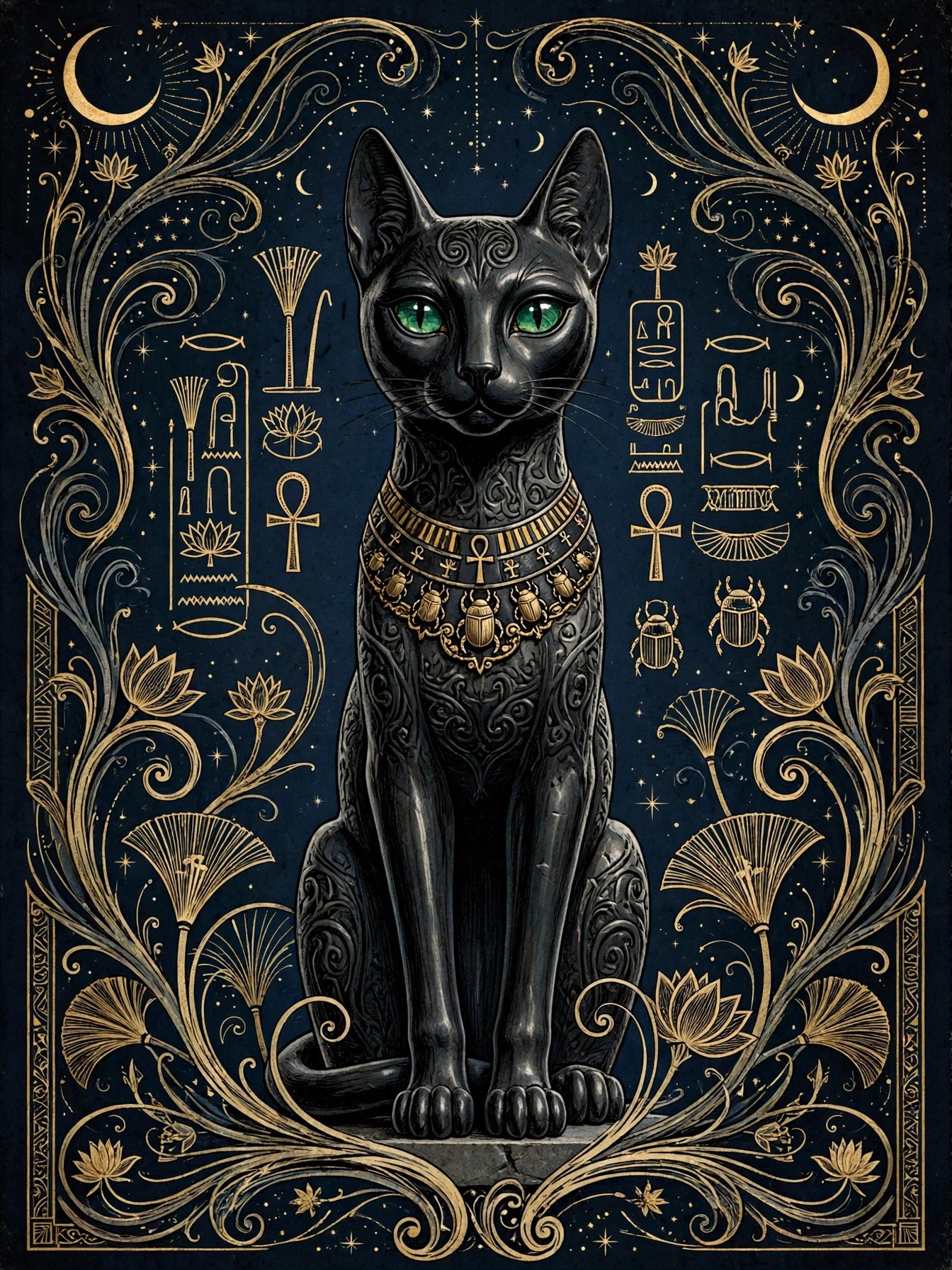
Bastet — the Egyptian cat goddess
Bastet (also Bast) was a goddess of ancient Egyptian religion, depicted as a woman with the head of a domesticated cat or as a cat outright. She was associated with home, fertility, protection, and — in her later form — with music, dance, and pleasure. Her cult center was the city of Bubastis in the Nile Delta, and the Greek historian Herodotus described the great festival held in her honor there (Histories, Book 2).
Cats in Egypt were deeply revered: harming one was a grave offense, and cats were mummified and buried with ceremony. This is genuine history — and it is the real-world root of Cat Jon’s sixth-life museum episode in Lore, where the fictional character sits before a real tradition’s statue. The episode is invented; the goddess is not.
The nine lives
The saying that cats have nine lives is genuine folk belief, widespread in the English-speaking world (other traditions say seven). Its exact origin is uncertain — proposed roots include the cat’s remarkable ability to survive falls and danger, and older associations of the number nine with completeness. What matters for honesty: it is folklore, not zoology. Real cats have one life, and they spend it magnificently.
Cat Jon’s nine remembered lives in Lore are a fictional riff on this folk saying — character canon, clearly labeled, borrowing the number and nothing else.
Cats in folklore
- Witches’ familiars: in early modern European folklore and witch-trial records, cats — especially black cats — were said to serve as witches’ familiars. This is documented belief, not documented fact.
- Luck, good and bad: black cats are considered unlucky in some traditions and lucky in others (in Britain and Japan, for instance, they are often seen as fortunate). The belief varies by place — a good reminder that folklore is local.
- The King of Cats: a folk tale found across the British Isles in which a cat witnesses a funeral procession of cats and learns he is their new king. A story about cats, told by humans, for humans.
- Ship’s cats: genuinely historical — cats were carried aboard ships for millennia to control vermin, and were considered good luck. Cat Jon’s third life nods to this real practice; the life itself is invented.
What this page does not do
It does not claim any myth as fact beyond what scholars document as belief. It does not present Cat Jon as mythological. And it does not let the character’s fiction borrow the authority of real tradition — the boundary runs both ways.
Sources for the real material
- Herodotus, Histories, Book 2 — on the festival of Bastet at Bubastis (public domain translations widely available).
- Standard Egyptological references on Bastet and the Bubastis cult (museum and university publications).
- Folklore collections on the nine-lives saying, familiars, and the King of Cats tale (documented as belief/tradition, not fact).
Source notes
- Real-world claims on this page are cited to genuine sources above; they describe documented belief and history, not the fictional character.
- All character-canon material (Cat Jon’s lives, the club, the cast) is fictional and lives on the lore pages; see Methodology.
- No real person is depicted or implied anywhere on this site.