Sayings
The famous lines, quoted accurately — each with its play, act, and scene.
Shakespeare wrote the lines; four centuries of quotation have worn some of them smooth and bent others out of shape. Below, 40 of the best-known are given in their dramatic context, with exact citations. Wording follows the standard modern-spelling texts (Folio tradition); where a famous variant exists, it is noted.
Tragedies
“To be, or not to be: that is the question”
To be, or not to be: that is the question: Whether ‘tis nobler in the mind to suffer The slings and arrows of outrageous fortune, Or to take arms against a sea of troubles, And by opposing end them.
Reference: Hamlet, Act 3, Scene 1. Hamlet’s great soliloquy — a weighing of life against death, spoken as he contemplates suicide.
“There are more things in heaven and earth, Horatio”
There are more things in heaven and earth, Horatio, Than are dreamt of in your philosophy.
Reference: Hamlet, Act 1, Scene 5. Hamlet to his friend after the ghost’s revelations — a rebuke to tidy rationalism.
“To thine own self be true”
This above all: to thine own self be true, And it must follow, as the night the day, Thou canst not then be false to any man.
Reference: Hamlet, Act 1, Scene 3. Polonius’s advice to Laertes — much quoted, and much undercut by the fact that Polonius himself is a scheming courtier.
“The lady doth protest too much, methinks”
Reference: Hamlet, Act 3, Scene 2. Gertrude, watching the play-within-the-play — the origin of the phrase for overdone denials.
“Good night, sweet prince”
Now cracks a noble heart. Good night, sweet prince, And flights of angels sing thee to thy rest!
Reference: Hamlet, Act 5, Scene 2. Horatio’s farewell over Hamlet’s body.
“Something is rotten in the state of Denmark”
Reference: Hamlet, Act 1, Scene 4. Marcellus, after the ghost appears — corruption sensed before it is understood.
“Fair is foul, and foul is fair”
Fair is foul, and foul is fair: Hover through the fog and filthy air.
Reference: Macbeth, Act 1, Scene 1. The witches’ chant — the play’s moral compass, deliberately broken.
“Out, damned spot! out, I say!”
Reference: Macbeth, Act 5, Scene 1. Lady Macbeth sleepwalking, trying to wash invisible blood from her hands.
“Tomorrow, and tomorrow, and tomorrow”
Tomorrow, and tomorrow, and tomorrow, Creeps in this petty pace from day to day To the last syllable of recorded time… Life’s but a walking shadow, a poor player That struts and frets his hour upon the stage And then is heard no more. It is a tale Told by an idiot, full of sound and fury, Signifying nothing.
Reference: Macbeth, Act 5, Scene 5. Macbeth, on hearing of his wife’s death — despair as metaphysics.
“Double, double toil and trouble”
Double, double toil and trouble; Fire burn, and caldron bubble.
Reference: Macbeth, Act 4, Scene 1. The witches brewing their charm — the most parodied spell in English.
“Is this a dagger which I see before me”
Is this a dagger which I see before me, The handle toward my hand? Come, let me clutch thee.
Reference: Macbeth, Act 2, Scene 1. Macbeth hallucinating on the way to murder Duncan.
“The green-eyed monster”
O, beware, my lord, of jealousy; It is the green-eyed monster which doth mock The meat it feeds on.
Reference: Othello, Act 3, Scene 3. Iago — warning Othello against the very jealousy he is busy manufacturing.
“One who loved not wisely but too well”
Then must you speak Of one that loved not wisely but too well, Of one not easily jealous, but being wrought Perplex’d in the extreme.
Reference: Othello, Act 5, Scene 2. Othello’s final self-assessment, spoken before he takes his own life.
“Nothing will come of nothing”
Reference: King Lear, Act 1, Scene 1. Lear to Cordelia, demanding flattery — the refusal that unmakes a kingdom.
“How sharper than a serpent’s tooth”
How sharper than a serpent’s tooth it is To have a thankless child!
Reference: King Lear, Act 1, Scene 4. Lear, on his daughters’ ingratitude.
“More sinned against than sinning”
I am a man More sinn’d against than sinning.
Reference: King Lear, Act 3, Scene 2. Lear in the storm — beginning, at last, to take his own moral inventory.
“As flies to wanton boys”
As flies to wanton boys are we to the gods, They kill us for their sport.
Reference: King Lear, Act 4, Scene 1. The blinded Gloucester — the play’s bleakest theology.
“Wherefore art thou Romeo?”
O Romeo, Romeo! wherefore art thou Romeo? Deny thy father and refuse thy name.
Reference: Romeo and Juliet, Act 2, Scene 2. “Wherefore” means why — Juliet asks why he must be a Montague, not where he is.
“What’s in a name?”
What’s in a name? that which we call a rose By any other name would smell as sweet.
Reference: Romeo and Juliet, Act 2, Scene 2. Juliet’s argument that names are accidents.
“A plague o’ both your houses!”
A plague o’ both your houses! They have made worms’ meat of me.
Reference: Romeo and Juliet, Act 3, Scene 1. The dying Mercutio — the curse the rest of the play fulfills.
“Parting is such sweet sorrow”
Good night, good night! parting is such sweet sorrow, That I shall say good night till it be morrow.
Reference: Romeo and Juliet, Act 2, Scene 2. Juliet to Romeo at the close of the balcony scene.
“Friends, Romans, countrymen, lend me your ears”
Friends, Romans, countrymen, lend me your ears; I come to bury Caesar, not to praise him. The evil that men do lives after them; The good is oft interred with their bones.
Reference: Julius Caesar, Act 3, Scene 2. Antony’s funeral oration — rhetoric as a weapon.
“Et tu, Brute? Then fall, Caesar”
Reference: Julius Caesar, Act 3, Scene 1. Caesar’s last words in the play — Shakespeare’s Latin invention; the ancient sources report no such line.
“The fault, dear Brutus, is not in our stars”
The fault, dear Brutus, is not in our stars, But in ourselves, that we are underlings.
Reference: Julius Caesar, Act 1, Scene 2. Cassius, recruiting Brutus to the conspiracy.
Comedies
“All the world’s a stage”
All the world’s a stage, And all the men and women merely players; They have their exits and their entrances, And one man in his time plays many parts.
Reference: As You Like It, Act 2, Scene 7. Jaques’s “Seven Ages of Man” speech.
“If music be the food of love, play on”
Reference: Twelfth Night, Act 1, Scene 1. Orsino’s opening line — love as appetite.
“Some are born great”
Some are born great, some achieve greatness, and some have greatness thrust upon ‘em.
Reference: Twelfth Night, Act 2, Scene 5. Malvolio, reading Maria’s forged letter — the gull at full sail.
“The course of true love never did run smooth”
Reference: A Midsummer Night’s Dream, Act 1, Scene 1. Lysander’s complaint — the thesis of every romantic comedy since.
“Lord, what fools these mortals be!”
Reference: A Midsummer Night’s Dream, Act 3, Scene 2. Puck, surveying the lovers’ chaos he himself caused.
“The quality of mercy is not strained”
The quality of mercy is not strain’d, It droppeth as the gentle rain from heaven Upon the place beneath. It is twice blest: It blesseth him that gives and him that takes.
Reference: The Merchant of Venice, Act 4, Scene 1. Portia, disguised as a lawyer — pleading for a mercy she will not herself extend.
“All that glisters is not gold”
All that glisters is not gold; Often have you heard that told.
Reference: The Merchant of Venice, Act 2, Scene 7. The scroll inside the golden casket — “glisters,” not “glitters,” in the original.
“If you prick us, do we not bleed?”
I am a Jew. Hath not a Jew eyes? hath not a Jew hands, organs, dimensions, senses, affections, passions? … If you prick us, do we not bleed? if you tickle us, do we not laugh? if you poison us, do we not die?
Reference: The Merchant of Venice, Act 3, Scene 1. Shylock’s great speech of common humanity — followed immediately by his demand for revenge.
“We are such stuff as dreams are made on”
We are such stuff As dreams are made on, and our little life Is rounded with a sleep.
Reference: The Tempest, Act 4, Scene 1. Prospero, after dissolving his spirits’ masque — the play’s farewell to illusion.
“O brave new world”
O wonder! How many goodly creatures are there here! How beauteous mankind is! O brave new world, That has such people in’t!
Reference: The Tempest, Act 5, Scene 1. Miranda, seeing the courtiers for the first time — innocent wonder; the audience knows these people are schemers.
Histories
“Now is the winter of our discontent”
Now is the winter of our discontent Made glorious summer by this sun of York.
Reference: Richard III, Act 1, Scene 1. Richard’s opening soliloquy — “sun of York” puns on son: Edward IV.
“My kingdom for a horse!”
A horse! a horse! my kingdom for a horse!
Reference: Richard III, Act 5, Scene 4. Richard at Bosworth, unhorsed — desperation in five words.
“Once more unto the breach”
Once more unto the breach, dear friends, once more; Or close the wall up with our English dead.
Reference: Henry V, Act 3, Scene 1. Henry rallying his troops at Harfleur.
“We band of brothers”
We few, we happy few, we band of brothers; For he to-day that sheds his blood with me Shall be my brother.
Reference: Henry V, Act 4, Scene 3. The St Crispin’s Day speech before Agincourt.
“The better part of valour is discretion”
The better part of valour is discretion; in the which better part I have saved my life.
Reference: Henry IV, Part 1, Act 5, Scene 4. Falstaff, having played dead to survive the battle — cowardice rebranded as wisdom.
“This sceptred isle”
This royal throne of kings, this sceptred isle, This earth of majesty, this seat of Mars, This other Eden, demi-paradise…
Reference: Richard II, Act 2, Scene 1. John of Gaunt’s dying praise of England — quoted by patriots ever since, though the speech ends in lament for what England has become.
Source notes
- All 40 quotations checked against public-domain modern-spelling texts in the First Folio textual tradition (Open Source Shakespeare; Project Gutenberg editions of the plays).
- Citation format: play + act + scene, per methodology. Line numbers vary by edition; act and scene are stable.
- Wording notes: “glisters” (not “glitters”) is the Folio/Quarto reading; “wherefore” = “why”; “Et tu, Brute?” is Shakespeare’s invention, not a historical report.
- “The lady doth protest too much, methinks” is Gertrude’s line at Hamlet 3.2 — frequently misattributed to Hamlet himself.
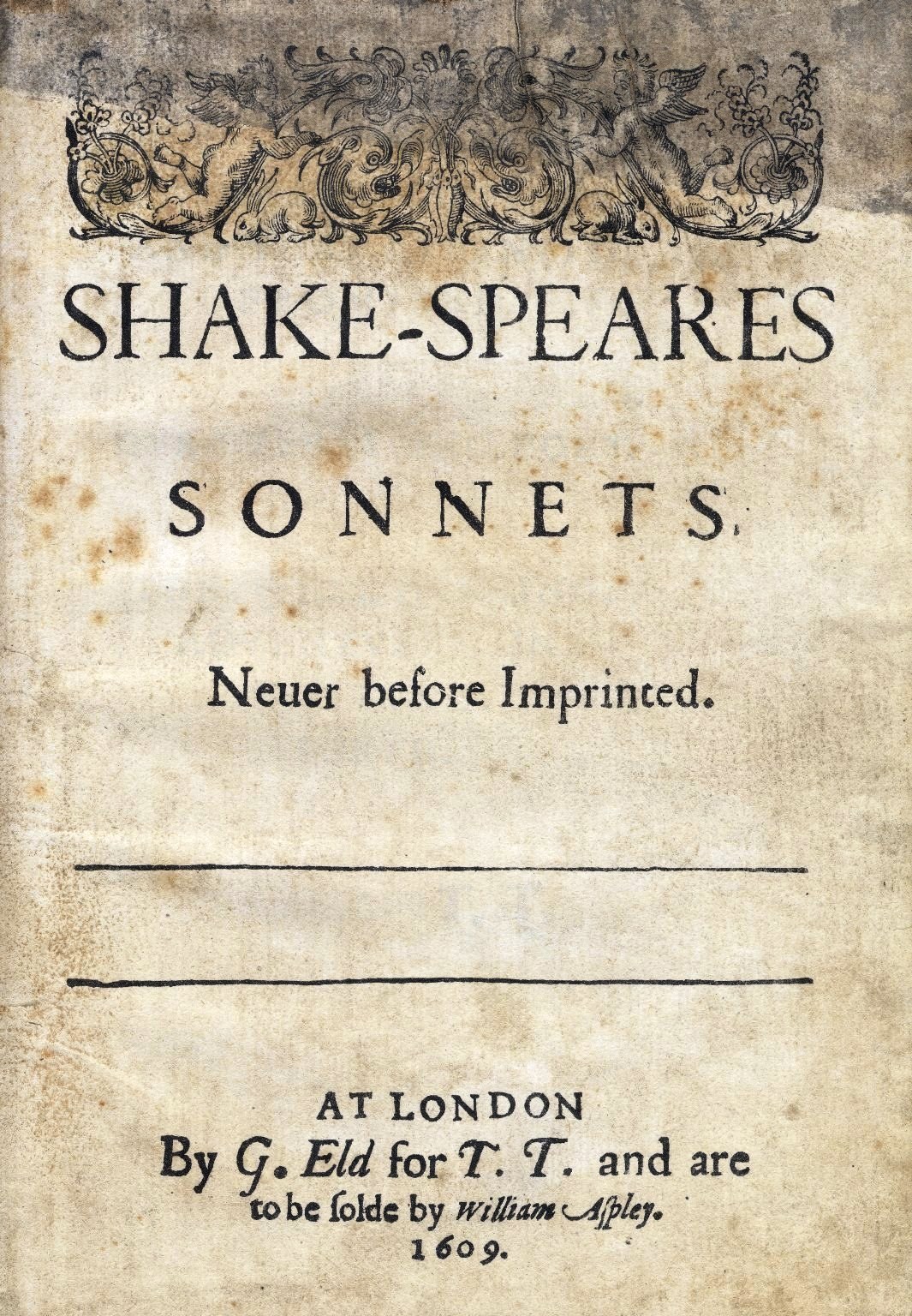
- Image: title page of Shake-speares Sonnets (1609) — see the image credits on this page.