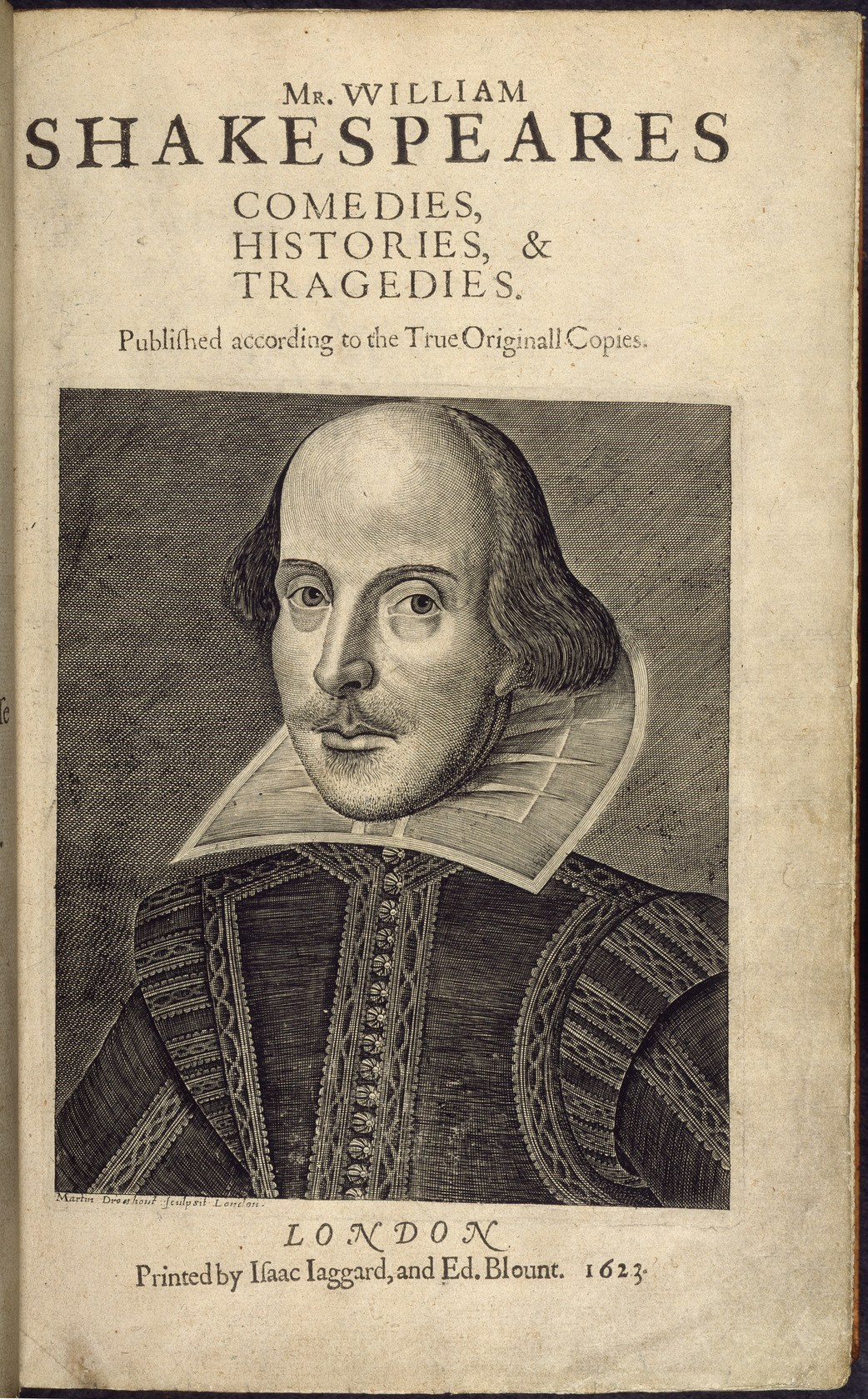
The First Folio
Eighteen plays that had never been printed, gathered by two actors seven years after the author's death. Without this book, there is no Macbeth.
The most important book in English literature is a posthumous rescue job. When William Shakespeare died in 1616, about half his plays existed only as manuscripts in his company’s possession — scripts, not literature. In 1623, two of his fellow actors did something about it.
The makers
John Heminges and Henry Condell had acted alongside Shakespeare for decades — Heminges is named in the 1603 royal patent; both were Globe and Blackfriars sharers, and both are remembered in Shakespeare’s will (26s 8d each, to buy memorial rings). They edited Mr. William Shakespeares Comedies, Histories, & Tragedies — the First Folio — published in London in 1623 by the printers Isaac Jaggard and Edward Blount.
Their preface, “To the great Variety of Readers,” is frank about the mission: earlier printed texts were “stolne and surreptitious copies, maimed and deformed by the frauds and stealthes of injurious impostors” — the bad quartos — and “we have scarse received from him a blot in his papers,” they claim, offering the plays “cured, and perfect of their limbes.”
What’s inside
The Folio contains 36 plays, organized by Heminges and Condell’s famous three-way split — Comedies, Histories, Tragedies — a classification that still shapes how we shelve Shakespeare. 18 of the 36 had never been printed before. The rescue list includes:
The Tempest, The Two Gentlemen of Verona, Measure for Measure, The Comedy of Errors, As You Like It, The Taming of the Shrew, All’s Well That Ends Well, Twelfth Night, The Winter’s Tale, King John, Henry VI Part 1, Henry VIII, Coriolanus, Julius Caesar, Macbeth, Antony and Cleopatra, Cymbeline, and Timon of Athens.
Read that list again: no Macbeth, no Twelfth Night, no Julius Caesar, no Tempest without two actors’ decision to print. Pericles — printed in quarto in 1609 — was left out, likely over rights; The Two Noble Kinsmen (1613, with Fletcher) was not yet attributed and would wait for the Second Folio era’s successors. Cardenio was never printed at all (see the lost plays).
The portrait
The title page carries the Droeshout engraving — Martin Droeshout’s portrait of Shakespeare, the only likeness with any early authority (see caption note). Opposite it, Ben Jonson’s verses:
This Figure, that thou here seest put, It was for gentle Shakespeare cut; Wherein the Graver had a strife with Nature, to out-doo the life: O, could he but have drawne his wit As well in brasse, as he hath hit His face; the Print would then surpasse All, that was ever writ in brasse.
Jonson’s longer eulogy in the Folio, “To the memory of my beloved, the AUTHOR,” gives the book its most famous lines: “He was not of an age, but for all time!” and the address to the “Sweet Swan of Avon.” Jonson had teased Shakespeare in life; in the Folio he canonized him.
The print run and survival
About 750 copies were printed. The price was 20 shillings (£1) unbound — roughly a week’s wages for a skilled craftsman, and the buyer then paid a binder separately. Of the 750, about 233 survive today, most incomplete; only a few dozen are substantially complete. The Folger Shakespeare Library holds 82.
The book sold well enough to justify three more folio editions (1632, 1663–64, 1685), each introducing new errors and corrections that have kept textual scholars employed for four centuries.
Why it matters
The First Folio is the sole authority for half the canon, the first attempt to define what Shakespeare wrote (as opposed to what got printed), and the origin of the genre divisions every edition still uses. Heminges and Condell were not scholars; they were actors saving their friend’s life’s work from the fate of every other playwright’s manuscripts — oblivion. It worked.
Source notes
- Publication (1623), Jaggard & Blount, Heminges & Condell editorship, the 36/18 figures: standard Folio scholarship (see sources).
- Print run ~750, price 20 shillings, ~233 surviving copies, 82 at the Folger: Folger Shakespeare Library and standard accounts; the £1 price is documented from contemporary stationers’ records.
- Jonson’s verses quoted verbatim from the First Folio preliminaries (“not of an age, but for all time”; “Sweet Swan of Avon”).
- The 18 first-printed plays: the Folio’s table of contents; Troilus and Cressida’s awkward placement (and near-exclusion over rights) is the standard textual note.
- The bequest of 26s 8d to Heminges, Condell, and Burbage in Shakespeare’s will (1616): the will’s text.
- Image: the Folio’s engraved title page — British Library copy (CC0), see the image credits on this page.
Limitations
- The “no blot” claim is self-advertising by the editors, not a scholarly finding; the Folio’s texts show plenty of revision and corruption.
- Survival counts (~233) shift as copies are identified or reattributed; treat the figure as current scholarship, not a fixed total.