Glossary
The language of Shakespeare's England — words, oaths, and theatre terms in plain language.
Shakespeare’s English is modern English with the edges still rough: the pronouns shift by social rank, the oaths dodge blasphemy laws, and the theatre has its own vocabulary. Forty terms below.
Words and pronouns
thou / thee / thy / thine
The singular “you” — intimate, or insulting. Thou (subject), thee (object), thy/thine (possessive, like a/an). Superiors say “thou” down; equals say it to show closeness; using it to a stranger picks a fight.
you / your
The plural or formal singular — respectful, distant, safe. The thou/you switch inside a scene is often the whole emotional story.
prithee
” I pray thee” — please, or “tell me.” Prithee, tell me = “please tell me.”
hark
Listen! “Hark, the lark” is not decoration — it means listen.
anon
Soon, in a moment. Also “coming!” — a servant’s “anon, sir” means “coming, sir.”
ere
Before. “Ere the sun rises” = before sunrise.
wherefore
Why — not where. Juliet’s “wherefore art thou Romeo” asks why he is Romeo (a Montague), not where he is.
forsooth
“Truly,” “indeed” — often with an edge of mockery.
marry
An interjection (“indeed!”), from “Mary” (the Virgin) — mild oath, not the wedding.
fie
Shame! An exclamation of disgust. “Fie upon’t!”
tush
Tut — an exclamation of impatience or contempt.
alack
Alas — sorrow, regret. “Alack, I love myself” (Richard III, of all people).
gramercy
“Great thanks” — from French grand merci.
beshrew
A mild curse: “beshrew me” = “curse me (if I’m wrong).” Often playful.
fain / lief
Gladly / willingly. “I would fain die a dry death” (Tempest) — willingly.
perchance / mayhap
Perhaps, maybe.
straight / straightway
Immediately. “Go straight” means go at once.
betwixt
Between.
whence / whither / hither / thither / yonder
Where-from / where-to / here / there / over-there. The directional toolkit.
tarry
Wait, linger, delay. “Tarry a little” = wait a moment.
hie
Hurry, hasten. “Hie thee home.”
list
Listen (verb). “List, list, O list!”
wot
Know. “Wottest thou?” = do you know?
mark me
Pay attention to me — often a cue that something important follows.
soft
Hush, wait a moment. “Soft! what light through yonder window breaks.”
anon, sir (servant’s cry)
“Coming, sir!” — shouted by servants offstage.
Oaths and insults
zounds
“God’s wounds” — a strong oath, clipped to dodge the blasphemy statutes.
‘sblood
“God’s blood” — same trick, stronger.
swounds
“God’s wounds” again — oaths came in a whole clipped wardrobe.
od’s bodikins
“God’s little body” — a mild, almost comic oath.
by’r lady
“By Our Lady” — a mild oath, frequent in women’s speech.
i’faith
“In faith” — honestly, truly.
knave
A dishonest man, a rogue — or just “fellow,” depending on tone.
varlet
A rascal, a low fellow.
bawd
A go-between in shady dealings, originally sexual.
wench
A young woman — affectionate or insulting by context.
coz
Cousin — used loosely for any kinsman or close friend.
good den
“Good evening” (from “good e’en”).
Theatre and print
groundlings
The penny-paying standing audience in the yard — the rowdiest, sharpest crowd in the house.
tiring-house
The backstage rooms (“attiring house”) where actors dressed and waited.
heavens
The painted canopy over the stage, representing the sky — gods descended from it.
discovery space
The curtained recess at the back of the stage for reveals (a bed, a tomb, a statue).
jig
The comic song-and-dance number that closed a performance — Rowley and Kemp territory.
sharer
A part-owner of the acting company — Shakespeare was one, which is why he died rich.
boy player
Young male actors played all women’s roles; women were barred from the public stage.
Lord Chamberlain’s Men / King’s Men
Shakespeare’s company: formed 1594 under the Lord Chamberlain’s patronage; renamed the King’s Men when James I took them in 1603.
quarto
A small-format playbook, printed from a single sheet folded twice. Cheap, quick — eighteen Shakespeare plays reached print this way in his lifetime.
folio
A large-format book, sheet folded once — prestige format. The 1623 First Folio collected 36 plays, 18 of them never before printed.
bad quarto
A garbled printed text, probably reconstructed from memory by actors — e.g., the 1603 Hamlet Q1.
Stationers’ Register
The London guild’s record book: entering a title licensed it for print. Many Shakespeare publication dates come from its entries.
Blackfriars
The indoor, candlelit winter playhouse the King’s Men took over in 1608 — smaller, pricier, more intimate than the Globe.
Source notes
- Definitions checked against the Oxford English Dictionary historical senses and the Folger Shakespeare Library’s “Shakespeare’s Words” guidance.
- Theatre terms (tiring-house, heavens, discovery space, jig): standard Elizabethan stage scholarship; see Andrew Gurr, The Shakespearean Stage.
- Quarto/folio formats and “bad quartos”: textual scholarship summarized in the plays source notes.
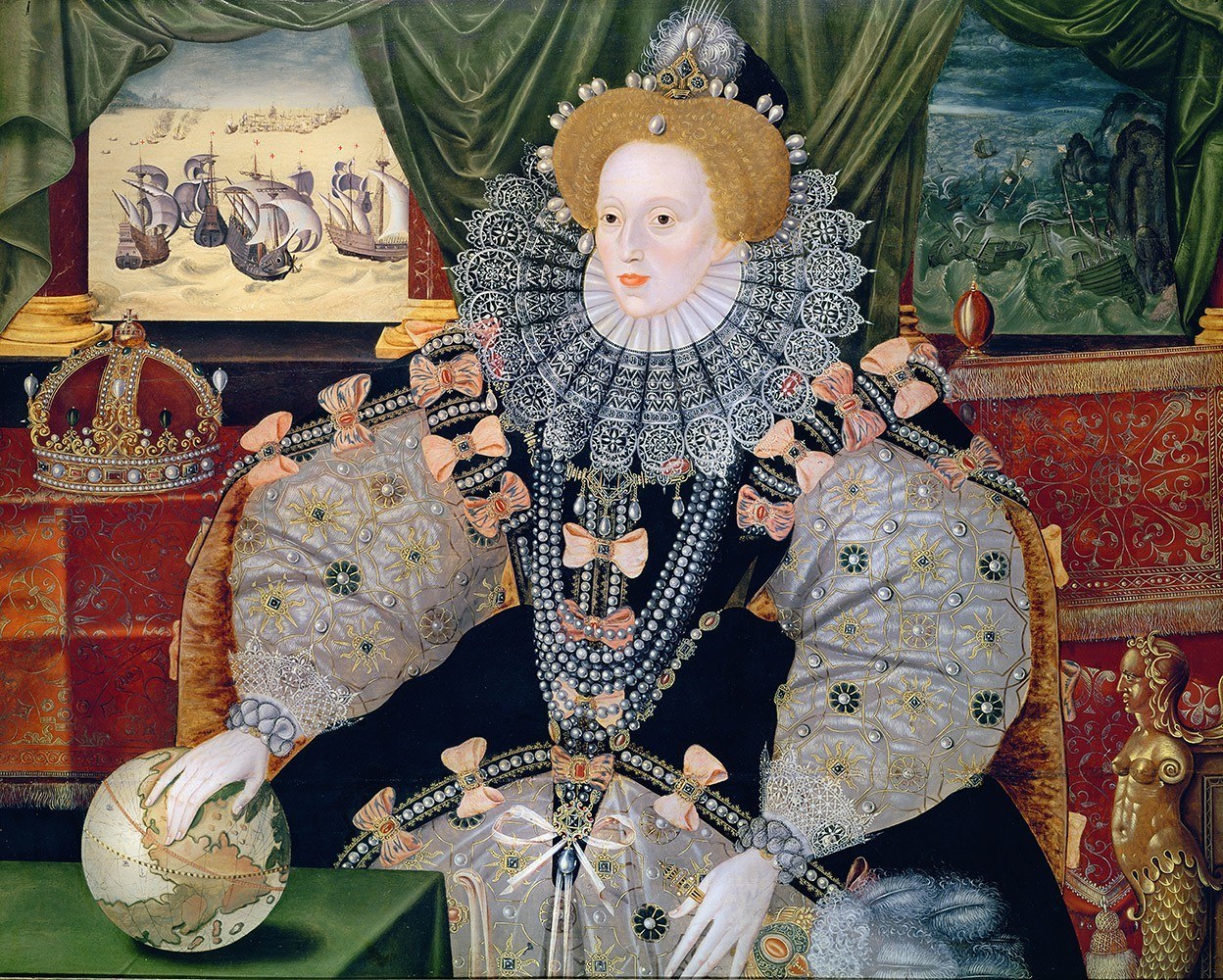
- Image: the Armada Portrait of Elizabeth I (c. 1588) — the monarch of Shakespeare’s first career (see the image credits on this page).