Reception & Authorship
Four hundred years of reputation — and the authorship debate, with both sides given their evidence.
The reputation, in brief
In his lifetime: a celebrated popular playwright and a bestselling poet. Francis Meres (1598) ranked him with the best English writers; Ben Jonson, rival and friend, would later call him “not of an age, but for all time.”
After his death: the First Folio (1623) kept the plays in print, but the closing of the theatres (1642–1660) broke the living tradition. The Restoration preferred adaptations — Davenant and Dryden rewrote Shakespeare freely, adding happy endings (Lear) and new characters.
The canonization: from the 18th century onward — Rowe’s edition (1709), the Shakespeare Jubilee at Stratford (1769, organized by actor David Garrick), the great actor-managers, Coleridge and the Romantics — Shakespeare rose to the status of national poet and, eventually, global author. Today his plays are performed in more countries, and translated into more languages, than those of any other playwright.
The present: Shakespeare is simultaneously high culture (the RSC, the Globe, university syllabi), pop culture (film adaptations, memes of his insults), and a political football (claimed by every ideology). The reputation is secure; the arguments are about what it means.
The authorship question
The most persistent controversy in Shakespeare studies: did the man from Stratford write the plays? Here is the debate, with each side’s case stated fairly.
The mainstream position
The overwhelming majority of Shakespeare scholars — and virtually all specialists in early modern English literature — accept that William Shakespeare of Stratford-upon-Avon wrote the works attributed to him. The case:
- Contemporary testimony. Meres (1598) names him as a leading playwright; Jonson’s Folio verses (1623) praise “Sweet Swan of Avon”; the Folio’s editors, Heminges and Condell, were his fellow actors. No contemporary ever suggested another author.
- Documentary continuity. The Stratford records (baptism, marriage, property, will) and the London records (theatre sharer, court performances, the 1592 “Shake-scene” attack) describe one continuous person moving between the two worlds the plays inhabit.
- The “learning” objection fails. The plays’ classical knowledge is exactly what a Stratford grammar school taught; the “legal knowledge” is what any London theatre professional absorbed; the Italian settings contain errors no native would make.
- Alternative theories explain less than they assume. Every candidate requires a conspiracy of silence among dozens of people over decades — printers, actors, rivals, officials — with no documentary trace.
The skeptical position
A persistent minority — including some distinguished writers (Mark Twain, Henry James, and others have expressed doubt) and a small number of academics — argues the Stratford man lacked the education, travel, and court access the plays display. The leading alternative candidates:
- Edward de Vere, 17th Earl of Oxford (1550–1604) — the most popular candidate: aristocratic, educated, traveled in Italy, wrote poetry. Problems: he died in 1604, before Lear, Macbeth, The Tempest, and other late plays were written; no contemporary linked him to the plays.
- Francis Bacon (1561–1626) — philosopher and statesman; the original 19th-century candidate. Problems: his known writing style is nothing like the plays’; the cipher “evidence” has never survived scrutiny.
- Christopher Marlowe (1564–1593) — the theory that he faked his death in 1593 and wrote on. Problems: the coroner’s inquest is documented; the theory requires the most elaborate conspiracy of all.
- Group theories — the plays as committee work. Problems: the stylistic unity across the canon is precisely what modern attribution science confirms.
What this site concludes
This site follows the scholarly consensus: the plays were written by William Shakespeare of Stratford, while reporting the existence and arguments of the skeptical position accurately and without mockery. The consensus is not a vote — it is the convergence of documentary evidence, contemporary testimony, and four centuries of textual scholarship. Readers who want the skeptical case in full can find it in the sources below; nothing here will pretend it does not exist.
Source notes
- Contemporary testimony: Meres, Palladis Tamia (1598); Jonson’s verses and Heminges & Condell’s preface, First Folio (1623).
- Reception history: standard accounts (see sources); Garrick’s Jubilee (1769); theatre closure 1642–1660.
- Authorship debate: the mainstream case as summarized in the New Oxford Shakespeare Authorship Companion (2016); the skeptical positions as presented by their own advocates (e.g., the Shakespeare Authorship Coalition’s “Declaration of Reasonable Doubt”). De Vere dates (1550–1604); Bacon dates (1561–1626); Marlowe inquest (1593).
- Editorial policy for contested claims: methodology.
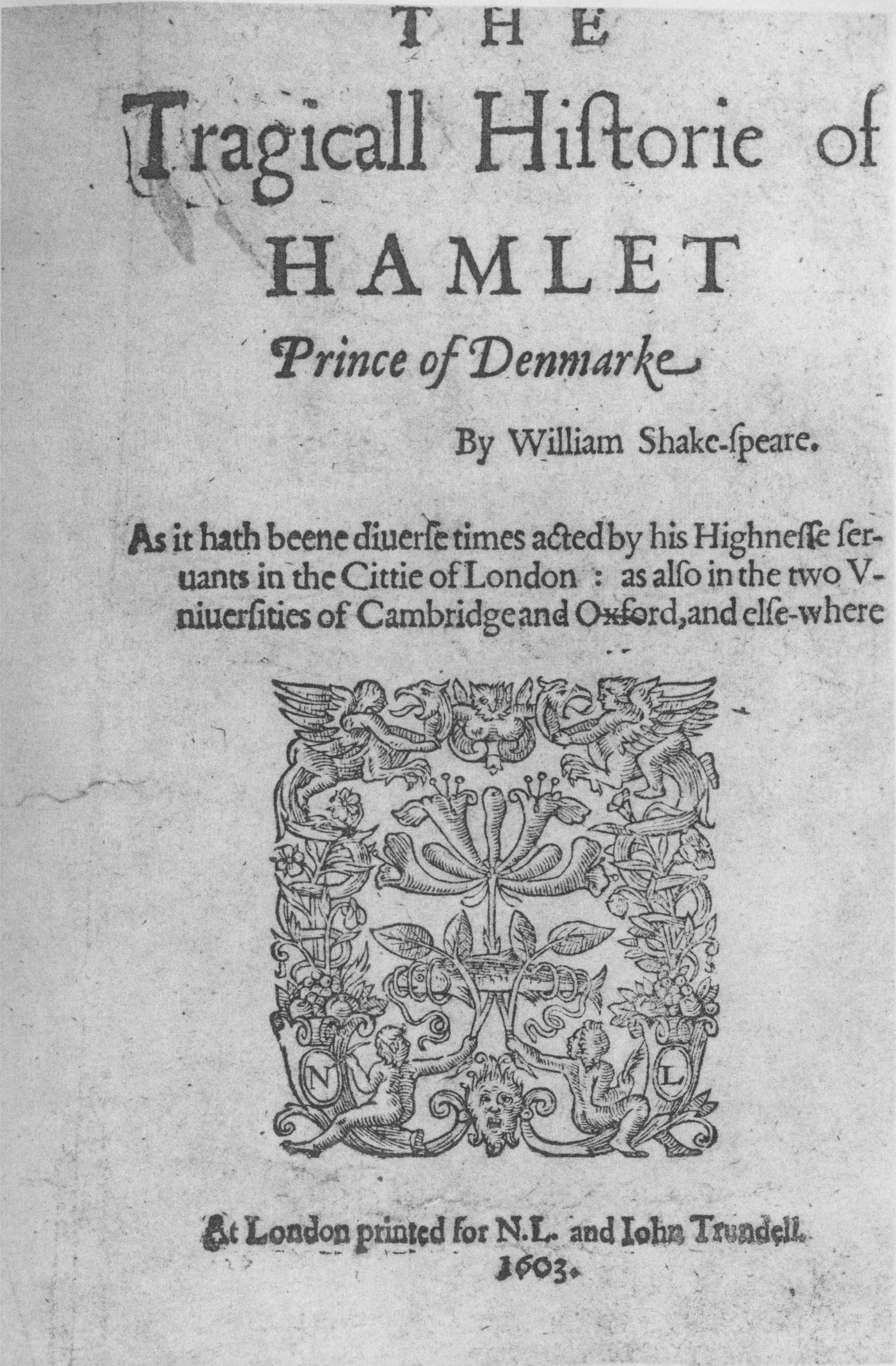
- Image: title page of the First Quarto of Hamlet (1603) — the earliest printed play text in this form, where questions of authorship and textual authority begin (see the image credits on this page).