Shakespeare the Businessman
He didn't just write the plays — he owned a piece of the company, the theatre, and half of Stratford's tithes. The money trail, in documented sums.
The romantic image is the struggling artist; the documents show a shrewd accumulator. Shakespeare invested in his company, his playhouses, and Stratford property — and he pursued debts through the courts with the persistence of any early modern businessman.
The company share
Shakespeare was a sharer (part-owner) of the Lord Chamberlain’s/King’s Men for the whole of his London career. A sharer’s fraction is usually reckoned at one-twelfth to one-fourteenth of the company — diluted as new sharers were admitted. The share paid dividends on everything the company earned: gate receipts, court performances, touring.
The Globe share
When the Globe was built in 1599 from the timbers of the old Theatre, six company men financed it. Richard Burbage and his brother Cuthbert took double shares (25% each); Shakespeare, John Heminges, Augustine Phillips, and Thomas Pope took single shares of one-eighth (12.5%) each. (Will Kemp had been meant to be a seventh partner but sold out.)
Over time, as new sharers joined, Shakespeare’s fraction shrank to about one-fourteenth (~7%). His share in the indoor Blackfriars theatre, taken when the company moved in from 1608, was similar. These were not vanity holdings: a Globe share was a serious income stream — the house could hold around 3,000 people.
The property portfolio
Shakespeare bought land and houses the way a modern professional buys index funds — steadily, in Stratford, where money bought status:
- New Place (1597) — the second-largest house in Stratford, bought from William Underhill for a recorded £60. (The deed’s price may be a legal fiction; the true cost was probably higher. The seller’s son was later found to have poisoned him — a Stratford scandal Shakespeare bought straight into.) A final legal confirmation of the title was negotiated in 1602 with the heir, Hercules Underhill.
- 107 acres of farmland (1602) — bought from William and John Combe for £320; arable land and pasture around Stratford, confirmed by a court fine in 1610.
- A half-share of the Stratford tithes (1605) — £440 for the remaining term of a 92-year lease on half the tithes of Stratford, Old Stratford, Welcombe, and Bishopton. Tithes were a tax on the parish’s produce; Shakespeare’s share brought in roughly £60 a year — a gentleman’s annuity. (It also made him, technically, a lay rector — which is why he was buried in the chancel of Holy Trinity.)
- The Blackfriars gatehouse, London (1613) — bought with three associates from Henry Walker for £140, with a £60 mortgage taken the next day, so £80 changed hands at completion. The deed, signed 10 March 1613, carries one of only six surviving Shakespeare signatures.
Put together: by his late forties Shakespeare owned the biggest private house in his hometown, a working farm estate, a rural annuity, a London property, and shares in two theatres and the leading acting company in England.
The litigant
He also chased money owed to him:
- 1604 — Shakespeare sued the Stratford maltster Philip Rogers in the Stratford Court of Record for £1 15s 10d, the price of malt delivered. Small money; the principle was the point.
- 1611–1612 — drawn into the Bellott v. Mountjoy dowry dispute in London (he had lodged with the Mountjoy family in Silver Street around 1604 and witnessed the marriage negotiations). His signed deposition is one of the six surviving signatures — and the only record placing him in London after 1599.
- 1614–1615 — the Welcombe enclosure dispute: the landowner William Combe planned to enclose common fields at Welcombe, which threatened Shakespeare’s tithe income. Shakespeare signed articles of agreement protecting his tithes against loss. The town opposed enclosure; Shakespeare protected his investment.
What the money means
The business career answers the authorship skeptics’ favorite question — how did a glover’s son learn the world? — with an unfashionable answer: he bought his way into it, and he worked inside the machine that produced the plays. The shares explain the plays’ practical stagecraft; the property explains the Stratford retirement; the lawsuits explain the legal vocabulary. The businessman and the poet were the same man, keeping the same accounts.
Source notes
- Globe shares (1/8 → ~1/14) and the Kemp sell-out: standard theatre histories (Andrew Gurr). Company share 1/12–1/14: conventional reckoning.
- New Place £60 (1597), Underhill poisoning, 1602 confirmation: conveyance records; the price-as-fiction caveat is standard.
- 107 acres, £320 (1602), confirmed 1610: Feet of Fines.
- Tithes £440 (1605), ~£60/year income: Stratford records; the tithe purchase is what placed him in Holy Trinity’s chancel.
- Blackfriars gatehouse £140 (March 1613), £60 mortgage, £80 down: the enrolled deed (The National Archives, C 54/2184) via Shakespeare Documented, Folger Shakespeare Library.
- Philip Rogers suit (1604): Stratford Court of Record. Bellott v. Mountjoy deposition (1612): Court of Requests — one of six surviving signatures. Welcombe enclosures (1614–15): articles of agreement.
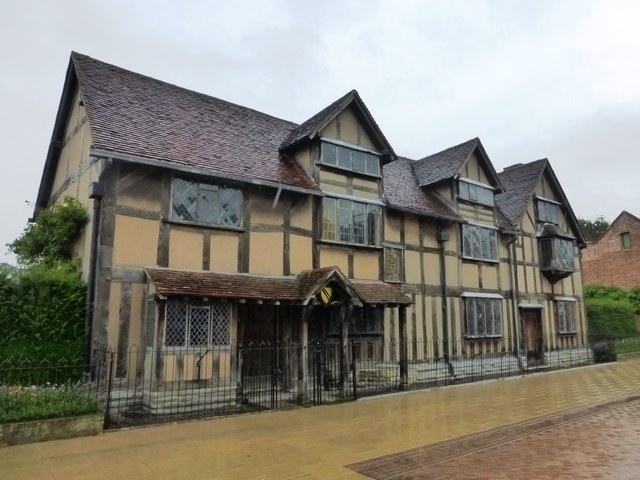
- Image: the Henley Street birthplace — the Stratford property story begins here (see the image credits on this page).
Limitations
- Exact incomes from shares are reconstructed, not recorded; the ~£60/year tithe income is an estimate from the lease terms.
- Six signatures survive; the handwriting varies, which is normal for the period and proves nothing about literacy.