Biography
Glover's son, actor, sharer, playwright — the documented life, with the legends labeled.
Stratford (1564–1585)
William Shakespeare was baptized on 26 April 1564 at Holy Trinity Church, Stratford-upon-Avon. His birth date is not recorded; tradition fixes it at 23 April (St George’s Day), three days before the baptism — plausible, but a guess, and this site treats it as one. He was the third child and eldest surviving son of John Shakespeare, a glover and wool dealer who rose to become an alderman and bailiff (mayor) of Stratford, and Mary Arden, daughter of a prosperous local farming family.
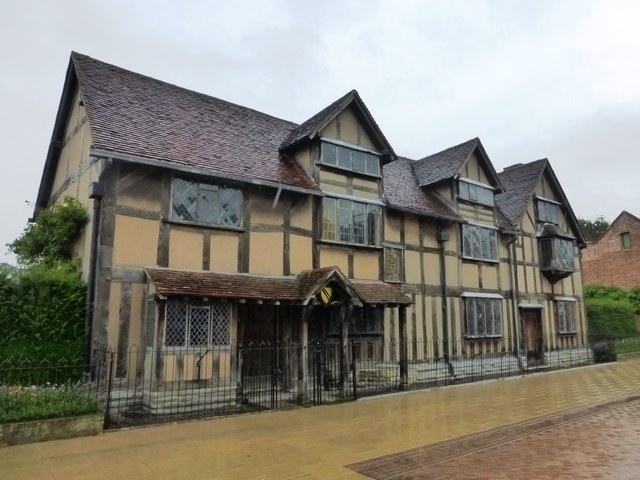
The family lived on Henley Street in the house now known as Shakespeare’s Birthplace — bought by John Shakespeare, though whether William was born in that exact building is tradition rather than documented fact. He likely attended the King’s New School in Stratford, where the curriculum was Latin grammar, rhetoric, and the classics: Ovid, Virgil, Cicero, Plautus, Terence. No school records survive naming him, but the plays’ deep classical texture makes a grammar-school education near-certain, and Stratford had a free one.
John Shakespeare’s fortunes declined in the late 1570s — he stopped attending council meetings, faced debts, and in 1592 was listed among those avoiding church, possibly for debt, possibly for Catholic sympathies. (The family’s religion is debated; a “spiritual testament” found in the Henley Street rafters in the 18th century, professing Catholic faith, may be a forgery. The evidence is genuinely ambiguous.)
In November 1582, aged 18, William married Anne Hathaway, 26, of Shottery. A special license allowed the wedding to proceed quickly; their daughter Susanna was baptized six months later, in May 1583. Twins Hamnet and Judith followed in February 1585. Then — silence.
The lost years (1585–1592)
No document places Shakespeare anywhere between the twins’ baptism (2 February 1585) and a savage London reference in 1592. These “lost years” are the great blank in the biography, and they have been filled with legend: that he fled Stratford after poaching deer from Sir Thomas Lucy’s estate at Charlecote (first told decades later; evidence: none), that he worked as a schoolmaster in Lancashire (possible; evidence: thin), that he joined a touring company as an actor (plausible; evidence: circumstantial).
What is documented: in September 1592, the dying playwright Robert Greene published Groats-Worth of Wit, warning fellow university-educated dramatists against an “upstart Crow, beautified with our feathers, that with his Tiger’s heart wrapped in a Player’s hide, supposes he is as well able to bombast out a blank verse as the best of you: and being an absolute Johannes fac totum, is in his own conceit the only Shake-scene in a country.” It is the first London reference to Shakespeare — and proof that by 1592 he was successful enough to threaten the establishment.
London and the poems (1592–1594)
Plague closed London’s theatres from 1592 to 1594, and Shakespeare turned to print. In 1593 he published the erotic narrative poem Venus and Adonis, dedicated to the 19-year-old Henry Wriothesley, Earl of Southampton; in 1594 came The Rape of Lucrece, dedicated to the same patron. Venus and Adonis was a bestseller — at least 16 editions before 1640 — and made Shakespeare’s name as a poet first, playwright second. The dedications’ warm language has fueled centuries of speculation about the relationship; the documents show patronage, nothing more.
In 1594 the Lord Chamberlain’s Men formed — with Shakespeare as a founding sharer (part-owner), actor, and house playwright. The arrangement made him wealthy by theatre standards: he bought New Place, the second-largest house in Stratford, in 1597 for £60.
The Globe years (1599–1608)
In 1599, the company dismantled the Theatre in Shoreditch, ferried its timbers across the Thames, and rebuilt them as the Globe on Bankside — Shakespeare a part-owner of the playhouse as well as the company. The great tragedies and mature comedies followed in quick succession: Hamlet (c. 1600–01), Twelfth Night (c. 1599–1601), Othello (c. 1603–04), King Lear (c. 1605–06), Macbeth (c. 1606), Antony and Cleopatra (c. 1606–07).
When Elizabeth I died in 1603, James I took the company under royal patronage as the King’s Men — Shakespeare now a “Groom of the Chamber” in the royal household. The 1609 publication of the Sonnets (“Neuer before Imprinted”) remains mysterious: dedicated to the unidentified “Mr. W.H.”, printed by Thomas Thorpe, possibly without the author’s involvement.
His son Hamnet had died in 1596, aged 11 — the only one of his children to predecease him. Biographers have long linked the loss to the grieving fathers of the later plays (Hamlet, King Lear); the plays support the theme, the documents do not confirm the link.
Retirement and death (1608–1616)
Around 1608 the King’s Men took over the indoor Blackfriars theatre for winter seasons. Shakespeare collaborated with the younger John Fletcher (Henry VIII, The Two Noble Kinsmen, the lost Cardenio) and bought the Blackfriars gatehouse in London in 1613 — while increasingly living at New Place in Stratford. The Globe burned down during a performance of Henry VIII on 29 June 1613 (a cannon fired for the play’s battle scene set the thatch alight; no one was hurt) and was rebuilt within a year.
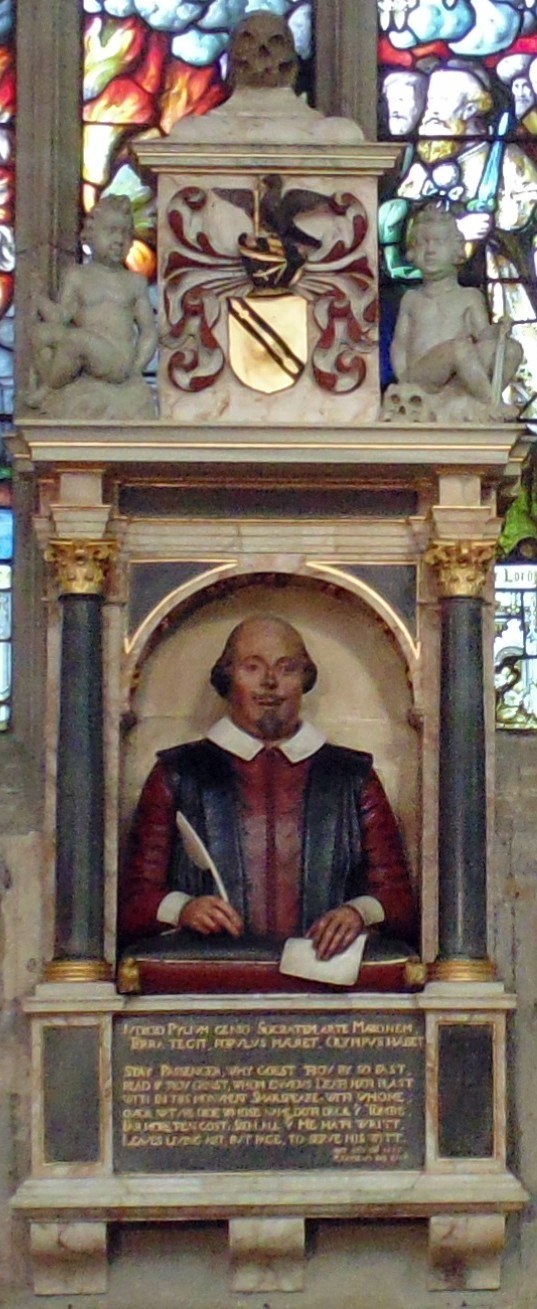
Shakespeare died on 23 April 1616, aged 52 — the date is tradition, though consistent with his burial record. He was buried in Holy Trinity Church on 25 April. His will — the most personal document he left — leaves his “second best bed” to Anne Hathaway (a common provision, not the slight it is sometimes read as), and is otherwise a careful businessman’s division of property.
What we don’t know
No letters. No diaries. No manuscripts in his hand (six signatures on legal documents survive; the handwriting is inconsistent enough that some scholars doubt even those). No record of what he thought about religion, politics, his marriage, or his own fame. The plays are the autobiography he left — and they are the autobiography of a man who specialized in disappearing into other people.
Source notes
- Baptism (26 April 1564), marriage license (November 1582), children’s baptisms, Hamnet’s burial (11 August 1596), Shakespeare’s burial (25 April 1616): parish and diocesan records, Stratford-upon-Avon and Worcester.
- Greene’s Groats-Worth of Wit (1592): “Shake-scene” passage quoted verbatim.
- Venus and Adonis (1593) and Lucrece (1594): dedications to the Earl of Southampton; publication history from the English Short Title Catalogue.
- New Place purchase (£60, 1597); Globe construction (1599); King’s Men patent (1603); Globe fire (29 June 1613); will (proved 1616): standard scholarly biographies — see sources.
- Legends labeled as such: deer-poaching (first recorded by Richard Davies, c. 1708), the Catholic “spiritual testament”, the exact birth date of 23 April, the second-best-bed slight.
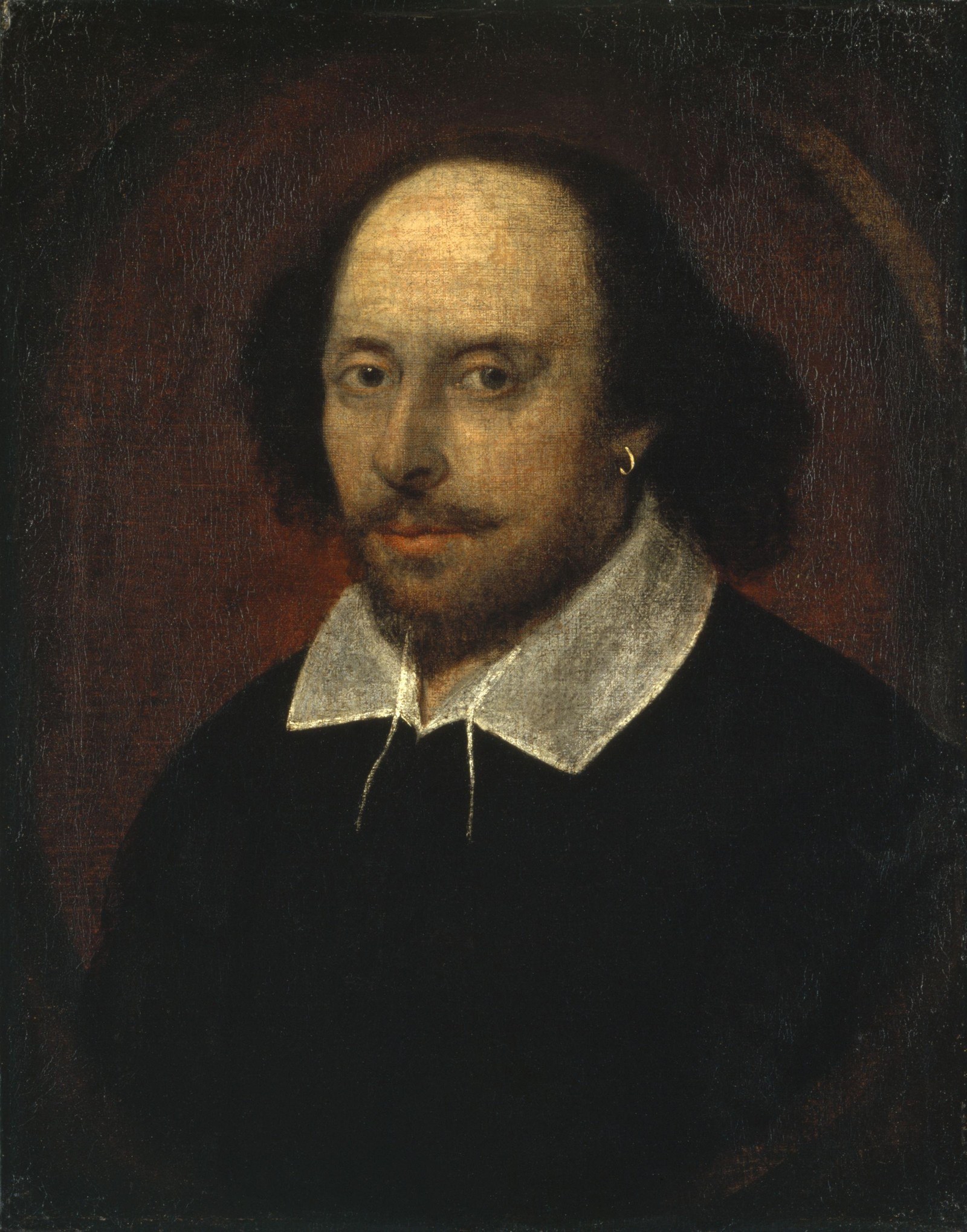
- Images: Chandos portrait (attributed to John Taylor, c. 1600–1610); Birthplace photograph (CC BY-SA 2.0); funerary monument photograph (public domain) — see the image credits on this page.