Shakespeare and Religion
Catholic? Protestant? Something in between? The evidence is thin, contested, and fascinating — here it is, all of it, labeled.
Shakespeare lived through England’s religious whiplash — born six years into Elizabeth’s Protestant settlement, dying under James I — and never once stated his beliefs in writing. What survives is a handful of documents, each claimed by both sides.
What the records show
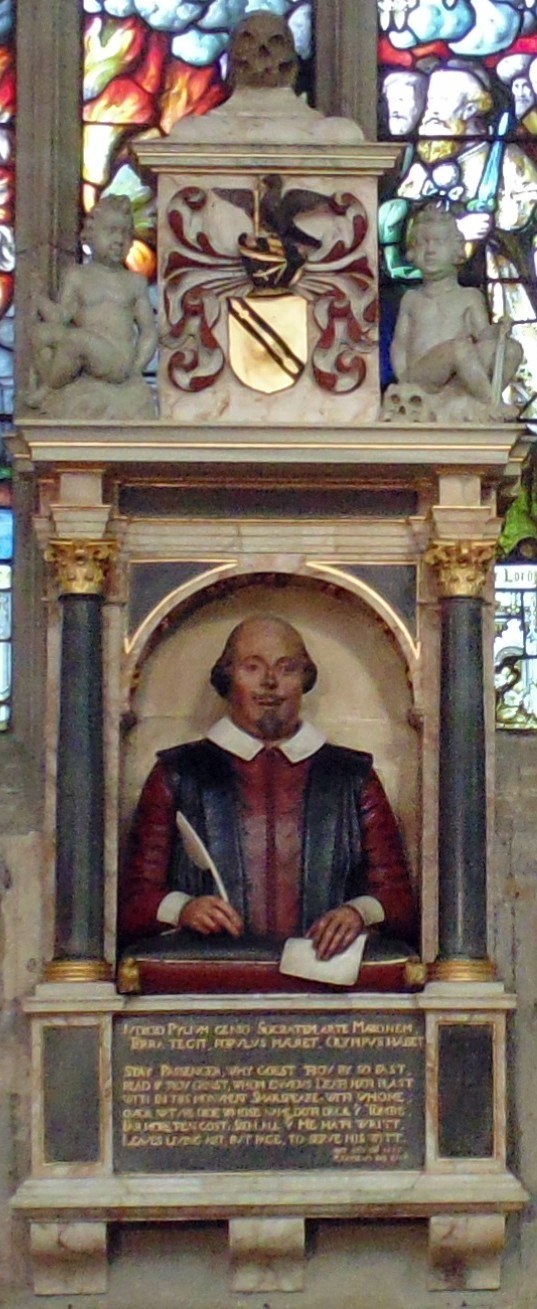
He was baptized, married, and buried in the Church of England. Holy Trinity, Stratford, records his baptism (26 April 1564); the Bishop of Worcester’s court issued the license for his marriage to Anne Hathaway (November 1582, in haste — she was pregnant — and in Advent, when marriages normally required special permission); his children were baptized in the parish church; he was buried in Holy Trinity’s chancel in 1616. Outwardly, he conformed his whole life.
He bought the tithes. In 1605 Shakespeare paid £440 for a half-share of Stratford’s tithes — which made him, technically, a lay holder of church revenues. Tithe-holders were entitled to burial in the chancel, which is where he lies. This is business, not belief — but it anchored him to the parish church’s fabric.
His daughter was cited. In 1606, church records list his eldest daughter Susanna among Stratford residents cited for failing to receive Easter communion — the standard marker of Catholic recusancy (or of Puritan nonconformity; the citation alone doesn’t say which). Susanna later married the staunchly Protestant Dr. John Hall, which complicates any simple reading.
His father’s “spiritual testament.” Around 1757, a document was found in the rafters of the Henley Street house: a Catholic “spiritual testament” in the tradition of St. Charles Borromeo, signed “John Shakespeare.” If genuine and his, it suggests the father — and perhaps the household — leaned Catholic. But the document’s authenticity and attribution have been disputed since the 18th century; the signature may not be John Shakespeare’s at all.
The London connections. Shakespeare’s 1613 Blackfriars gatehouse purchase put him among neighbors with Catholic sympathies, and his company included Catholics. None of this is evidence of his own belief — London theatre people lived cheek by jowl regardless of faith.
What the plays show (and don’t)
Both sides draft the plays as witnesses, and both can. The plays contain Catholic-sounding moments (ghosts from Purgatory in Hamlet, friars everywhere, the reverent treatment of holy orders) and Protestant-sounding ones (mockery of pardons and relics, the bleak providence of King Lear). But plays are not confessions: Shakespeare wrote Catholic characters and Protestant characters because his audience contained both. A playwright who only wrote his own beliefs would be a pamphleteer, not a dramatist.
The epitaph
The one text certainly his, carved on his monument in Holy Trinity:
Good friend, for Jesus’ sake forbear To dig the dust enclosed here. Blest be the man that spares these stones, And curst be he that moves my bones.
It worked — his grave has never been opened. As theology it says nothing beyond conventional piety.
The honest conclusion
The evidence is compatible with a man who conformed outwardly to the established church while keeping his inward views — whatever they were — to himself. That describes most Elizabethans. Claims that Shakespeare was secretly Catholic, secretly Puritan, or secretly atheist all outrun the documents. The documents show a parishioner, a tithe-holder, and a father whose daughter once missed Easter communion. Everything else is interpretation — interesting, sometimes brilliant, never proof.
Source notes
- Baptism (1564), marriage license (1582), burial (1616): Holy Trinity parish records and the Worcester consistory court (see timeline).
- Tithe purchase (1605): Stratford records; lay-rector status explains the chancel burial.
- Susanna’s 1606 citation: Stratford archdeaconry records; the recusancy-vs-nonconformity ambiguity is noted by scholars on both sides.
- The “spiritual testament”: found c. 1757; authenticity disputed since Edmond Malone’s investigation (1790s).
- Epitaph quoted verbatim from the Holy Trinity monument.
- Editorial policy: methodology. This page assigns no denominational label to Shakespeare.
Limitations
- Absence of evidence is not evidence of absence — but it is also not evidence of presence. Every confessional reading of Shakespeare is, strictly, an argument from silence plus cherry-picked texts.