Plays
The complete canon — 36 Folio plays, the collaborations, the poems — with dates where scholarship agrees and uncertainty where it doesn't.
How the canon is organized
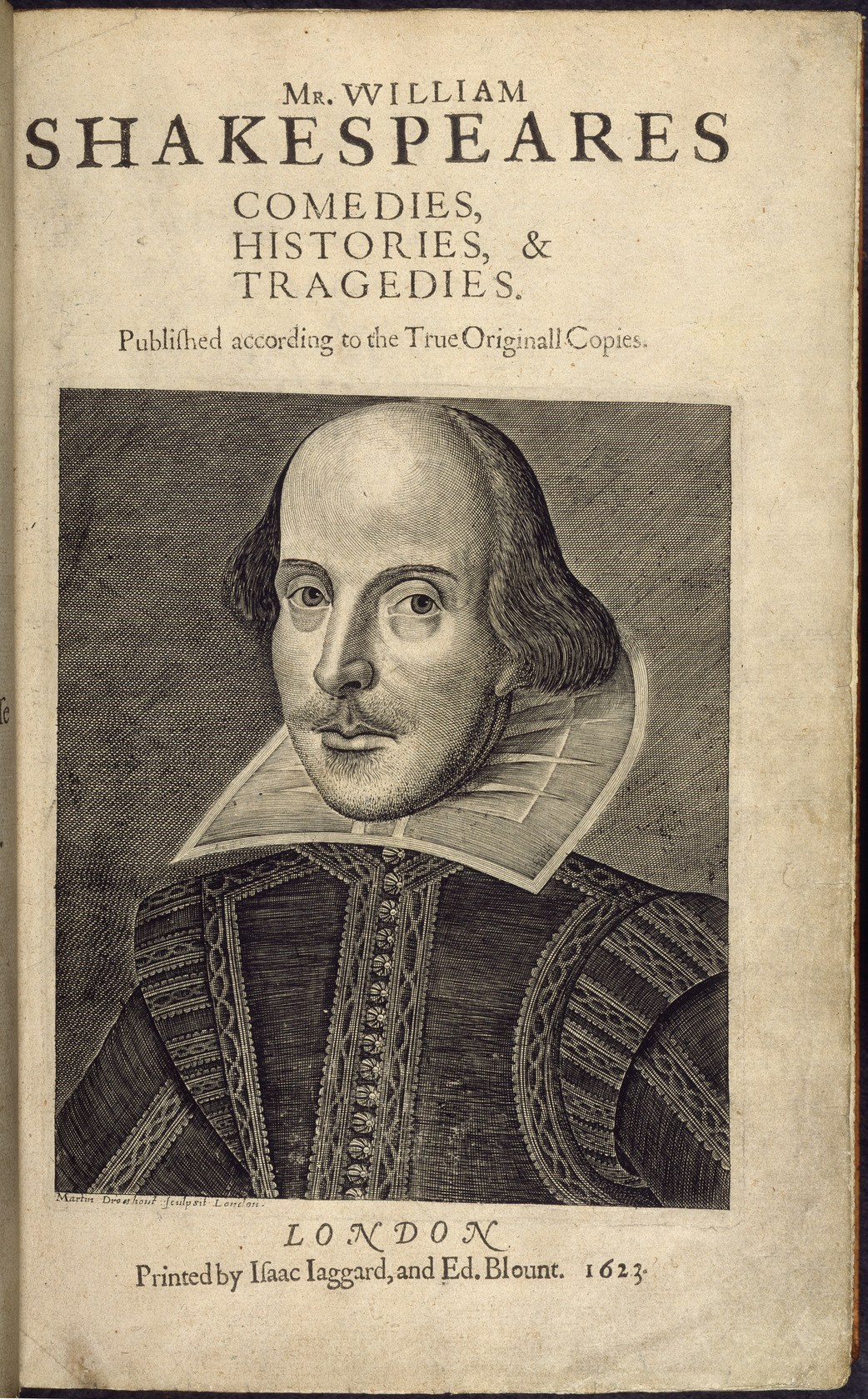
The First Folio (1623) grouped 36 plays as Comedies, Histories, and Tragedies — an editor’s convenience, not the author’s. Modern scholarship adds Romances for the late plays and recognizes collaborations. Composition dates below are scholarly consensus estimates (Oxford/Arden chronologies); a “c.” means the range is genuinely debated. Plays marked * survive only in the First Folio — without Heminges and Condell, they would be lost.
Tragedies (12)
| Play | Written (est.) | Notes |
|---|---|---|
| Titus Andronicus | c. 1592 | Early, bloody; possibly co-written with George Peele. |
| Romeo and Juliet | c. 1595 | Quarto 1597 (“bad” text); Quarto 1599. |
| Julius Caesar * | c. 1599 | First Globe-season tragedy; Folio only. |
| Hamlet | c. 1600–01 | Three texts: Q1 (1603, “bad”), Q2 (1604–05), Folio. |
| Troilus and Cressida | c. 1602 | Bitter, satirical; genre debated. |
| Othello * | c. 1603–04 | Folio (1623) and a 1622 quarto; texts differ. |
| King Lear * | c. 1605–06 | Quarto (1608) and Folio differ substantially — two versions, not one. |
| Macbeth * | c. 1606 | Folio only; the shortest tragedy. |
| Timon of Athens * | c. 1605–08 | Unfinished-seeming; likely co-written with Thomas Middleton. |
| Antony and Cleopatra * | c. 1606–07 | Folio only. |
| Coriolanus * | c. 1608 | Folio only. |
| Cymbeline * | c. 1609 | Folio classes it a tragedy; modern critics call it a romance. |
Comedies (14)
| Play | Written (est.) | Notes |
|---|---|---|
| The Comedy of Errors | c. 1594 | Earliest; Plautus adaptation. |
| The Taming of the Shrew | c. 1593–94 | Dating and text disputed. |
| The Two Gentlemen of Verona * | c. 1594–95 | Folio only. |
| Love’s Labour’s Lost | c. 1595–96 | Quarto 1598. |
| A Midsummer Night’s Dream | c. 1595–96 | Quartos 1600. |
| The Merchant of Venice | c. 1596–97 | Quarto 1600. |
| The Merry Wives of Windsor | c. 1597 | Written, by tradition, at Elizabeth’s request for Falstaff. |
| Much Ado About Nothing | c. 1598 | Quarto 1600. |
| As You Like It * | c. 1599–1600 | Folio only. |
| Twelfth Night * | c. 1599–1601 | Folio only; performed 1602 at Middle Temple (documented). |
| Measure for Measure * | c. 1603–04 | “Problem play”; Folio only. |
| All’s Well That Ends Well * | c. 1604–05 | “Problem play”; Folio only. |
| The Tempest * | c. 1610–11 | Folio only; often read as a farewell — cautiously. |
| The Winter’s Tale * | c. 1610–11 | Folio only; contains “Exit, pursued by a bear.” |
Histories (10)
| Play | Written (est.) | Notes |
|---|---|---|
| King John * | c. 1595–96 | Folio only. |
| Richard II | c. 1595 | Quarto 1597; the deposition scene censored in print until 1608. |
| Henry IV, Part 1 | c. 1596–97 | Quarto 1598. Falstaff’s debut. |
| Henry IV, Part 2 | c. 1597–98 | Quarto 1600. |
| Henry V | c. 1599 | Quarto 1600 (“bad”); Folio text much fuller. |
| Henry VI, Part 1 | c. 1592 | Folio only; authorship shared with Nashe and others (now widely accepted). |
| Henry VI, Part 2 | c. 1590–91 | Quarto 1594 as The Contention. |
| Henry VI, Part 3 | c. 1590–91 | Octavo 1595 as The True Tragedy. |
| Richard III | c. 1592–93 | Quarto 1597. |
| Henry VIII * | c. 1612–13 | With John Fletcher; the play being performed when the Globe burned. |
Romances — the late plays (4)
Modern grouping for the late tragicomedies of reunion and forgiveness. Three appear in the Folio under other headings; Pericles was excluded entirely.
| Play | Written (est.) | Notes |
|---|---|---|
| Pericles | c. 1607–08 | With George Wilkins; excluded from the Folio; quarto 1609. |
| Cymbeline * | c. 1609 | Folio tragedy; modern romance. |
| The Winter’s Tale * | c. 1610–11 | Folio comedy; modern romance. |
| The Tempest * | c. 1610–11 | Folio comedy; modern romance. |
Outside the Folio
- The Two Noble Kinsmen (c. 1613–14) — with John Fletcher; printed 1634. Generally accepted in the modern canon: 38 plays.
- Cardenio (1613) — performed, then lost. Attributed to Shakespeare and Fletcher from the records; no text survives. Reconstructions exist; all are modern inventions, labeled as such.
- Edward III (c. 1590s) — anonymous; some scholars argue Shakespeare’s hand in parts. Debated; not counted in the canon here.
- Poems: Venus and Adonis (1593), The Rape of Lucrece (1594), The Phoenix and the Turtle (1601), A Lover’s Complaint (1609), and the 154 Sonnets (1609).
A note on dating
No manuscript dates any play. Scholars triangulate from: Stationers’ Register entries, title pages, the Revels accounts, Francis Meres’s 1598 list, topical allusions, and stylistic analysis (verse tests, vocabulary). Ranges like “c. 1605–06” are honest; single years are editorial conveniences. Where the range is wide, the table says so.
Source notes
- Canon and Folio contents: Mr. William Shakespeares Comedies, Histories, & Tragedies (1623), printed by Isaac Jaggard and Edward Blount.
- Composition dates: consensus ranges from the Oxford Shakespeare chronology and Arden editions; contested cases noted in-table (see methodology).
- Collaboration attributions (Peele, Middleton, Wilkins, Fletcher, Nashe): modern stylometric and textual scholarship, summarized in the New Oxford Shakespeare (2016) Authorship Companion.
- “Bad quartos” and the two texts of King Lear: standard textual scholarship; the Folio/Quarto Lear differences are documented in the Oxford and Arden editions.
- Image: First Folio title page (British Library, CC0) — see the image credits on this page.