Who Is Don Quixote?
Two names, one man: the reader of romances, and the knight of his own invention.
Alonso Quixano
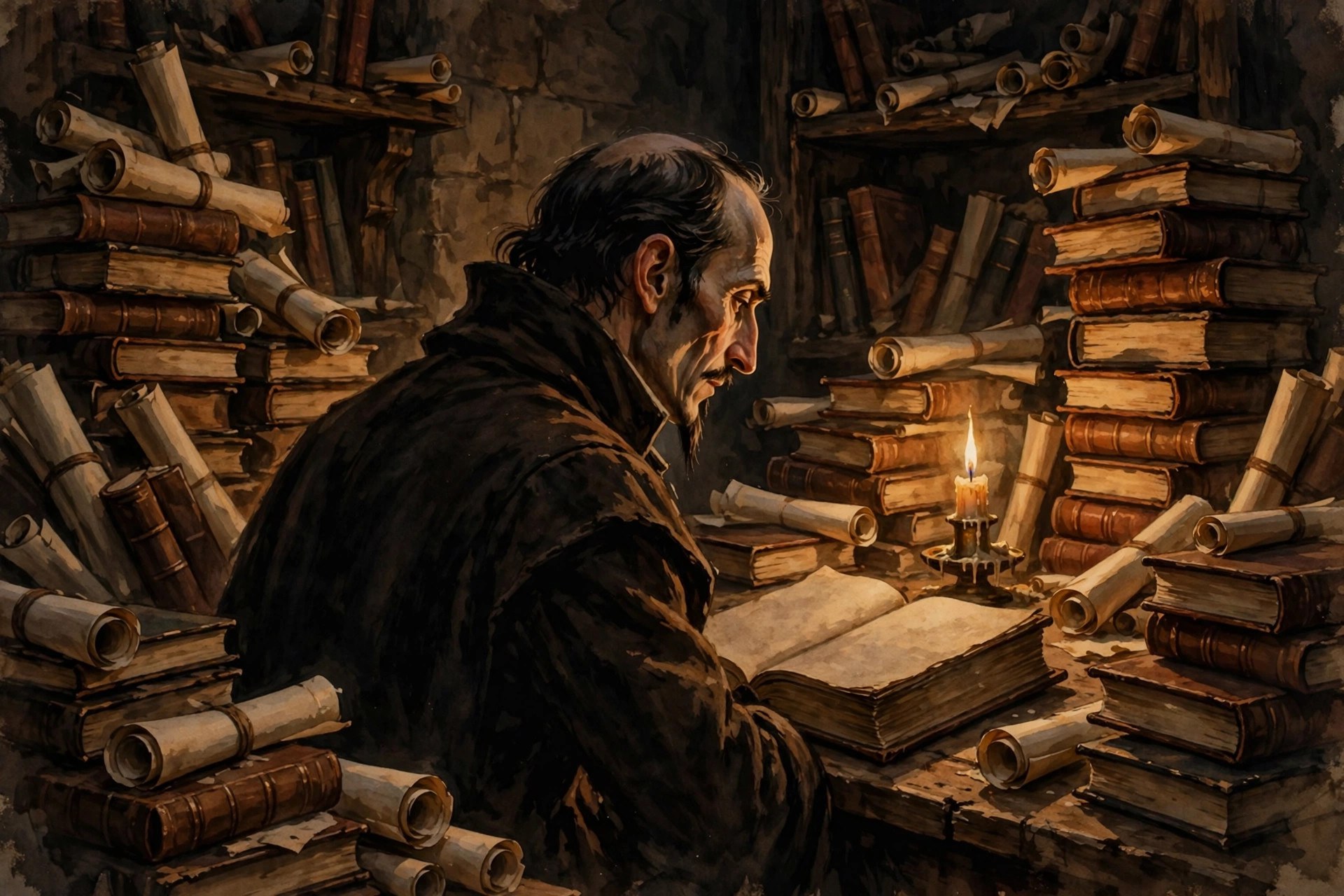
Before the helmet, there was a hidalgo. In the novel's famous opening — "In a village of La Mancha, the name of which I have no desire to call to mind" (Part I, ch. 1) — Cervantes introduces one of those gentlemen who "keep a lance in the lance-rack, an old buckler, a lean hack, and a greyhound for coursing." He is about fifty, lean-bodied, "spare, gaunt-featured," and lives on a modest income: he sells "many an acre of tillageland" to buy books of chivalry, and reads so continuously — "what with little sleep and much reading his brains got so dry that he lost his wits" — that he decides the romances are true history and that he must revive knight-errantry himself.
Cervantes gives him several possible surnames — Quixada, Quesada, Quexana — and lets the record disagree. The one thing the narrative settles is his poverty and his rank: a hidalgo, the lowest rung of the gentry, with more pride than income. See glossary.
Don Quixote of La Mancha
The transformation is a deliberate act of self-authorship. He cleans his great-grandfather's armor, patches the half-helmet with pasteboard, renames his old horse Rocinante ("the first and foremost of all the hacks in the world"), takes a barber's brass basin for the enchanted helmet of Mambrino, and styles himself Don Quixote of La Mancha. Love, being mandatory for a knight-errant ("a knight-errant without love was like a tree without leaves or fruit, or a body without a soul," Part I, ch. 1), is supplied by renaming the peasant girl Aldonza Lorenzo as Dulcinea del Toboso — "a name, to his mind, musical, uncommon, and significant."
Madman, idealist, or satire's instrument?
Scholars have argued the question for four centuries, and the novel keeps every reading alive:
- The madman. The text calls his condition a loss of wits; his neighbors, his priest, and his niece all treat him as ill.
- The idealist. His speeches — the Golden Age elegy (Part I, ch. 11), the discourse on arms and letters, the counsel to Sancho — are among the most eloquent moral writing in Spanish literature.
- The instrument. Cervantes wrote the book as a parody of the romances of chivalry; the knight's delusions let the author skewer books, pride, and empire by turns.
The novel's genius is that these readings are not alternatives. Quixote is funniest when he is wrong and noblest when he persists; the laughter and the reverence arrive in the same scene. By Part II he knows — half-knows, anyway — that he is a character in a book, and the game becomes something stranger: a fiction about fiction, four hundred years early. See the manuscript.
The two of them, briefly
| Alonso Quixano | Don Quixote | |
|---|---|---|
| Home | A village in La Mancha | Wherever adventure calls |
| Horse | A lean hack | Rocinante |
| Helmet | Pasteboard and brass | "Mambrino's helmet" |
| Lady | Aldonza Lorenzo | Dulcinea del Toboso |
| End | A Christian deathbed, renouncing the romances (Part II, ch. 74) | Never dies — the name outlives the man |
Source notes
- Character description and transformation: Ormsby, Part I, ch. 1.
- "a knight-errant without love was like a tree without leaves or fruit, or a body without a soul": Ormsby, Part I, ch. 1.
- "he decided upon calling her Dulcinea del Toboso—she being of El Toboso—a name, to his mind, musical, uncommon, and significant": Ormsby, Part I, ch. 1.
- Deathbed renunciation: Ormsby, Part II, ch. 74.