Digital Quixote
Everything you need to know about Don Quixote — in one place.
The single canonical reference
Who was Don Quixote — and who was Alonso Quixano, the hidalgo who dreamed him? What is the novel actually about, and how did one Spanish book from 1605 change world literature? This site answers those questions with the facts, verbatim quotations from the public-domain John Ormsby translation (1885), and clear attribution: what Cervantes wrote, what scholars agree on, and what remains debated.
Meet the character
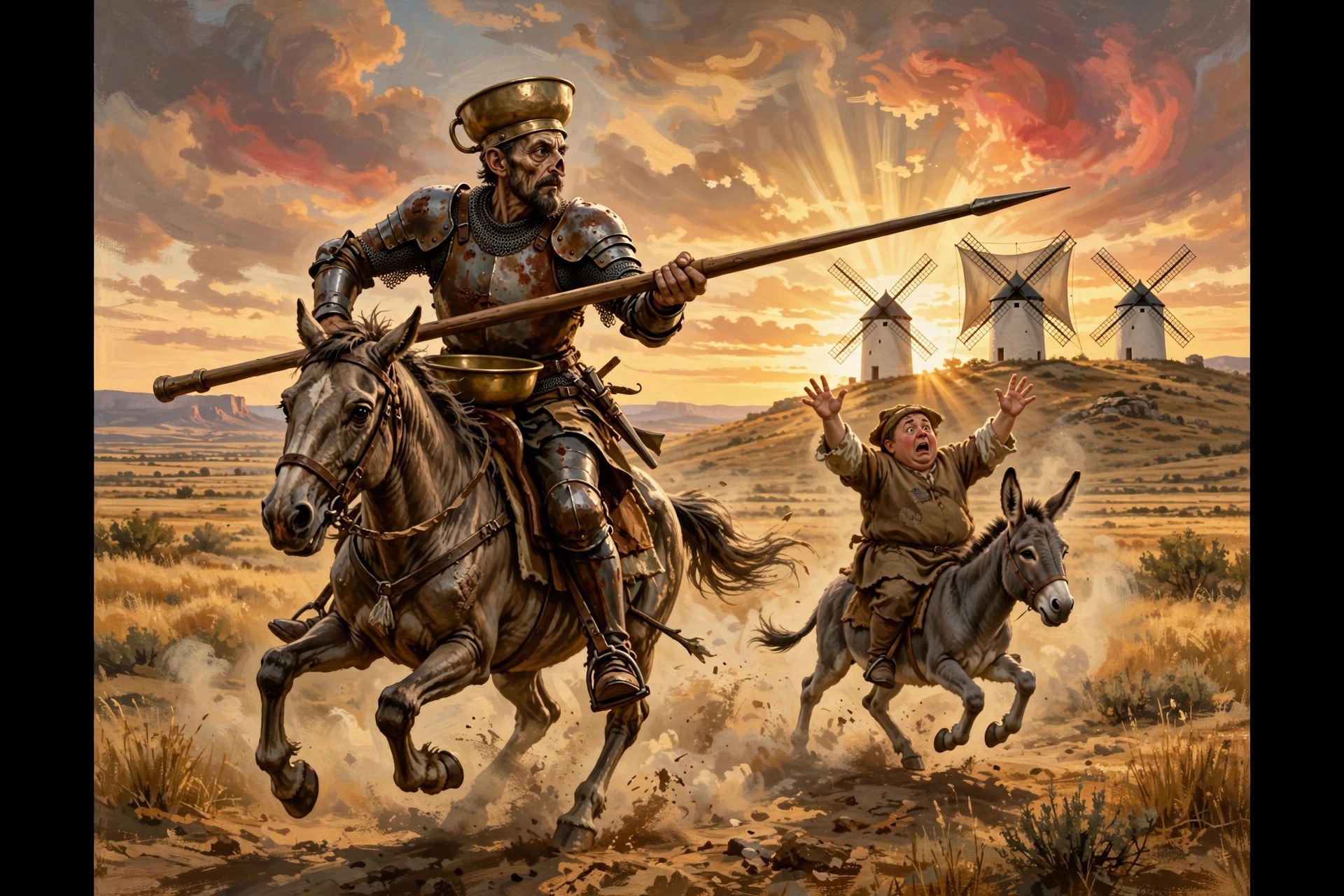
In the novel's own terms, he is Alonso Quixano, a lean gentleman of La Mancha who reads so many books of chivalry that "his brains got so dry that he lost his wits" — and rides out to become Don Quixote, the Knight of the Rueful Countenance. Beside him rides Sancho Panza, and above every adventure shines Dulcinea del Toboso.
Start here
New to the story? The 10-minute primer brings you up to speed fast. Prefer the facts in order? Read who Don Quixote is, the novel's two parts, and the timeline.
Explore
- Famous sayings — twenty of the best-known lines from the novel, each quoted verbatim from the Ormsby translation with part and chapter.
- The windmills — the most famous scene in the book, Part I, chapter 8, line by line.
- The quests — a catalogue of the knight's adventures, from the dubbing to the final defeat.
- Sancho Panza and Dulcinea del Toboso — the squire and the lady.
- The knight-errant — the chivalric romances that made Quixote possible, Amadis of Gaul above all.
- Cervantes — the real man behind the book: soldier, captive, tax-collector, writer.
- The manuscript — Cide Hamete Benengeli and the novel's great metafictional game.
- Glossary — hidalgos, enchanters, and Mambrino's helmet, explained plainly.
Deep dives
- Part One guide · Part Two guide — chapter-by-chapter companions to the two volumes.
- Spain in the 1600s — the world the novel walked through: empire, Inquisition, and the roadside inn.
- Adaptations — from ballet and opera to film, four centuries of Quixotes.
- Quixotic idealism — how one fictional knight gave the world a word for noble folly.
- Character stream — the dramatized character stream concept, with a mockup player.
- Social content pack — shareable quote cards and character art, downloadable at full resolution.
How this site works
Every quotation cites part and chapter of the Ormsby translation. Dates are labeled: documented record vs. scholarly estimate, with uncertainty named, not smoothed over. Disputed points carry their owner — "scholars conclude…", "the record shows…", "Cervantes writes…". Read the methodology and sources for the full picture.
Source notes
- Site concept and build pipeline adapted from the Digital Shakespeare reference-site template (editorial/*.md with front matter, static build, QA checks), 2026-09-26.
- Quotation texts verified verbatim against the John Ormsby translation (1885) via Project Gutenberg eBook #996; each entry cites part + chapter (see methodology).
- Biographical facts on Cervantes: standard scholarly consensus; see sources.
- Character art: all images are AI-generated dramatization art, 2026-09-26 (see the image credits on this page). No image on this site depicts a real person.