Spain in the 1600s
The empire, the inn, and the hidalgo: the world the novel walked through.
Don Quixote is a fantasy only in its hero's head. Everything around him — the roads, the inns, the hidalgos, the galley slaves, the morisco translator — is the Spain Cervantes knew. To read the novel without that Spain is to miss half its jokes and most of its bite.
An empire beginning to doubt itself
When Part I appeared in 1605, Spain was the greatest power in Europe and felt, in places, like it was running on memory. Philip II had died in 1598; his son Philip III (reigned 1598–1621) left government largely to his favorite, the Duke of Lerma. American silver still poured in, but inflation had hollowed out Castile's economy, and the long wars in the Netherlands drained men and money. The novel's innkeepers, muleteers, and ruined hidalgos are the human texture of that strain.
Cervantes had lived the empire's costs directly: he fought at Lepanto in 1571, spent five years a captive in Algiers (1575–1580), and later worked as a commissary and tax collector — jobs that took him along exactly the roads his knight would travel. See cervantes and timeline.
The hidalgo: a title without a fortune
Alonso Quixano is a hidalgo, the lowest rank of Spanish nobility — entitled to be called don, exempt from certain taxes, and expected to live like a gentleman. The opening sentence itemizes his estate with accountant's precision: a lance in the rack, an old buckler, a lean hack, a greyhound — and an income three-quarters consumed by food. The hidalgo's dignity without means is the novel's social engine: Quixote's chivalry is, among other things, a poor gentleman's way of insisting his title still means something.
The road: inns, muleteers, and the Holy Brotherhood
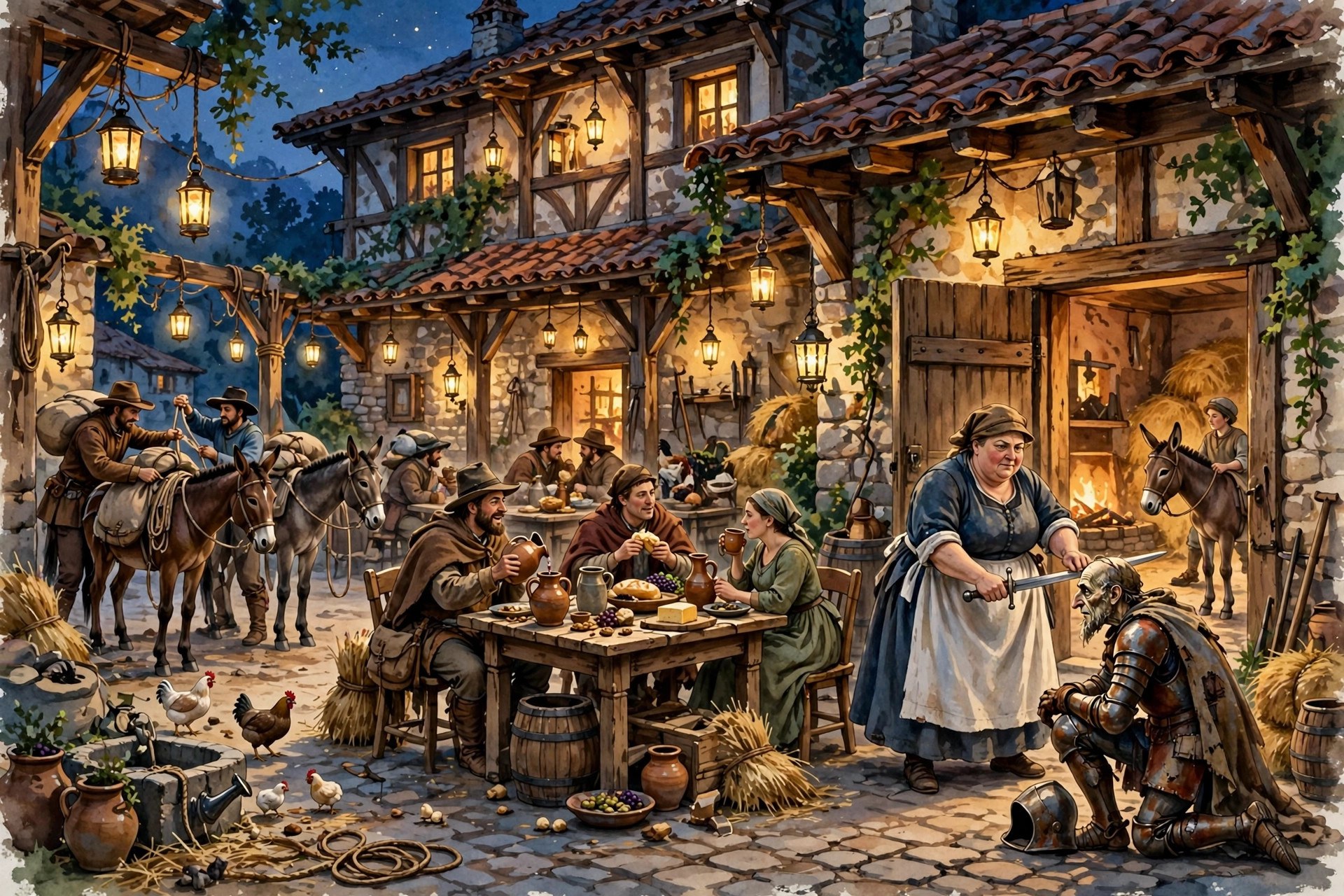
The novel's Spain is a road novel's Spain. Its great interior scenes happen in ventas — roadside inns that Quixote mistakes for castles, where muleteers, priests, barbers, and a captive just returned from Algiers all collide. The inns were the information network of the age, and Cervantes, who had worked the roads, writes them with an insider's ear.
The law on those roads belonged to the Santa Hermandad, the Holy Brotherhood — the rural constabulary Quixote keeps assaulting, most memorably when he frees the galley slaves (Part I, ch. 22). The Brotherhood's officers are always a day behind the knight, and the threat of them hangs over the second half of Part I.
Faith, the Inquisition, and the moriscos
Catholic Spain policed belief through the Inquisition, and the novel moves carefully around it — the famous scrutiny of Quixote's library (Part I, ch. 6) is conducted by a priest, and its mock-inquisitorial bonfire of romances is one of the book's great comic set pieces.
Between the novel's two parts, Spain carried out the expulsion of the moriscos — Spaniards of Moorish descent, forcibly converted a century earlier — in 1609–1614. Cervantes gives the expulsion one of the novel's most humane episodes: the morisco Ricote, met on the road in Part II (ch. 54), who returns in disguise to the country that expelled him. And the novel's founding document is itself in Arabic: in Part I, chapter 9, the narrator finds Cide Hamete Benengeli's manuscript in Toledo and hires a morisco to translate it. See the manuscript.
Madrid, the printing press, and a new reading public
Madrid had been the permanent capital only since 1561, and it was booming — the city of Lope de Vega's theaters, where Cervantes's own plays failed to find the success he wanted. The printing press had created something new in Spain: a mass reading public, hungry for the chivalric romances Quixote devours and for the book Quixote himself becomes. Part II's great joke — that the characters have read Part I — only works in a world where books travel faster than knights. See the novel and adaptations.
What the novel assumes you know
Cervantes wrote for readers who knew the price of bread, the look of a galley chain, and the sound of a muleteer's oath. Four centuries later, the Spain around the knight needs a little reconstruction — but it repays it. Nearly every "mad" thing Quixote does is funnier, and sadder, against the real country Cervantes sets it in.
Source notes
- Political and social history above follows standard scholarly consensus on early-17th-century Spain (Philip III, Lerma, inflation, the morisco expulsion of 1609–1614); see sources.
- Novel-internal details cite part and chapter of the Ormsby translation; see sources.
- Interpretive claims ("the human texture of that strain") are the site's own reading, labeled as such per methodology.