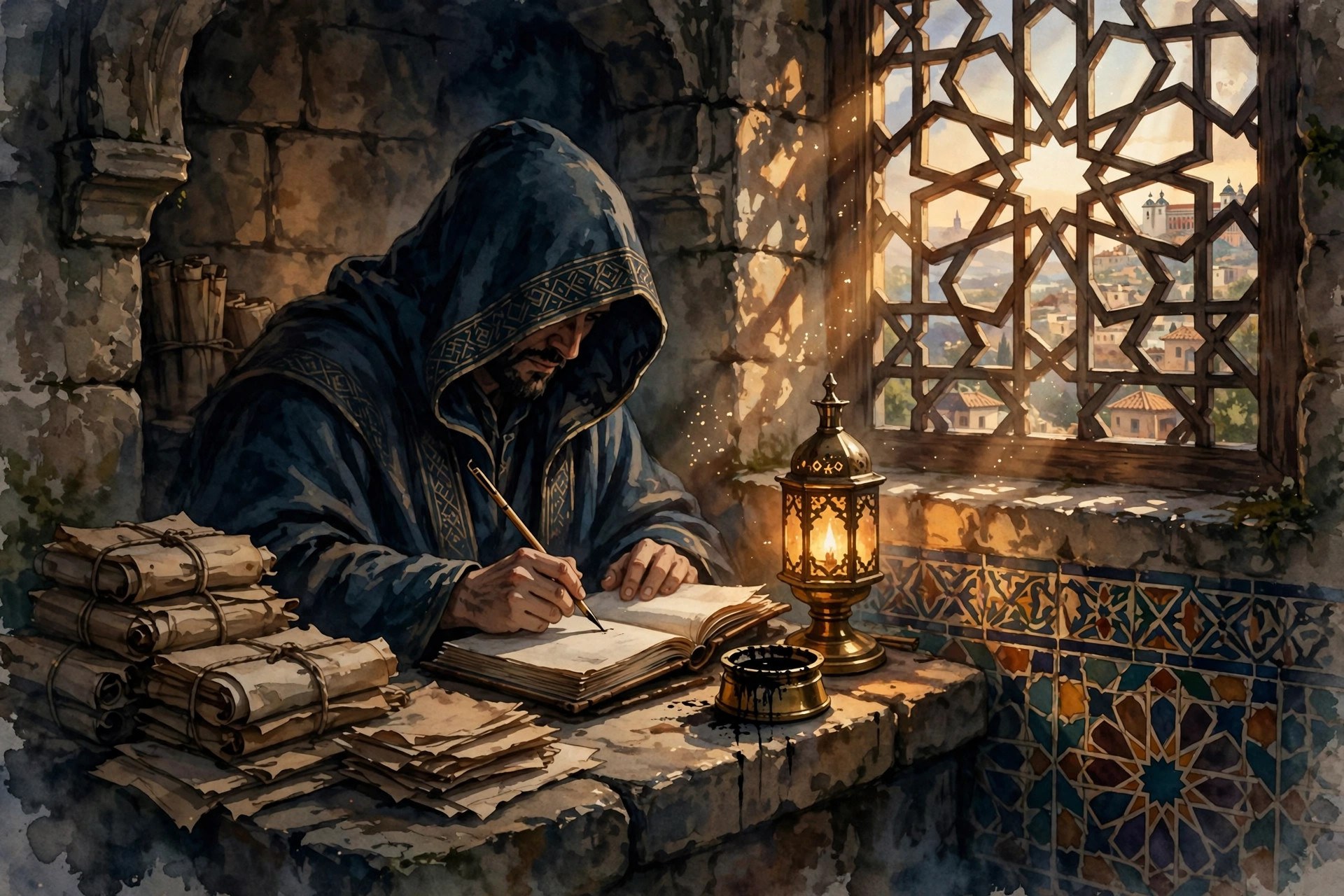
The Manuscript
The book inside the book: who really wrote Don Quixote?
Nine chapters into Part I, Cervantes pulls the floor out from under his own novel. The fight with the Biscayan is interrupted mid-stroke — and the narrator announces that his sources have run out. What follows is the most famous metafictional device in literature: the discovery, in a Toledo marketplace, of a manuscript in Arabic, written by one Cide Hamete Benengeli, "Arab and Manchegan," which a morisco is hired to translate. From that moment, everything we read is presented as a translation of a translation of a found text.
The game and its rules
Cervantes never lets the device sit still. The narrator quarrels with his "author" — doubting him because he is an Arab ("that nation being very prone to tell falsehoods," Part I, ch. 9, in the voice of the age's prejudice, which the novel then complicates), praising him, catching him in contradictions. Marginal notes, missing pages, and secondhand reports interrupt the story at the moments of highest drama. The effect is deliberate: a novel that constantly reminds you it is a novel, four centuries before the term "metafiction" existed.
The morisco translator
The manuscript's journey into Spanish runs through a morisco — a Spaniard of Moorish descent — found in Toledo and paid to render the Arabic into Castilian. Between the novel's two parts, the moriscos were expelled from Spain (1609–1614). Cervantes's choice of a morisco as the bridge between his fiction and his readers, and his humane portrait of the expelled Ricote in Part II (ch. 54), make the manuscript game carry the weight of real history. See spain in the 1600s.
Part II: the characters have read Part I
The game's boldest move comes in the second part. The characters have read the published Part I of their own history — the real book, published in 1605, existing inside the fictional world of 1615. Samson Carrasco arrives having studied it; the Duke and Duchess stage adventures based on it; Quixote himself corrects the record. The novel becomes a story about fame, readership, and what it does to a man to become a character.
The war on Avellaneda
In 1614 a spurious continuation appeared under the name Alonso Fernández de Avellaneda. Cervantes's revenge is written into the genuine Part II: in chapter 59, travelers at an inn are reading the false sequel aloud, and Don Quixote's party denounces it as fraudulent; in chapter 72, a character from the false book meets the true knight and recants. The closing chapter warns that the history is finished "in order to remove the possibility of any other author save Cide Hamete Benengeli bringing him to life again falsely." The first fan-fiction war in literary history, and the author won it.
Why it matters
The manuscript game is not decoration. It is the novel's theory of truth: every history is somebody's telling, every translation loses and finds something, and the reader — like the morisco in Toledo, like the Duke's household, like us — is always part of the story. When Quixote says "I know who I am" (Part I, ch. 5), the manuscript asks quietly: do you? Who told you?
Source notes
- Manuscript episodes cite part and chapter of the Ormsby translation (Part I, ch. 9; Part II, ch. 3, 59, 72, 74), verified against Project Gutenberg eBook #996; see sources.
- The Avellaneda publication date (1614) and the morisco expulsion (1609–1614) are standard scholarly facts; see sources.
- Interpretive claims are the site's own reading, labeled per methodology.