Start Here
Ten minutes, and you'll know more about Don Quixote than most of the people who quote him.
The story in sixty seconds
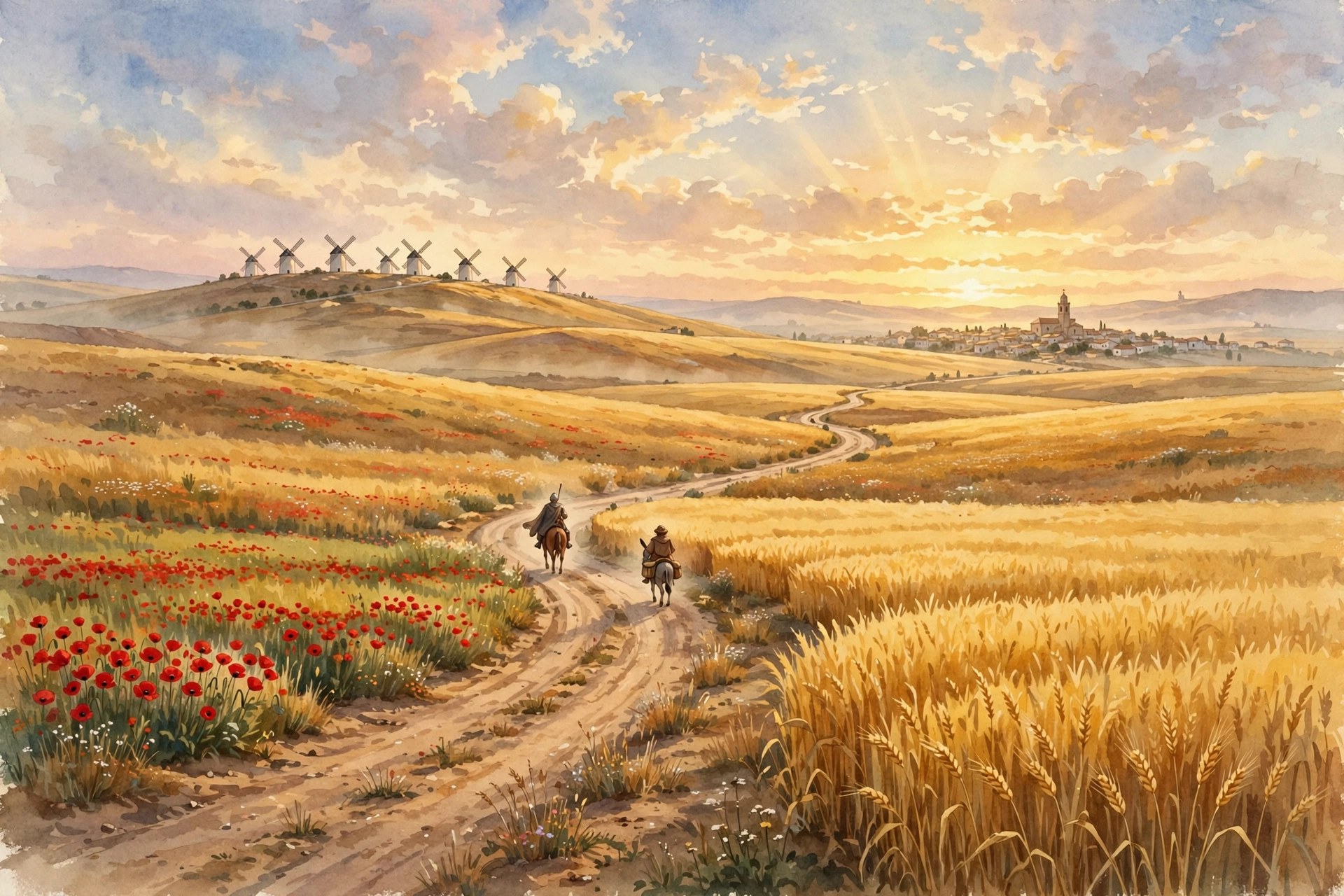
Alonso Quixano, a poor gentleman in a village of La Mancha, reads so many romances of chivalry that his wits dry up. He renames himself Don Quixote, takes a barber's basin for a helmet, saddles his bony nag Rocinante, and rides out to right wrongs and win eternal fame — accompanied by his peasant squire Sancho Panza and guided by his devotion to the lady Dulcinea del Toboso. The world keeps answering him with inns, windmills, and beatings. He keeps answering back with impossible, beautiful faith.
The five scenes you must know
- The naming (Part I, ch. 1). He cleans his great-grandfather's rusted armor, names his hack Rocinante ("the first and foremost of all the hacks in the world"), and christens himself Don Quixote of La Mancha.
- The windmills (Part I, ch. 8). Thirty or forty windmills become "thirty or more monstrous giants" — and the most famous misunderstanding in literature begins.
- The Golden Age speech (Part I, ch. 11). Over a supper of acorns with goatherds, he delivers an elegy for a lost age when "mine" and "thine" did not exist.
- Sancho's island (Part II, ch. 45–53). The duke's household lets the squire govern a "kingdom" as a joke; Sancho governs so wisely it stops being funny.
- The deathbed (Part II, ch. 74). Alonso Quixano wakes, renounces the books of chivalry, and dies sane — having become, in death, larger than the knight.
The facts in thirty seconds
- The book: The Ingenious Gentleman Don Quixote of La Mancha, by Miguel de Cervantes. Part I published 1605 in Madrid; Part II in 1615. Often called the first modern novel.
- The author: Cervantes (1547–1616), soldier wounded at Lepanto, five years a captive in Algiers, commissary and tax-gatherer in Spain. See Cervantes.
- The trick: Cervantes pretends the story is translated from an Arabic manuscript by one Cide Hamete Benengeli. See the manuscript.
- The quotes: Every famous line on the sayings page is quoted verbatim from the public-domain John Ormsby translation (1885), with part and chapter.
Where to go next
- Who is Quixote? — the hidalgo and the knight, side by side.
- The windmills, scene guide — read the masterpiece scene with notes.
- Sayings — the lines everyone knows, cited.
- Quixotic idealism — why the knight's name became an adjective.
- Spain in the 1600s — the country behind the story.
Source notes
- Plot summary condensed from the Ormsby text of Don Quixote (Project Gutenberg eBook #996).
- Publication dates 1605/1615: standard scholarly record; see sources.
- The "first modern novel" label is a scholarly consensus claim, not a documented fact; the methodology page explains how such claims are handled here.